

 Peter Costello
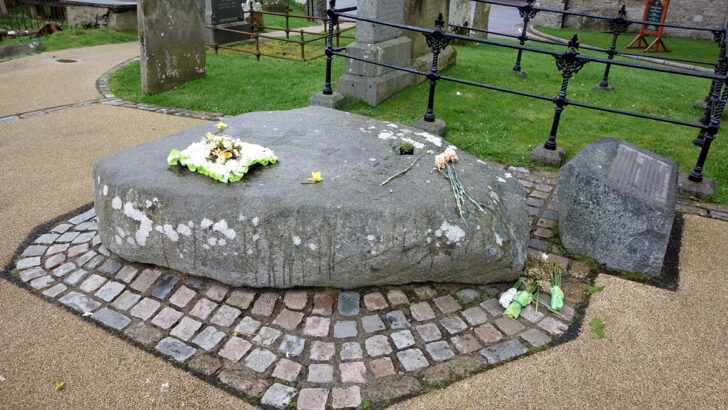 St Patrick’s Grave at Downpatrick.
 This has been the week that people of Irish culture, wherever they are in the world, celebrate St Patrick’s Day.

Our government ministers have sped around the world to capitals where they think Ireland can achieve better things. Otherwise, it has become, especially at home, a sort of carnival, with Mock Bishops surrounded by red-bearded leprechauns in tall green hats. “Sure it is only a bit of fun”, as the revellers in the streets proclaim. But St Patrick also deserves to be taken very seriously for he is just as important now as he was back in the fifth century of our supposedly common era.
St Patrick poses many problems to the conscientious historian, for the sources for his life are few and their content and meaning often debated. In 19th-century Ireland, and in many modern anniversary cards, Patrick is represented in the garb of a contemporary Victorian bishop; though it is unlikely that he appeared that way in real life.
I have become all things to all men, that I may by all means save some”
Today we find that St Patrick is engaged with by all those in Ireland who claim to be Christians, despite their many differences. He recalls in many ways those words of St Paul in his first epistle to the Corinthians: “I have become all things to all men, that I may by all means save some.”
So to Catholics, he is seen as a man appointed by the pope, underlining the importance of the continuity of the pope in Rome. By contrast then, he is often seen by those in the Church of Ireland tradition as being the founder of a “Celtic church” not dependent on Rome but holding to the teachings of the Gospels.
We find too that Patrick is also seen as “the Father of Irish Presbyterianism”. In North America, George Macloskie, a 19th-century Princeton professor of biology and Presbyterian minister, remarked that “the St Patrick of legend and superstition is not attractive, but the historical Patrick is a beautiful personage, whose memory should be revered by all Irishmen and by all Christians”.
Methodists
The Methodists too see Patrick in the essential role of an evangelist, in keeping with their views, a man of Biblical faith, a protestant avant l’heure of Protestantism. They use ‘The Breastplate of St Patrick’, a prayer ascribed by tradition to St Patrick, after avoiding an ambush by his enemies.
Isn’t it amazing that we celebrate Irishness and Ireland on a day associated with an immigrant who was not Irish, but made Ireland home and contributed positively to the society?”
Even the Unitarians, while rejecting the theological idea of the Trinity, still see Patrick as a historical figure, a man of faith, though in a more liberal light, in keeping with their traditions.
None of this should surprise us. It is quite in keeping with the ideals of Ecumenism to find the common ground between all those who invoke the name of Patrick.
The Islamic Centre of Ireland this year reminds us of another view of Patrick. “On St Patrick’s Day,” they note, we celebrate Irishness and Ireland. Isn’t it amazing that we celebrate Irishness and Ireland on a day associated with an immigrant who was not Irish, but made Ireland home and contributed positively to the society?”
Quest
But the search for the ‘historical Patrick’ is a bit like the quest for the “historical Jesus”. Not only is it a continuous process, but is an approach that demands we try to see the sources that we have in the light of their own day, and not in our own day only. This has proved since the first century of our era an endless task, but one which has been carried on in the hope of gaining a deeper understanding of the past and what happened there.
The past can only partly shape what people do. The call to a faith steeped in charity, in the sense of caritas or love, as St Paul again reminds us: “If I speak with the tongues of men, and of angels, and have not charity, I am become as sounding brass, or a tinkling cymbal.” [First Corinthians, 13:1.]
So it is likely that the British Christian, Patricius, son of Calpurnius, will remain the common ground of many Irish people in the future, no matter what the carnivality of his feast day may suggest.