

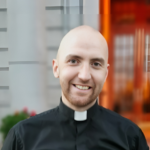
 Fr Barry White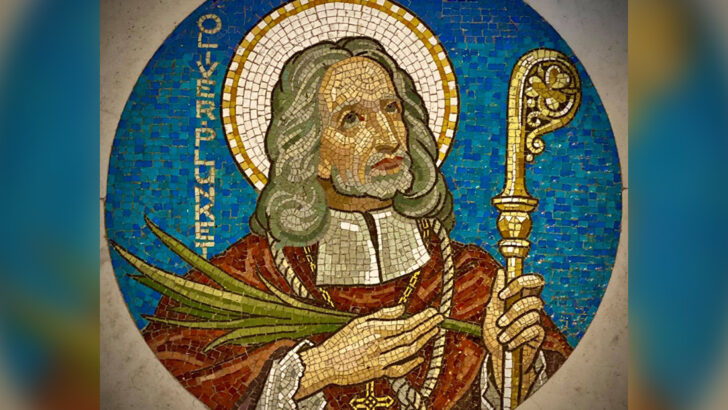
This year marks the 150th anniversary of Georges Bizet’s opera Carmen, which premiered in Paris in 1875. A scandal at the time, Carmen revolutionised opera—no kings or noble heroines, but instead soldiers, smugglers and bullfighters. Bizet’s heroine, Carmen, is bold, unpredictable, and free-spirited, living by her own rules. She captivates Don José; whose obsessive love drives him to abandon everything. When Carmen leaves him for the toreador Escamillo, the opera ends in a fatal confrontation.

Raw, sensual, and violent, Carmen was revolutionary in its realism. Bizet’s masterpiece brought opera down from aristocratic stages into the brokenness of real life. It was a descent—katabasis—into the shadows of love and desire.
Why begin with Carmen? Because like the opera, the Gospel too descends into the messiness of human love and betrayal—but it doesn’t end in tragedy. In Christ, there is always the promise of rising again. As Paul writes in Philippians: “Though he was in the form of God… he emptied himself, taking the form of a servant… he humbled himself and became obedient unto death, even death on a cross” (Phil 2:6–11). This kenosis—Christ’s radical self-emptying—leads to anabasis, the ascent into resurrection and glory. Where Don José’s love is possessive and Carmen’s rebellious, Christ’s love is self-giving.
Upends
Just as Carmen defied operatic conventions, the Christian story upends human expectations—strength through weakness, glory through suffering. This paradox lives not only in Scripture, but in the saints—most vividly in St Oliver Plunkett, whose 400th birthday and 50th canonisation anniversary this year mark a powerful witness to that same pattern of descent and rising.
St Oliver’s feast day, July 1, holds personal meaning for me. My grandfather’s family came from Oldcastle, Co. Meath, and each July I was brought to nearby Loughcrew—Oliver’s birthplace—for outdoor Mass at the ruins of his ancestral home. That annual pilgrimage, a tradition since the 1960s, was my first encounter with this great Irish saint, who has accompanied me on my journey of faith ever since.
While studying in Belgium (2020-2023), I visited places linked to him: St Bavo’s Cathedral in Ghent, where he was ordained Archbishop in 1669, and the Irish College in Louvain, where he stayed with the Franciscans before returning to Ireland. As a seminarian in 2013, I visited Tyburn—where St. Oliver was martyred—and the Benedictine convent there, which preserves artefacts and images honouring the Catholic martyrs.
As Irish pilgrims prepare to travel to Rome—the city where Oliver studied and served—I pray that he may be their spiritual companion”
This summer, from July 28 to August 3, young people from around the world will gather with Pope Leo XIV in Rome for the Jubilee of Youth. On previous World Youth Day pilgrimages, groups from the Diocese of Meath visited places connected to St Oliver, including Lamspringe Abbey in Germany in 2005, where some of his relics are held, and in 2016, Ghent and Louvain en route to Kraków. At his canonisation in 1975, a young Cardinal Karol Wojtyła—later Pope John Paul II—was present. A decade later, he would inaugurate World Youth Day. As Irish pilgrims prepare to travel to Rome—the city where Oliver studied and served—I pray that he may be their spiritual companion.
Born on November 1, 1625, at Loughcrew, Oliver heard Christ’s call at 16 and journeyed to Rome to train for the priesthood. Despite news of Cromwell’s persecution in Ireland, he was undeterred by storms, pirates, or politics. Ordained in 1654, he trained in canon and civil law, combining academic excellence with a deep commitment to pastoral ministry, serving the sick and poor at Santo Spirito Hospital. A contemporary called him “everywhere and at all times a model of gentleness, integrity, and piety.”
Appointed Archbishop of Armagh in 1669, he returned to the Irish Church which was deeply wounded and heavily persecuted. Oliver travelled tirelessly by horseback, often in disguise as ‘Captain Browne’, reforming clergy, founding schools, confirming thousands, and ordaining priests. Living in hiding and sleeping outside in harsh conditions, he rekindled hope and restored order.
Hysteria
In 1679, during the hysteria of the “Popish Plot,” he was arrested and taken to London. In his final days, he prayed the Rosary and celebrated Mass in his cell. In imitation of Jesus, he was denied a fair trial and condemned to death. On July 1, 1681, he was hanged, drawn, and quartered at Tyburn—and he forgave his executioners.
His light shone in a dark era. Even today, he remains a beacon. Living near Loughcrew, where each equinox the sun pierces the heart of an ancient tomb, I see his life as a similar promise: darkness does not have the final word.
Pope Leo XIV recently said: “It is important that young men and women on their vocational journey find acceptance, listening and encouragement in their communities, and that they can look up to credible models of generous dedication to God and to their brothers and sisters” (May 11, 2025). St Oliver is such a model. His life speaks to young people—especially those discerning their vocation—as a testimony of faithfulness, integrity, and love in hard times.
His life reminds us that holiness doesn’t flourish in comfort or perfection, but in gritty, generous commitment to truth and mercy”
Both in his time and today, amid deep division and suspicion within Irish society and the Church, Oliver stands for unity. As Archbishop, he reconciled factions, restored discipline with compassion, and built bridges in a polarised landscape. His life reminds us that holiness doesn’t flourish in comfort or perfection, but in gritty, generous commitment to truth and mercy.
As pilgrims prepare for the Jubilee of Youth, we pray our young people may discover in Oliver’s life a pattern for their own: not a tale of glory or escape, but a Gospel story of faith lived in service. Like Carmen, which shattered convention to reveal beauty in flawed humanity, St Oliver’s witness shows that holiness is found not in status, but in sacrifice. Just as the equinox sun pierces the tomb at Loughcrew, so too does the light of Christ pierce even the darkest cell. And from there, a new ascent begins.
St Oliver Plunkett Anniversary Mass at Loughcrew
On June 29, the Solemnity of Sts Peter and Paul, around 1,000 gathered at Loughcrew, Co Meath, at the ancestral home where St Oliver was born, for the annual outdoor Mass. The Archbishop of Armagh, Eamonn Martin – the 24th successor of St Oliver – preached the homily, with Bishop Tom Deenihan presiding and 22 priests concelebrating. Relics of St Oliver were carried by the Knights of St Columbanus and venerated after Mass. The Knights of the Holy Sepulchre and the Knights of St Lazarus were also in attendance. A special blessing was given to 38 young pilgrims from the Diocese of Meath travelling to Rome in July for the Jubilee of Youth.