

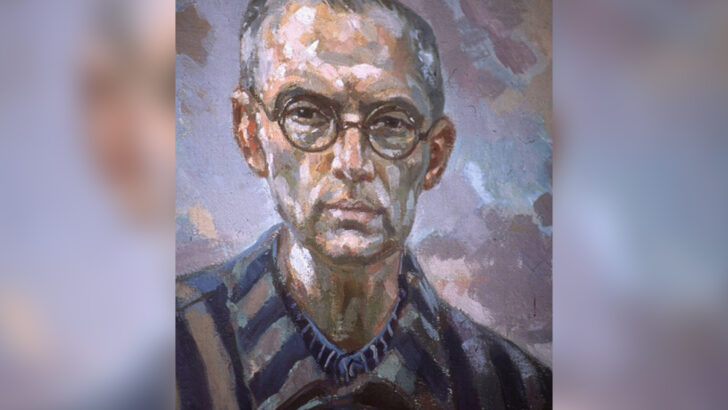
 28_01 - An undated painting of St Maximilian Kolbe .Photo: OSV News / John Pole.
 The most convincing argument for the truth of our faith against every denial is the witness of the saints and the beauty that their lives have generated. This is particularly true when that beauty shines like a light in the darkness of a time in human history that threatened us with despair. A terrible time of such darkness was the Second World War. Last week, I reflected on the life of Edith Stein who was a beautiful light that renewed hope. Another is Maximilian Kolbe whose feast day we celebrate on August 14.
Poland
Maximilian Kolbe was born on January 8, 1894 in occupied Poland. He joined the Franciscans in 1910, and was ordained eight years later, as his country became free and independent for the first time in over 120 years.
As the dark clouds of war loomed in Europe, he believed that the world was passing through a time of intense spiritual crisis, and that Christians must actively witness to and work for the kingdom of God that is always opposed by the powers of darkness. To encourage and empower Christians to do this, he founded a newspaper, and a sodality called the Knights of Mary Immaculate, which spread widely both in Poland and abroad. In 1927 he founded a community, a “City of Mary”, centred around the Franciscan friary. It attracted many lay people, and became self-supporting, publishing many periodicals and running its own radio station.
When the Germans invaded Poland in 1939, the Franciscan community sheltered thousands of refugees, most of them Jew”
In 1930 he went to Japan, studied Buddhism and Shintoism, and through the Japanese edition of his newspaper, spread the Christian message in a way that was in harmony with Japanese culture. In Nagasaki, he set up a “Garden of the Immaculate,” which survived the atomic bomb in 1945. He also travelled to Malabar and to Moscow, but was recalled to Poland in 1936 for reasons of health.
When the Germans invaded Poland in 1939, the Franciscan community sheltered thousands of refugees, most of them Jews. In 1941 he was arrested and sent to the concentration camp at Auschwitz, where he helped and encouraged the inmates. In August of that year a prisoner escaped, and in reprisal, the authorities choose ten people to die. One of the men chosen had a family, and Maximilian Kolbe offered to take his place. The offer was accepted, and he spent his last days comforting his fellow prisoners in a starvation bunker. He died on August 14, 1941.
Auschwitz
I have visited Auschwitz twice and the bunker where Maximilian died is preserved. Its narrow walls are black – symbolic of the horror that took place there during the war. In the middle of the bunker stands a lit Paschal candle that was placed there by fellow Pole, Pope St John Paul II during his visit in 1979. The Paschal candle is the main symbol of the Risen Christ and its light pierces the darkness of this bunker where St Maximilian died. How appropriate this is – that the symbol of Christ who overcame the brutality of human cruelty on the cross with love and forgiveness, should enter into the darkness and suffering of what Maximillian endured. In exchange for the life a man he barely knew, Maximilian Kolbe witnessed to the love with which Christ rescued us, for “greater love has no one than this: to lay down one’s life for one’s friends” (John 15:13).
‘They will never kill our souls…They cannot kill our dignity. Their terror will never kill the Polish soul. We die in holiness and peace’”
There is something heroic and inspiring about the love that made Maximilian offer his life for another. Like the love of the Master, it was a pure love that willed the good of another and was completely free of self-interest. What is also inspiringly beautiful is his priestly encouragement of those who were dying with him, to guard that part of themselves that degradation and suffering couldn’t touch. One person who was with him in Auschwitz, said the following: “Fr Kolbe began to speak quietly about the great and Almighty God, about the suffering he sends us to make us ready for a better life…He said that ‘They will never kill our souls…They cannot kill our dignity. Their terror will never kill the Polish soul. We die in holiness and peace’”.
This is this holiness and peace that produces the light that we are called to let shine in our world today. The missionary awareness of St Maximilian to meet the darkness with the light of Christ, is a call for us not to remain passive in the face of evil but to bring the Kingdom of God to bear wherever it is absent. Like him, Christians are called to be “Knights” who turn darkness into days and make the world a brighter place.