

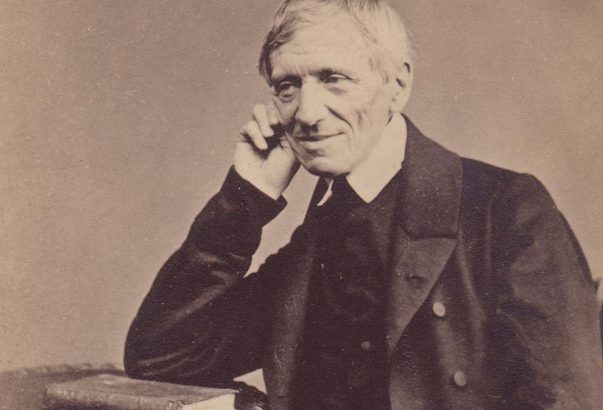
 St John Henry Newman Photo: CNS photo/courtesy Fathers of the Birmingham Oratory
 The elevation of St John Henry Newman to the 38th Doctor of the Church was a moment of great joy for Catholics around the world, especially in England, where Newman was born, educated, preached, taught and wrote. The title honours not only his holiness of life but also his deep theological insight, which continues to inspire and shape the life of the Church today.

By God’s grace, just a month after his canonisation on October 13, 2019, I found myself at the London Oratory — a community established in 1849 by Fr Frederick Faber, a close disciple of Newman, and founded with Newman’s blessing and guidance, following the model of St Philip Neri.
As I knelt in prayer within the beauty and silence of the church, I felt a quiet sense of awe. I sensed the living presence of a man who had given everything to God without reservation. I tried to imagine his inner struggles: the loneliness, the loss of status, the stigma that came with his conversion. I, too, have walked through moments of desolation in search of truth, and so his journey deeply resonated with me.
I looked around, and there was some faithful praying silently and a few tourists walking around the church. Newman’s legacy, I realised, lives on in the hearts of those seeking truth and courage.
A pilgrimage of mind and heart
John Henry Newman was born in London on February 21, 1801, and raised in the Church of England. He became a brilliant academic at Oxford University and an influential clergyman in the Anglican Community. He was one of the central figures of the Oxford Movement, a 19th-century initiative that sought to return the Church of England to its Catholic roots.
As Newman prayed, studied and reflected more deeply on Church history and doctrine, he found himself drawn steadily toward the Roman Catholic Church. Guided by the Holy Spirit, he finally made the momentous decision to convert. On October 8, 1845, the quest for truth led to his being received into the Catholic Church, an event that shocked both Anglicans and Catholics at the time.
Newman was no ordinary convert; he was already a respected Anglican theologian and scholar. Why would such a man give up status, friendship and his standing in the community? His answer was simple but profound: “I consider the Roman Catholic Communion the Church of the Apostles.”
For Newman, following conscience meant everything. He once said, “Conscience is the aboriginal Vicar of Christ.” In his fidelity to conscience and truth, we are reminded of another great English saint, St Thomas More, who placed obedience to God above all others.
After becoming a Catholic, Newman continued to use his intellect and heart in the service of the Church. His writings on the development of doctrine, the role of conscience and Catholic education are essential reading for anyone seeking a genuine understanding of the faith.
Regarding his conversion to Catholicism, Pope Francis, in the encyclical, Dilexit Nos, explained why Newman had chosen the motto, Cor ad cor loquitur – “Heart speaks to heart.”
He noted, “… since, beyond all our thoughts and ideas, the Lord saves us by speaking to our hearts from his Sacred Heart. This realisation led him, the distinguished intellectual, to recognise that his deepest encounter with himself and with the Lord came not from his reading or reflection, but from his prayerful dialogue, heart to heart, with Christ, alive and present. It was in the Eucharist that Newman encountered the living heart of Jesus, capable of setting us free, giving meaning to each moment of our lives, and bestowing true peace.” [Delixit Nos, §26]
A doctor for our times
To be named a Doctor of the Church is a rare and exalted title, bestowed upon saints who have made extraordinary contributions to the Church’s theological understanding. Other Doctors include St Augustine, St Thomas Aquinas, St Teresa of Ávila, St John of the Cross, St Thérèse of Lisieux, and many others.
In our modern world that is filled with moral confusion and ideological conflicts, Newman offers clarity, depth and hope. His writings grapple with questions that remain relevant today: How do we follow our conscience without succumbing to moral relativism? How do we grow in faith while engaging with a changing world?
Newman famously wrote: “To live is to change, and to be perfect is to have changed often.”
This echoes the spirit of St Paul, the agent of change (cf. Romans 12:2; Ephesians 4:22–24), and reminds us that the path to holiness is one of ongoing conversion and transformation. It also speaks directly to our Church today, as we seek to embrace the spirit of synodality – walking together, sharing and listening attentively and discerning God’s will in communion.
A prolific writer, Newman left behind a treasure trove of over 40 books and more than 20,000 letters, touching on various aspects of theology, education and philosophy. His ‘Prayer for a Mission’, in which he asks God to reveal His purpose, continues to inspire countless people seeking truth.
St John Henry Newman is, as we are recognise, a living voice for our times. A man of conscience, courage, prayer and intellect, He teaches us how to seek the truth with humility, to follow Christ with both heart and mind and to speak heart to heart.
Dr Christopher Ng, Emeritus Professor of Medicine at Universiti Malaya, is a Catholic scholar and 2018 Marie Skłodowska Curie Award recipient. He advocates for ethics in science, serves in church outreach, and speaks on faith in daily life.