

 Photos: Alice Corideo.
A sunny day, a great welcome with coffee, tea and smiles and a walk in the countryside of Kildare Town: this is a brief summary of the day organised by the Focolare Movement at Solas Bhride Centre in October. The aim was to get to know St Brigid of Kildare, the order of the Sisters of St Brigid and the core points of their vocation.
They started off by coming to Solas Bhride at noon and then went directly to a room where tea and coffee were served by the sisters. Laughter and companionship followed within the members of the Focolare Movement. They wanted to learn more about St Brigid of Kildare and her legacy in today’s society.
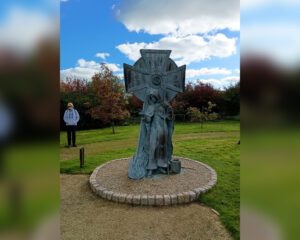
St Brigid of Kildare
They then gathered at 12.30 in Cill Dara room, a nice oval conference space with high and large windows that display the surrounding nature. All seemed to be in a harmonic relation with God’s creation and felt all its sacredness. After they all took their seats and made themselves comfortable, Srs Rita and Phil introduced them to the life of St Brigid of Kildare.
It was a nice way to know more about her, especially through the latest academic studies and research on her and the values she promoted and the order inspired by her holiness. “We have no historical records of St Brigid, hence, we depend on traditional and folkloristic tales”, said Sr Rita, “but she was a renowned peacemaker”.
Born in the 5th century, St Brigid of Kildare is one of the three patron saints of Ireland along with St Patrick and St Columba. Medieval Irish hagiographies indicate Brigid as the abbess who founded the abbey of Kildare and other convents. She was the daughter of an Irish clan chief and grew up in a druid household. At 18 years of age, she decided to work no more for her father and instead become a consecrated virgin.
Sisters of St Brigid’s values
The order of the Sisters of St Brigid is a little more than two hundred years old: it was established by Daniel Delaney, Bishop of Kildare and Leighlin, at Tullow, Co. Carlow, in 1807. An earlier congregation linked to St Brigid had been founded in the 5th century AD, and lasted until the Reformation in 1517. Bishop Delany considered the establishment of this new congregation to be a refounding of the original one.
Srs Rita and Phil then gave a glimpse of the values the order carries on and demonstrated how actual they are for today. The first is contemplation, to be intended as a sensitivity to the divine energy that permeates the whole of God’s Creation. They said that Brigid used to stop before performing any action because she wanted it to be rooted in God: a lesson much needed today as people are constantly doing things without much prior thinking. The second is hospitality, which is welcoming all with graciousness. The sisters were proud to say that the Solas Bhride Spiritual Centre hosts people from any (or without any) faith, unreservedly.
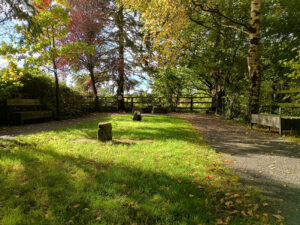
Ecology is also a key point in their spirituality, as they embrace a deep understanding of the sacredness and interconnectedness of all creation. It was surprisingly good to know that the centre is entirely run by fossil-free energy. The same ecological sensitivity was fairly visible during the nice walk to St Brigid’s Well after lunch.
Nature and St Brigid’s Well
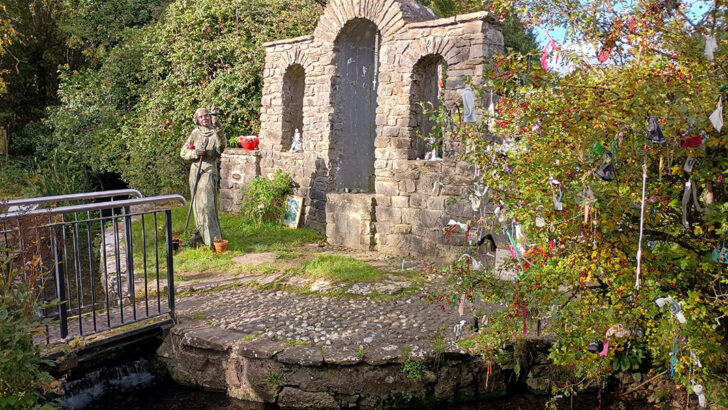
There was a nice packed lunch where the sisters helped serve tea and coffee. The guests were overall delighted to head to St Brigid’s Well, a ten-minute walk from Solas Bhride. As they entered the garden where the well is to be found, an immense sense of peace and tranquillity permeated the atmosphere among them: there were trees whose branches were full of objects that represented prayers by pilgrims and a small stream of water gently passing by the statue of St Brigid holding a flame.
It was such an interesting day, and spiritually deep too. After today, I certainly gained a new friend in Heaven and an inspiration for my daily life”
There they learned that she had a steady connection with animals, as she used to feed them while encountering them on her path. Then the participants prayed for several intentions like peace, climate and social justice. A striking anecdote of St Brigid’s life was reported: there was once a rich woman who brought her a lot of apples. Brigid took them and gave them to the poor. The rich lady complained to her, saying that they were meant to be hers, but Brigid famously replied: “What is mine is theirs”, referring to the poor.
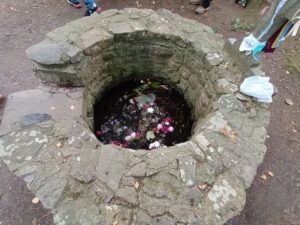
After a few minutes, they all came to the Well, where colourful flowers were floating. Sr Phil gave everybody holy water from the well, asking them to make the sign of the Cross with it.
After this visit, I asked a young Italian man his opinion about the day: “It was such an interesting day, and spiritually deep too. After today, I certainly gained a new friend in Heaven and an inspiration for my daily life. As a foreigner, I appreciated how welcoming St Brigid was: she helped me feel part of the Irish people and its rich spiritual tradition.”
Another young girl noted: “It is so refreshing to see a woman so deeply caring for others and for nature. Today I learned that St Brigid’s leadership charism consisted in empowering others, and I think it is fascinating. It is the exact opposite of today’s concept of leadership, which is highly individualistic. I recommend that anyone come here and experience such a peaceful and eye-opening atmosphere!”
Alice is an Italian journalist based in the West of Ireland. She previously lived in Sweden, where she studied a master’s programme in aesthetics and graduated in 2023. She likes to intertwine faith and philosophy with a particular focus on questions related to art and beauty.