

 The Ondo-Ilorin region of south-eastern Nigeria, the scene of Bishop Hughes’ mission work.
 Our history is full of untold and almost unknown lives. Twenty-five years ago, while researching a book on the Royal Irish Constabulary, I first got to know something about Tom Hughes (b. February 1, 1891).

He was one of the constables in Listowel barracks in June 1920 when the British government declared Munster to be under martial law. Despite the danger in which they placed themselves, he and his comrades refused to hand their barracks to the military. Their mutiny caused a sensation and was given considerable coverage in the press. Hughes and his comrades then formally resigned and left the barracks.
Hughes returned to his home in Hollymount, Co. Mayo, to inform his family that he had decided to join the Society of African Missions (SMA). His family and friends were not unduly surprised by his announcement. Of a serious disposition and with obvious leadership qualities, he was known to his comrades in the RIC as “the Monsignor”.
He founded 250 primary schools, 30 secondary-modern-type schools, two teacher-training colleges and a number of highly-regarded colleges for boys and girls”
Thus, aged 31, Hughes began studying for the priesthood in September 1921. He was ordained in 1927 and immediately set out for his mission in Nigeria. For three years he taught in the Society’s St Gregory’s College in Lagos. Then he was transferred to minister in Benin province. Four years later, he was appointed superior over the area which later became the archdiocese of Kaduna in Northern Nigeria.
In 1943 Hughes became the first bishop of Ondo-Ilorin, south of Kaduna. During the next 12 years, he founded 250 primary schools, 30 secondary-modern-type schools, two teacher-training colleges and a number of highly-regarded colleges for boys and girls. He was also instrumental in the establishment of two Catholic hospitals. In addition, he ensured that parishes had well-built churches and presbyteries.
Bold
He was bold not only in his vision and planning for the future but also in the design and style of the buildings for which he was responsible. Indeed, he personally designed and supervised the construction of many of them and took a hand in their building. At that time there were two SMA bishops in Nigeria. The other one was very prayerful and it was said by members of the Society that if one were to seek him the first place to look was in the church, whereas one invariably found Hughes on the roof of some building.
Owing to World War II, Hughes was not able to return to his homeland for a holiday until May 1946. During that summer he made a nostalgic visit to Listowel and called at Listowel Garda Station, the former RIC barracks. Word quickly spread about his presence in the town and Bryan MacMahon, then a young national school teacher, persuaded him to call into the Urban District Council office after he had lunched in the Listowel Arms Hotel.
A quorum of local representatives and dignitaries was gathered and a formal presentation was made to a somewhat bemused Bishop Hughes on behalf of the town’s people for his courageous stand and that of his comrades during the War of Independence.
On his return to Nigeria, he continued his untiring efforts to spread Christianity. However, the unremitting toil and stress and the harsh tropical sun took their toll. His health began to decline and in 1955 he returned to the provincial house in Cork on sick leave. He did not recover his health and he died in April 1957.
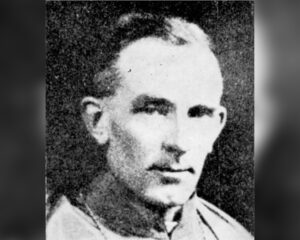
One of the most endearing qualities of Hughes, it seems, was his modesty. It is ironic that his fame has eventually caught up with him”
Even today, 70 years later, the memory of his zeal and dedication is fresh among the bishops, priests and people of this region of Nigeria. A number of schools are named in his honour. In 1990 the state government of Ondo gave Hughes a posthumous award and inscribed his name in gold on the state’s hall of honour. The citation read of his extraordinary achievements in the areas of education and human development.
One of the most endearing qualities of Hughes, it seems, was his modesty. It is ironic that his fame has eventually caught up with him, albeit years after he has left the scene of his labours. It is really time his story should be told.
The History of the Society of African Missions (SMA, €24.99) is available from the order’s Irish headquarters in Cork, email info@sma.ie.
The story of what happened at Listowel Barracks is told in The Memoirs of Constable Jeremiah Mee RIC, edited by J. Anthony Gaughan (The Mercier Press, €19.99; copies printed on demand.