

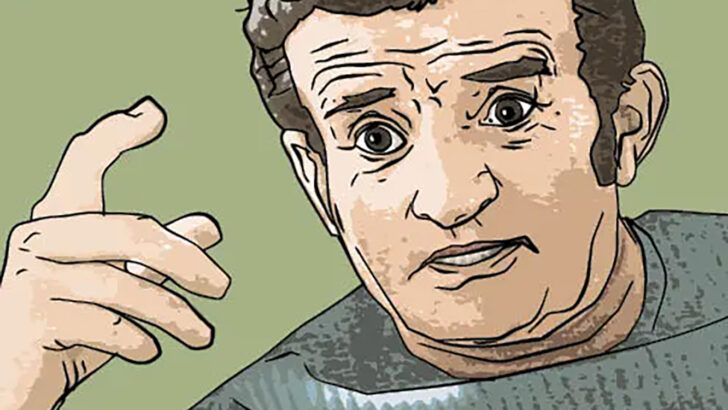
 Jean Sulivan explaining himself, drawing from Golias Editions.
 How is Catholicism to remain relevant in an increasingly secular society? That is the question which the French priest-writer Jean Sulivan (1913-1980) grappled with in his writings, and it lies at the heart of this study of Sulivan by the distinguished Franco-Irish scholar, Eamon Maher.

Jean Sulivan was the pseudonym of Joseph Lemarchand, a native of Brittany. His father was killed in the early days of the Great War in 1914, and Maher tells us that Sulivan always “had difficulty coming to terms with being what he described as the ‘son of a dead man’, a condition that would influence the type of marginal, uprooted, wounded characters that are to be found in his fiction and prose writing”.
Sulivan was ordained a priest in 1938 and worked for the next twenty years at the Catholic diocesan school in Rennes. During this time, he was prominent in the intellectual and cultural life of Rennes. By the end of the 1950s, however, he had decided that, in Maher’s words, “he wanted to live out his priestly vocation in a different way” – namely, as a full-time writer. His bishop permitted it, and he moved to Paris where he lived for the rest of his life.
His nom de plume was derived, bizarrely, from the Hollywood comedy Sullivan’s Travels, in which a famous film director withdraws from his comfortable life to do research for a film about how the downtrodden live.
He was ‘ahead of his time in predicting how the Church was going to have to change in order to survive’”
This parallels Sulivan’s decision to abandon a conventional priestly role. He did not engage in active ministry in Paris, but confined himself to writing – most particularly, about priests who minister, sometimes in controversial circumstances, to the marginalised. He presents such priests as exemplars of how the Catholic Church should be in the modern world.
He never gave up his priesthood, but he rejected much of what he found in the Catholic Church – its opulence, its elaborate rituals, its authoritarianism, its emphasis on dogma and moral absolutes (especially in the area of sexuality), its pervasive anti-intellectualism. These were, in his view, the reasons why the Church was in decline in France in the years after the Second World War. As Maher notes, he was “ahead of his time in predicting how the Church was going to have to change in order to survive”.
Vision
Sulivan’s vision of what Catholicism should be was that of Simone Weil as set out in a passage that he quotes approvingly in his spiritual journal, translated into English as Morning Light (1976): “I accept the Church’s mission, as depository of the sacraments and guardian of the sacred texts, to formulate decisions on some essential points, but only as directional signals for the faithful. I don’t recognise its right to impose its interpretation.”
Sulivan was, as Maher explains, “a voice of protest from within the Church or, perhaps more accurately, from the margins of that institution”. There have been many similar voices in Ireland – now, like France, a post-Christian society.
Accordingly, in the final section of this book, Maher compares Sulivan’s writings with those of certain Irish writers who have explored the predicament of the Catholic Church in Ireland. He shows that their work illustrates the relevance of Sulivan’s writings for the Church in Ireland today – and that, if Sulivan’s message is heeded, it is a message of hope. He writes:
“Rather than viewing the apparent collapse of the once-powerful Catholic Church in Western society as a cause for concern, Sulivan looked on it as a real opportunity to rediscover the model put forward by Jesus … the bringing together of small groups of people who shared common values in relation to justice and the dignity of the human person, and the conviction that religion was not merely about rules and obligations.”
Only a handful of his books have been translated into English and published either in Britain or North America”
Maher is right to insist upon Sulivan’s importance as a French Catholic writer. He was the author of some thirty titles, and was published by both Gallimard, the leading Paris publisher, and Desclée de Brouwer, the religious house, also in Paris. Yet only a handful of his books have been translated into English and published either in Britain or North America. He is not well-known in Ireland, and seems not to have broken through to readers in Spain, Italy or Germany either.
Unless Sulivan appears in accessible popular editions in languages other than French, merely academic appreciation will not achieve the creative and philosophical aims he had as a writer. His “prophetic voice” will not be heard.