

 Photo: Michael Sanfey.
 The North Atlantic Treaty Organisation (NATO) is often lauded as the world’s most successful ever military alliance, and I for one am not about to ‘diss’ the role it played in providing protection for Western Europe against the Soviet Union during the Cold War. Supposedly, NATO is not just a military alliance, it is also (supposed to be) a community of values, as Prof. Trine Flockhart of the Florence School for Transnational Governance described it in an important essay in 2024.
Arguably it was time for NATO to call it quits as far back as 1991 with the collapse of the aforementioned Soviet Union. That seismic event didn’t remove all challenges and problems, of course, but the collapse posed an existential threat to NATO’s own raison d’être. Nothing daunted, NATO proved adept at keeping itself in existence and finding new outlets for its often misplaced energies. However, increasingly, NATO is beset by a set of issues and contradictions which prompt one to wish that the EU countries concerned would undertake NEXIT: exit from NATO.
Currently, twenty-three of the EU’s twenty-seven member states are also members of NATO – the four exceptions being Austria, Malta, Cyprus and Ireland. One appreciates that a debate – if not actually ‘raging’ – has at least begun in Ireland about the fact that we spend so little on defence – in 2024 only 0.24% of GDP, according to a McCann-Fitzgerald report published in late-February – way below the European average. But that is a separate issue, so let’s put it to one side for now.
Conundrum
Last week the annual conference of the Council for European Studies (CES) took place at UCD Belfield. The mission of the CES is to produce, support, and recognise outstanding, multi-disciplinary research on Europe through a wide range of programs and initiatives. I gave a presentation on Day 2 about tackling ‘the EU’s NATO conundrum’. A conundrum is defined by the OED as ‘a confusing and difficult problem or question’, and it is apt in an EU-NATO context, especially since the advent of the Trump 2.0 administration in January 2025.
If the United States chooses to attack another NATO country militarily, then everything comes to an end”
The confusion and difficulty are to do with the extraordinary hostility Trump and his henchmen – especially Hegseth, but also Rubio – have displayed towards NATO allies. It is a veritable litany: Trump’s unfriendly attitude towards Canada; branding NATO allies as “cowards” for failing to back the (illegal?) US / Israel war on Iran; his hostility to some European leaders – e.g., Starmer (UK), Meloni (Italy), and Merz (Germany). Hegseth lambasted NATO allies as “shameful” for being reluctant to help America in striking Iran.
And then there’s Greenland, the world’s largest island. Trump has made no secret about wanting to take it over “one way or another”. These unprecedentedly aggressive, predatory manoeuvres prompted Danish PM Mette Frederiksen to say that “If the United States chooses to attack another NATO country militarily, then everything comes to an end – including NATO and, with it, the security that has been provided since the end of the Second World War”.
She added that “The world order as we know it – that we have been fighting for, for eighty years – is over, and I don’t think it will return.” Prof. Sergio Fabbrini of LUISS University Rome said as much in his special lecture on Day 1 of the conference. We can no longer think it will suffice to “weather the Trump storm” after which things will revert to “normal”. Not going to happen, experts are increasingly concluding.
How do we explain Trump’s hostility to the EU and to NATO? Look no further than the tech bros and the ‘Make America Great Again’ (MAGA) crowd. In an excellent new book entitled The End of American Europe, Prof. Glyn Morgan notes that few observers of Trump’s second administration would have predicted the vigour and sweep of his hostility to Europe; for MAGA critics, Western Europe functions as a negative meme, a term of abuse to be deployed in a rhetorical battle against the ‘Brahmin Left’.
There is very little Europeans can do to avoid being caught up in an intra-elite battle in the US, argues Morgan. But it is not just the MAGA red hats who do not like Europe. Prof. Daniel Kelemen of Georgetown University said in a panel at the CES event last week that there’s also hostility to Europe on the American left. Some leftists see the EU as a ‘whiteness’ project, and as being weighed down by being too ‘Euro-centric’. There is a trend in parts of US academia, it seems, to steer clear of Europe and not praise the EU model too much.
An ice hockey analogy
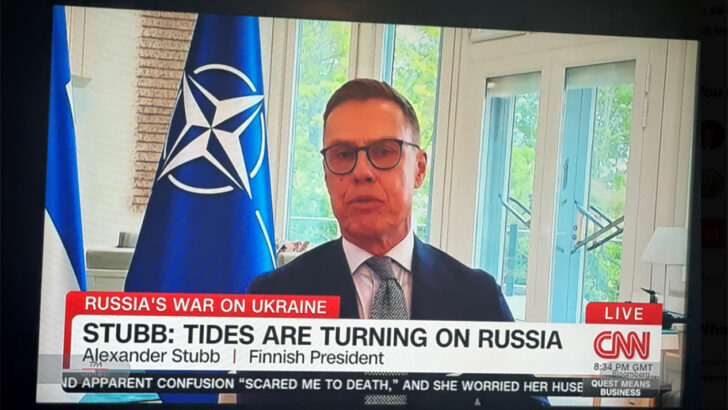
The pro-NATO narrative holds that the alliance has been greatly bolstered inter alia by the adhesion of two new members, Finland and Sweden. The Finnish President, Alexander Stubb, champions the organisation’s value. In a recent interview that he gave to CNN’s Quest Means Business, the NATO flag was even more prominently displayed than that of his own country.
Finland is really good at ice hockey. Very recently they won the men’s ice hockey World Championship in Switzerland. There is a saying by the ice hockey ‘great’ Wayne Gretzky, a Canadian: “I skate to where the puck is going to be, not where it has been”. Given the lamentably poor state of transatlantic relations generally, it is difficult to see NATO as where the puck is going to be. By his own admission, Stubb realises that “the West” has split, conceding in an interview with the Sunday Telegraph that America under Trump is no longer the leader of a single Global West.
Why an EU rupture with NATO is necessary
The undeniable fact is that in the sphere of security and defence, the EU is not sovereign; it is not the master of its own destiny. It is beholden to a superpower – America – which under Trump 2.0 has increasingly taken on the characteristics of a rogue state – e.g., in partnership with Israel attacking Iran in a war of choice; and by enabling genocide by Israel in Gaza. It pains me to say, to criticise America.
In the pages of this venerable newspaper, I have lauded America to the skies and still remain an ardent Americanophile at my core. But just as China did with the Soviet Union back in the late 1950s, it is time for the EU to ‘stand up’ vis-à-vis the United States by leaving NATO.
What brought me to this radical standpoint? More than anything, it was a post on X by the Italian sociologist Paolo Gerbaudo of Complutense University, Madrid. He was commenting on a post on Truth Social by President Trump berating other NATO allies for not weighing in on America and Israel’s war against Iran, branding leaders of those (mostly EU) countries as “cowards”.
Gerbaudo wrote as follows: “At this point NATO exit should be viewed as the common sense position for self-respecting Europeans. Being part of such an ‘alliance’ does not make any sense”.
What is key is the concept ‘self-respect’. Yes, in life one sometimes has to roll with the punches, to ‘offer it up’. There is a Saudi Arabian proverb that says “If a King should say that day has turned to night, be sure to marvel at the moon’s bright light”. But EU leaders – and the EU itself – cannot retain credibility – or self-respect – while still being shackled to an alliance led by an ogre. This is particularly the case when those EU leaders are constantly ‘banging on’ about the importance of EU ‘strategic autonomy’.
During a Q&A, I put in the idea of NEXIT to the panel on Day 1 of the CES conference being chaired by Prof. Mitchell Orenstein of the University of Pennsylvania. Prof. Kelemen – politely but clearly – was of the view that NEXIT was very much not on the cards – i.e. European leaders are highly unlikely to take such a course of action.
In this security and defence context, the EU really does need to ‘move fast and break things’”
Another panellist, Prof. Veronica Anghel of the EUI, also threw cold water on the idea on the basis that the US has control of the “gadgets” – did I sense some feminine disdain in that term? I took what she said to mean that the Americans could render existing arrangements and protocols inoperable if the EU countries left. Of the three panellists, only Prof. Milada Vachudova of UNC Chapel Hill offered a glimmer of hope for my NEXIT idea.
At the conclusion of the panel in which I myself took part, an image came to my mind – the Apple advertisement at the Super Bowl in 1984 for the introduction of its revolutionary new Mac computer. A young woman athlete hurls a hammer into the screen where Big Brother is berating an audience of shaven-headed catatonic males. The screen is shattered into pieces.
It is a phrase that is often criticised, but in this security and defence context, the EU really does need to ‘move fast and break things’. And Apple has gone on to do rather well, hasn’t it?
In a forthcoming article I shall look at the practicalities of NEXIT as well as examining the possible implications for Russia’s war with Ukraine.
Michael Sanfey is a researcher at Católica University in Lisbon.