

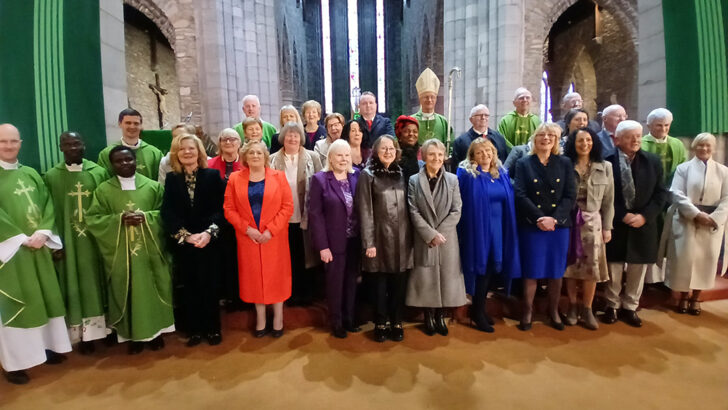
 25 pastoral leaders of the Diocese of Kerry at their commissioning in February 2025, alongside Bishop Ray Browne and clergy of the diocese. Photo: Diocese of Kerry.
 Pastoral development worker Frances Rowland on responding to the changing needs of her diocese
In conversation with The Irish Catholic, pastoral development worker Frances Rowland shared stories of collegiality, openness, and formation from the Diocese of Kerry, highlighting the changing needs of parish life in the diocese she has worked in for over 20 years.
While many assume the Diocese of Kerry only spans the county itself, Ms Rowland noted that the diocese also comprises the Beara Peninsula and northwest Cork. Its size and spread mean clergy and diocesan workers like herself must be aware of “the changing needs of people.”
The pastoral development worker shared that one of the strengths of the diocese is its “willingness to respond to the changing needs of parishes and schools.”
This response to changing needs is often shared between parishes through the establishment of training programs, support for clergy and youth ministry, among others, said Ms Rowland, who also shared that Kerry was one of the first dioceses in the country to develop “parish clusters”, which turned into pastoral areas in 2008.
Program
Ms Rowland told this newspaper that she is particularly proud of the Pastoral Leader Ministry programme, which she said officially started in 2022. “All dioceses had people involved at various levels, but there was an awareness that we needed to up a level whereby there was a greater formation programme for people taking on pastoral leadership roles.” She shared that the programme focuses on discernment, where participants have around 4 months to reflect on their calling to specific areas of ministry and whether or not they are able to commit over the next 5 or 6 years.
In February 2025, the diocese commissioned 25 pastoral leaders for three years. These pastoral ministers are involved at a local level in a variety of ways, offering sacramental support, supporting parish-pastoral councils, working with liturgy, music, finances and more.
Ms Rowland herself is an example of taking one’s skills and developing them into a pastoral role suited to one’s interest”
Ms Rowland described the program as a “two-fold piece” which allows the future pastoral ministers to train for ministry, but also helps them enable others to get involved. “If you train someone who then involves others, suddenly you’ve got the ripple effect, and suddenly what you have is people who have a whole gamut of connections and relationships, able to draw other people into ministry,” the pastoral development worker continued. Broadening the knowledge of who is around and what kind of skills they can bring to the table cultivates fresh energy and ideas which contribute to the diocese as a whole, as people bring unique ideas from their parishes and localities.
Ms Rowland herself is an example of taking one’s skills and developing them into a pastoral role suited to one’s interests. The current Kerry pastoral development worker comes from a background of post-primary teaching, but also spent time working with theological formation and liturgy. She described seeing the role of pastoral development worker for the Diocese of Kerry as enriching, as it was an opportunity “to bring all of those together to do this full time, rather than trying to squash it in alongside my post-primary teaching.”
Mission
In her time with the diocese, the pastoral development team has grown to six people, with the roles shapeshifting as the team grows. Ms Rowland works primarily in the areas of faith formation, liturgy and prayer, while her team members focus on areas that interest them. She said this format allows the team to “pivot and support one another in what we do, but also there is a shared wisdom.”
The primary mission of the pastoral development workers is to support parishes in terms of “sharing the Good News, supporting those in their communities, enabling the celebration of the sacraments, and being a presence to the witness of Christ in the world,” said Ms Rowland. As the pastoral development team works to support the parishes, when the nature of the parishes change, so do the roles.
“Parishes are multifaceted,” said Ms Rowland, “and therefore what they need is multifaceted.”
There’s a danger that we presume we know what the other person thinks, so maybe we don’t ask them”
Contemplating how a synodal approach has affected her role, the Kerry pastoral worker said it has illuminated how moving forward as a Church must involve hearing with a “fresh ear” and listening to the voices of each. “I think the quietening moments invite us to listen more deeply to one another,” she continued.
Observing training sessions such as Conversations in Spirit, which took place in the Kerry diocese last month, Ms Rowland said she was struck by the invitation for participants to “hear someone in a new way”. Regarding the relationships within Church hierarchy, Ms Rowland said that like any other relationship, “there’s a danger that we presume we know what the other person thinks, so maybe we don’t ask them.” She emphasised that synodality asks us to open our ears to what is being said in the present moment, rather than focusing on what might have been said in the past.
Efforts
From the clerical perspective, Ms Rowland praised the efforts the clergy in Kerry have made engaging in formation with each other and also supporting pastoral and liturgy teams, which she said makes all the difference to pastoral development workers like herself. “Every year they have what we call the clergy assembly, a few days of nourishment, of shared collegiality, with speakers from anywhere and everywhere.”
For Ms Rowland, the practice of working together and moving forward as a team is not limited to the Diocese of Kerry. She said one of the most fulfilling aspects of her job is attending national gatherings with other pastoral development workers. She praised the fellow pastoral development teams in Munster, describing them as a “very strong group.”
‘Maybe there’s somebody who’s coming with fresh energy because they’re new to a role,’ said Ms Rowland”
“They’re the people who understand the work in a real way, so there’s always a welcome energy, new ideas, as well as a sharing of the challenges,” said Ms Rowland. She said these gatherings are vital because they enable the listening with “fresh ears” that synodality entails. Speaking with members of pastoral teams of different ages and experience levels helps gain perspective on the similarities and shared challenges of the dioceses.
“There’s always somebody who’s further down the road than I am, and maybe there’s somebody who’s coming with fresh energy because they’re new to a role,” said Ms Rowland. “That’s been enormous.”