

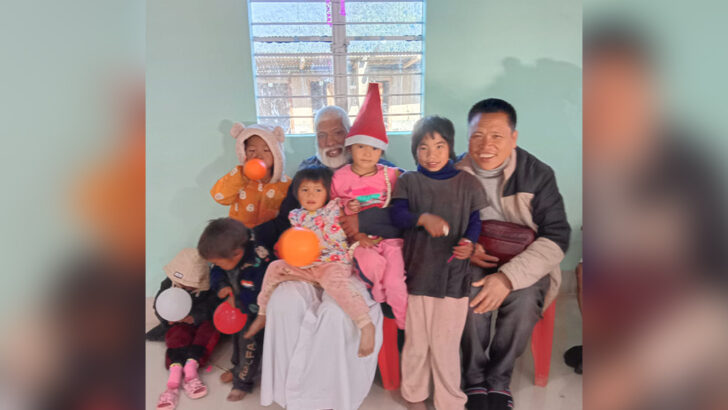
 Fr. Manuel at
Christmas time,
with children in
front of a traditional
Nyishi House
Fr. Manuel at
Christmas time,
with children in
front of a traditional
Nyishi House Memoirs of Fr. Dominic Pendanathu SDB, an Indian Salesian Missionary now working in Milford Salesian community Limerick Ireland

Go, make disciples of all nations”, (Matthew 28:19) is the great call of Jesus that led the Salesian Congregation to India, where their mission began in 1906 with Fr. George Tomatis SDB and his companions. By 1922, the mission had reached Northeast India, where Fr. Louis Mathias SDB and his team laid the foundation for a ministry particularly among the tribal communities.
Since then, the mission has grown in northeast India, from Shillong to Guwahati, and from Tezpur to Dimapur, where the Salesians engage in direct evangelization, build schools, train catechists, and nurture indigenous vocations.
St. Francis De Sales, Don Bosco Province, Dimapur, INDIA
The Salesian Province of Dimapur was established in 1981, and serves Nagaland, Manipur, Arunachal Pradesh, and parts of Assam. Rooted in Don Bosco’s charism, it focuses on youth ministry, education, and evangelization. It empowers marginalized communities and nurtures vocations, becoming a beacon of hope and transformation across Northeast India.
In Arunachal Pradesh, the Salesian mission faced a unique challenge with the Arunachal Pradesh Freedom of Religion Act of 1978, which restricted religious conversions and delayed the Church’s outreach until the 1990s.
Despite these obstacles, pioneers like Archbishop Emeritus Thomas Menamparambil SDB, Bishop George Palliparambil SDB, Fr. Job Kallarackal SDB (a sort of a legend in some parts of Ireland with more than 600 Irish benefactors at one time), and Fr. Jose Chemparathy SDB, brought the gospel, healing, education, and dignity to remote villages. Their work helped Christianity take root not as a foreign imposition, but as a source of hope and renewal.
So, to my mission story in this region of India
Palin
I was ordained on January 6, 1999, and soon after, I was sent to Palin, the farthest mission station of the Dimapur Province in Arunachal Pradesh—a place that would shape me more deeply than I ever imagined. Though I longed to be a missionary, what I experienced there was far beyond my asking: a crucible, could I call it of grace, grit, and Gospel.
The terrain was unforgiving—mountainous paths, dense forests, and 12-hour treks between villages, often along narrow foot trails carved by generations. I remember yearning for just an inch of level ground, where both my feet could rest evenly. Leeches, biting cold, and the haunting beauty of landscapes that felt untouched were daily companions.
Palin became not just a mission station, but a sacred ground of transformation—for them, and for me”
The very thought of how I navigated around tree roots, with gorges right beneath my legs, or how I walked on a single cable way across a roaring river, still send shivers down my spine. Walking across the rivers in that manner, I was scared to death and looking back now, even for the sake of Gospel, it appears reckless.
Yet amid hardship, there was joy. The people welcomed the Word of God with open hearts. Their eagerness to hear about Jesus made every step worthwhile. I was there for three years, and Palin became not just a mission station, but a sacred ground of transformation—for them, and for me.
The parish priest and I organized a three-month-long medical camp, spread across many centres of the mission station. With support from the Arunachal Pradesh Government, we were able to provide free medicines to over 15,000 people. The rainy season of 1999–2000 brought floods, disease, and suffering—but also miracles of healing. Lives were saved, wounds were tended, and hearts were opened—not just to medicine, but to the Gospel of love. That season remains etched in my soul as a reminder of what faith, service, and solidarity can achieve.
It was here in Palin that we also worked against girl child marriage. It was a reality then that girls as young as eight years of age, were being forcefully given in marriage to men who were many times their age. This disrupted what was culturally and socially accepted at the time, but the government eventually acknowledged our courage to stand against this evil practice of child marriage. Looking back, the Salesian community took a great risk in taking this stand, but it bore fruit.
Doimukh, Arunachal Pradesh
After three rugged years in Palin, I was transferred to Doimukh, a more comfortable station nestled in the foothills of Arunachal Pradesh. Here I launched an innovative educational programme for children aged 5 to 15, drawn from the remotest tribal villages. Many had never held a pencil, yet their eyes sparkled with curiosity. We offered them free education in the form of an abridged curriculum tailored to their needs, along with food, and accommodation.
The Salesian Congregation, central mission office, generously funded the initiative. Over the course of five years, we provided free education to more than 400 children, planting seeds of hope in lives long untouched by opportunity.
Fifteen years later, one of the naughtiest boys—now a devout Catholic and successful professional—came searching for me with his family. “If I am what I am today,” he said, “it’s because of those three years.” A girl from the same cohort recently shared that our programme gave her the courage to dream, proving that even the poor can aspire and achieve.
Most of these children have flourished in life through becoming teachers, nurses, entrepreneurs, and leaders. Their lives are living testaments to what faith, education, and generosity can accomplish.
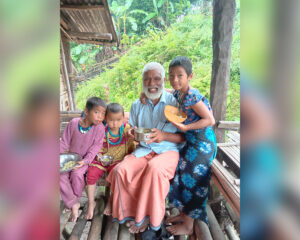
Manuel Paikada SDB, from
the Dimapur Province at his
mission station in Chambang,
Arunachal Pradesh, India.
Charismatic revival
One of the greatest challenges the Church faced in Arunachal Pradesh was the lack of catechesis. Missionaries were not allowed into the state until the early 1990s. As a result, many people had faith in Jesus and were baptized—but had little more. In his article Bring Men to Match My Mountains, Joseph Pulianthanathu described the people as those who “celebrated Easter Sunday before Good Friday”. They did not know that Good Friday pre-ceeded Easter Sunday, but they had faith in Jesus Christ. Experiences such as this, has helped me to cultivate a pastoral heart.
When I reached Doimukh, this spiritual vacuum was palpable, and Catholics were being drawn to other Christian groups offering prayer, fasting, and healing ministries. In response, I invited a group of enthusiastic youth from Kerala, known then as Divine Youth to offer a catechesis. They lived in hunger and hardship yet preached the Gospel and taught with zeal. Their teaching and witness laid the foundation for a Christian charismatic revival. The youth preached Christ to more than 50,000 people during the four years that they were in Doimukh.
We were able to bring together more than a thousand families under this umbrella of development”
The turning point came when we brought Fr. Mathew Naikomparambil VC, the patriarch of the Kerala Charismatic Movement, to Itanagar, the capital of Arunachal Pradesh. His retreat drew over 1,000 participants, creating a wave of renewal.
From this humble beginning, Vincentian preachers established a foothold in Gumto, and today, there are over 15 Vincentian retreat centres across Northeast India.
These centres have become sanctuaries of spiritual and physical consolation. What began as a response to catechetical poverty has blossomed into a vibrant movement of faith, rooted in suffering yet radiant with resurrection.
Side by side with the faith development there was the formation of self-help groups, adult literacy programmes and skill training opportunities. We were able to bring together more than a thousand families under this umbrella of development.
A Journey Shared
What I have shared of the three pivotal moments in Palin, Doimukh, and the charismatic revival is but a thread in the vast tapestry of missionary life in Arunachal Pradesh. Behind every retreat, every classroom, and every healing touch stands the selfless sacrifice of hundreds of Salesians and other missionaries, who walked, wept, and witnessed in silence and service. I share my own missionary journey, to honour them.
The great commission of Jesus belongs to all. All are called to pray, volunteer, support financially, and dare to believe that the Gospel can transform even the most forgotten corners of the earth. Whether through a whispered prayer in Ireland or a donation from afar, each act of solidarity becomes part of this living mission—a mission of hope, healing, and resurrection.
If you wish to give financial support to the Salesian mission, please contact:
Don Bosco Aid, Salesian House, 45 St Teresa’s Road, Crumlin, Dublin 12XK52, Telephone 01 4650717. email dba@salesiansireland.ie.