


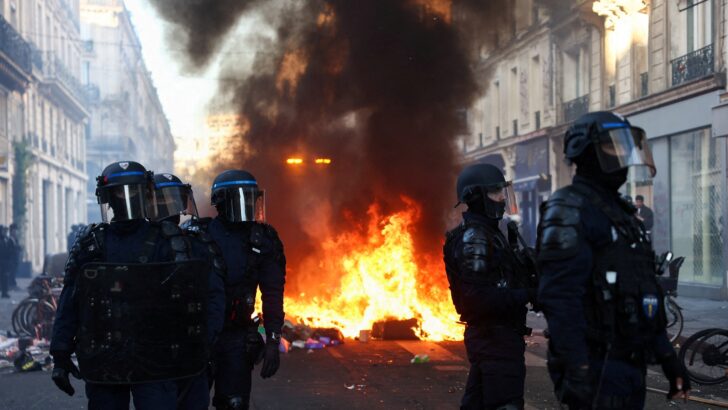
 A fire burns as police officers in riot gear stand guard during civil unrest in Paris Oct. 18, 2026, the day after a national day of demonstrations against the cost of living and rising fuel prices. (OSV News photo/Abdul Saboor, Reuters)
‘France is on Fire’ was a fairly familiar news headline during the summer of ’26 when sweltering temperatures set the perfect conditions for wildfires. We have been reading that headline again now in the very different circumstances of violent civil protest but there is an uncanny kind of resonance between the two events.
Hyperbolic headlines and single-track narratives don’t capture the complexity of the recent wave of French protests but neither did they tell us everything we needed to know about the summer fires.
When politics is febrile and the pressure to promote a particular take on a story is strong it is never more necessary for reporters and commentators to stand back and offer a broader framed perspective.
Wildfire reporting calculatedly stoked climate anxiety and intensified calls for net-zero carbon as a survival priority. Accepting the climate argument however shouldn’t require bypassing other troubling aspects of the story. For a start, it was noteworthy that the western seaboard of France was the area most affected because of the dense planting of maritime pines under the reign of Napoleon III to stabilise the sand dunes.
He couldn’t have anticipated of course that over time the same coastal areas would become almost as densely planted with holiday camps with their associated fire risks. The ways we interact with our natural environment can greatly exacerbate the risks from naturally occurring weather events, something that’s often scarcely, if at all, noted in the climate-fixated reporting of outlets like RTÉ, which can allow those responsible for environmental management to evade responsibility by blaming it all on the weather.
A more significant factor underreported to the point of being overlooked was the prevalence of arson during the French summer. How many of us were aware that hundreds of arrests were made, a significant number of which involved minors? The fact is that the weather creates the conditions for wildfires; in the overwhelming majority of cases, it is people, deliberately or accidentally, who directly cause them. By mid July, Macron identified arson as a major contributor to the crisis and announced a ‘zero tolerance’ policy for arsonists.
In the light of what is now happening across French cities, it is not unreasonable to say that the anarchic and vandalistic spirit that expressed itself in furtive incidents during the heatwaves has resurfaced, emboldened in the violence we have witnessed in French cities. This matters because a fuller reporting of all the factors relevant to the wildfires would have shown that there were grounds for social as well as climate concerns and that both could be equally consequential.
Moving to where we are now, the media initially presented the recent unrest and disorder in terms of the fairly typical French tradition of ‘manifestations’ which usually erupt in a degree of violence on the fringes. We don’t have to go back further than 1968, when disgruntled students joined by workers brought the French capital to a standstill. Then too the usual assortment of ‘malcontents’ and anarchists, for whom any protest is catnip, joined in and Molotov cocktails were hurled at police. But this ‘plus ça change‘ spin didn’t hold up long because the level and style of violence on this occasion showed it could not be dismissed as a fringe element.
There can be no denial that the protest wasn’t deeply infiltrated by what the French call ‘islamo-gauchisme’, something which is well recognised in anglophone Europe too in the incongruous alliance between Islamism and the far Left. United by nothing more than a common hatred of western civilisation, they are each other’s useful idiots. The common cause is the destruction of everything that can be summed up as ‘western’, the Christian roots of its civilisation, its artistic and intellectual legacy, its history – retro-fitted with a Marxist hermeneutic – its traditions and customs, its institutions including, yes, its schools.
The French school system has its problems undoubtedly but burning schools down, and some 25 of them were gutted, doesn’t seem a logical response especially when some decent looking buildings were included. Can we conclude that this was the work of the infiltrating ideologues rather than students?
The flags of Islamic countries, Algeria, Morocco and Palestine were more in evidence than the ‘le tricolore’ so it could indeed look like the primary cause was hijacked. However, if we take a closer look as educator and social commentator (‘Britain’s strictest headmistress’), Katherine Birbalsingh, did, we can see that such flags were carried by young, white French people as often as not. It was also extraordinary and shocking that young white people desecrated a church in the Vendée while singing a song celebrating the sole terrorist survivor of the Bataclan theatre attack in 2015 where 89 young French teenagers died. Such scenes were reminiscent of what happened in Mao’s cultural revolution when young Red Guard zealots hunted down their teachers. Of course France is a long way from that excess but we can’t forget that it was there once during the Reign of Terror that followed the Revolution.
Birbalsingh concludes that this was no regular French protest turbo-charged by opportunistic Islamists and leftists. This was French youth turning on France itself. It was even broader than that. It was French youth turning on everything that we characterise as western civilisation. They didn’t pick up this hatred from extremist agitators. It has been inculcated into them in their French state schools, where they are imbued with collective guilt for their country’s colonial past and for the privilege of being white. This is why the protests spread quickly to other European countries. This is why they are an ominous signal, not just one of France’s predictable, periodic outbreaks of citizen rage. It is a warning for all countries who have also lost faith with their cultural roots.
There is little sense that these young protestors know what they want beyond breaking everything. Do they even still value ‘laiceté’? Were they disturbed to see a statue of Jeanne d’Arc draped in a hijab in Toulouse? The fact they attacked churches and waved the flags of Islamic states leaves the question open.
As France prepares for its presidential election early next year, the choice is shaping up to be between the hard left Mélenchon, who supported the protests and the far right Marine le Pen. The centre is hollowed out as it is in so many other European countries. People like Macron have been played by the propaganda of the left to fear the rise of the far right by conflating it with Nazism, raising the spectre of a return of some new incarnation of the Third Reich.
Yet, there is another face to France, one we saw only weeks earlier when Pope Leo visited the country. That was France ablaze with a different kind of fire. How interesting that it came between two major civil disruptions? The glow in the eyes of young French people who came out in throngs to greet the Pope and later sat at cafés where the only flags on display were the tiny papal flags used as table centrepieces reflects a gentler France that has kept faith with its Christian heritage.
News stories are often more complex than reported and, to be fully understood, need to be set within larger stories. The wider story here is that young French people are searching for meaning that their culture no longer provides. The Pope’s visit offered it to them. Maybe the catharsis of riotous protest was necessary before the message could reach them? We can hope. It has certainly offered them a choice and it is the fundamental choice that faces every people and every individual person alike. It is best expressed in the following lines from the Book of Deuteronomy, “…I have set before you life and death, blessing and curse; therefore choose life that you and your descendants may live.” (Deut. 30:19)