

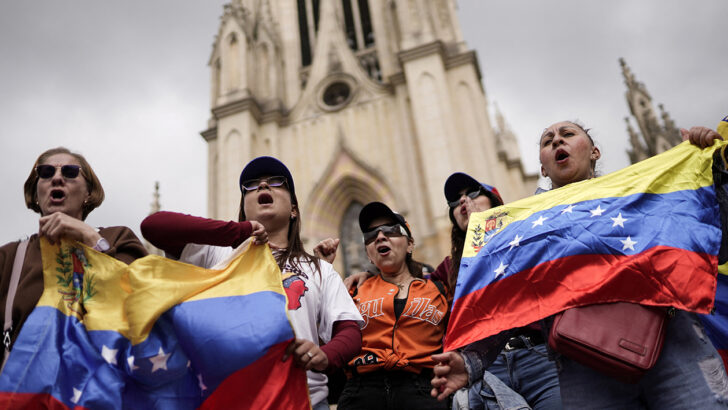
 Venezuelans living in Colombia demonstrate in front of the Minor Basilica of Our Lady of Lourdes in Bogota January 4, 2026, for a democratic transition, after the US launched strikes on Venezuela, capturing its President Nicolas Maduro. Photo: OSV News photo/Sergio Acero, Reuters.
 Pope Leo XIV and the bishops of Venezuela have urged prayer, calm and respect for national sovereignty following the US military operation that captured Venezuelan President Nicolás Maduro and his wife, Cilia Flores, and transferred them to the United States to face federal narcoterrorism charges.
Speaking at the conclusion of the Angelus prayer in St Peter’s Square on January 4, Pope Leo said, “With a heart full of concern I follow the evolution of the situation in Venezuela,” insisting that “the good of the beloved Venezuelan people must prevail over every other consideration.”
The Pope called for an end to violence and appealed for “the pursuit of paths of justice and peace,” stressing the need to guarantee “the sovereignty of the country,” to “ensure the rule of law enshrined in its Constitution,” and to “respect the human and civil rights of each and every person.”
He also urged Venezuelans and the international community to work together “to build a serene future of collaboration, stability and harmony,” adding that this must be done “with special attention to the poorest, who are suffering because of the difficult economic situation.”
Entrusting Venezuela to Our Lady of Coromoto and to its recently canonised saints, José Gregorio Hernández and Carmen Rendiles, Pope Leo invited Catholics worldwide to unite in prayer for the country.
Venezuelan bishops
Venezuela’s bishops issued their first statement shortly after news of the US operation became public, offering what they described as “a message of accompaniment and closeness with the People of God.”
“In light of the events that our country is experiencing today,” they wrote, “let us ask God to grant all Venezuelans serenity, wisdom and strength.”
The bishops expressed solidarity with victims of the violence, stating, “We stand in solidarity with those who were wounded and the families of those who died,” and urged the faithful to “persevere in prayer for the unity of our people.”
In a second message issued less than an hour later, the bishops called on Venezuelans “to live more intensely in hope and fervent prayer for peace in our hearts and in society, rejecting any type of violence.”
“May our hands open for encounter and mutual aid,” they added, “and may the decisions that are taken always be made for the well-being of our people.”
Archbishop Jesús González de Zárate of Valencia, president of the Venezuelan bishops’ conference, said he was accompanying the people “with prayer,” while acknowledging that events were still unfolding. Bishop Juan Carlos Bravo Salazar of Petare urged citizens to “maintain a climate of prayer,” warning against spreading “unverified and unconfirmed information” and calling on people to remain sheltered.
Caribbean
Just a few days before the January 3 US strikes on — and temporary takeover of — Venezuela, the Catholic bishops of several Caribbean nations had repeated their earlier plea for peace while expressing support for the Venezuelan people, amid a pre-attack buildup of U.S. military in the region.
“We stand in solidarity with the people of Venezuela at this critical moment in their nation’s history,” wrote Archbishop Charles Jason Gordon of Port of Spain, Trinidad and Tobago, and president of the Antilles Episcopal Conference, in a December 29 letter issued by the conference.
The archbishop noted that since the conference’s October statement calling for peace, “the geopolitical landscape of our region has changed at an alarming pace.” While recognizing “the legitimate responsibility of states to address transnational crime and uphold international law,” wrote Archbishop Gordon, “we reaffirm more urgently than before that militarisation is not the road to durable security.” Echoing the words of St. John Paul II — repeated by Pope Francis and Pope Leo XIV — Archbishop Gordon wrote, “War, or the threat of war, is always a defeat for humanity.”