

 Michael Kelly
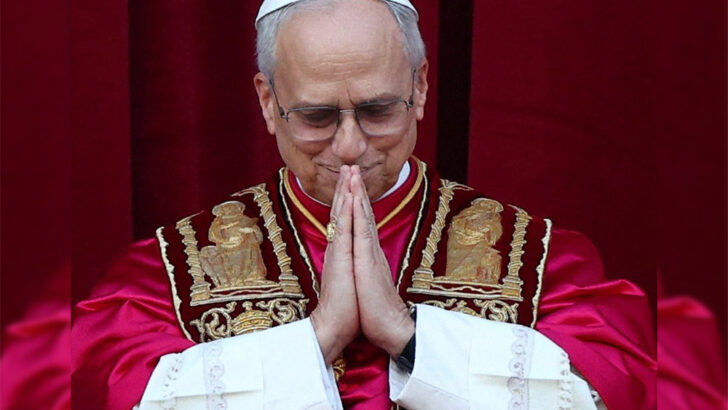 Pope Leo XIV pauses on the central balcony of St Peter's Basilica at the Vatican May 8, 2025, following his election during the conclave. He is the first American pope in history. Photo: OSV News/Guglielmo Mangiapane, Reuters
 Pope Leo XIV will build bridges within the Church, and prioritise the proclamation of the Gospel writes Michael Kelly
The well-worn cliché about the Catholic Church is that it is an institution so deeply rooted in tradition that it is incapable of embracing change and transition. But the reality is, few global organisations in our modern world have the capacity to embrace difference and new ways of doing things almost overnight.

In late April 2025, Pope Francis toured the streets around the Vatican giving what none of us knew then would be his last blessing. Minutes beforehand he had sat on the loggia of blessings overlooking the vast St Peter’s Square and delivered his traditional Easter Sunday blessing urbi et orbi – to the city and to the world.
Then, just 12 days after Pope Francis’ funeral, millions of people looked on as a new Pope – Leo XIV – stood on that same balcony and greeted the crowds.
I was in St Peter’s Square that evening, and one of the first things that struck me is just how much like a Pope the former Cardinal Robert Francis Prevost looked like. It seemed that he had been born for the role or had served as Pope for decades already.
And the College of Cardinals, maybe not the first group of people one would naturally think about in speaking of innovation, had surprised us all and chosen a Pope from the United States.
I was amongst those seasoned Vatican watchers who had confidently said ‘it will never be an American’. I knew of Cardinal Prevost, of course, and had he been born in a different country he would have ranked highly on my list of papabile (potential future Popes). But the fact that he was an American, ruled him out for me. Like so many Vaticanologists, I believed the received wisdom that the electors would not want the Church to be headed by a citizen of the world’s greatest superpower.
It is a reminder, as always, that when it comes to scoring papabili, usually those who know don’t say, and those who say don’t know!
On that balmy May evening, as the new Pope prepared what he would say to those gathered below the loggia of blessings, members of the College of Cardinals filled the windows overlooking the piazza. This was an occasion not to be missed.
Below, pilgrims and visitors chanted viva il Papa – long live the Pope. Frantic googling had ensured that those who didn’t know anything about the 69-year-old Chicago native, soon could confidently rhyme off a few facts about Leo XIV.
Character
For me, one of the most remarkable things about the new Pope is how he immediately looked made for the role. When he appeared on the balcony, he looked as if he had been Pope for 20 years. His gestures and demeanour displayed a comfort in the new role that can only be the fruit of profound peace.
Emotional at times, Pope Leo nonetheless cut a confident figure. “Peace be with you all!” he said in a booming voice that resonated all the way down the Via della Conciliazione to the River Tiber and beyond.
“Dear brothers and sisters, these are the first words spoken by the risen Christ, the Good Shepherd who laid down his life for God’s flock. I would like this greeting of peace to resound in your hearts, in your families, among all people, wherever they may be, in every nation and throughout the world. Peace be with you!” he said to rapturous applause.
We must look for ways to be a missionary Church, a Church that builds bridges and encourages dialogue”
He described the peace of Christ as “a peace that is unarmed and disarming, humble and persevering. A peace that comes from God, the God who loves us all, unconditionally.”
Of course, all of our hearts and minds thought back to the last time a pope appeared on that same balcony when Pope Francis has blessed the crowds on Easter Sunday, April 20, and told us that “we are made for life, not for death” just hours before he passed to life eternal.
As if intuiting this, Leo said: “we can still hear the faint yet ever courageous voice of Pope Francis as he blessed Rome, the Pope who blessed Rome, who gave his blessing to the world, the whole world, on the morning of Easter.
“Allow me to extend that same blessing: God loves us, God loves you all, and evil will not prevail! All of us are in God’s hands. So, let us move forward, without fear, together, hand in hand with God and with one another! We are followers of Christ. Christ goes before us. The world needs his light. Humanity needs him as the bridge that can lead us to God and his love. Help us, one and all, to build bridges through dialogue and encounter, joining together as one people, always at peace,” he said.
Underlining his roots as a humble friar, the Pope said, “I am an Augustinian, a son of St Augustine, who once said, ‘With you I am a Christian, and for you I am a bishop.’ In this sense, all of us can journey together towards the homeland that God has prepared for us.”
Setting the tone of his papacy, he said confidently: “Together, we must look for ways to be a missionary Church, a Church that builds bridges and encourages dialogue, a Church ever open to welcoming, like this [St Peter’s] Square with its open arms, all those who are in need of our charity, our presence, our readiness to dialogue and our love.”
Expectations
Cardinal Prevost was, above all, a missionary and it was fitting that he turned to his beloved Peru. Switching from Italian to word-perfect Spanish, he begged the congregation’s indulgence. “And if you also allow me a brief word, a greeting to everyone and in particular to my beloved Diocese of Chiclayo, in Peru, where a faithful people has accompanied its bishop, shared its faith and given so much, so much, to continue being a faithful Church of Jesus Christ,” he said before proceeding to the apostolic blessing.
In the short address, he reaffirmed his commitment to synodality – that process of co-responsibility for the life and mission of the Church so dear to Pope Francis. But synodality has not been without its critics. Some people have said that it has created divisions within the Church, even within the College of Cardinals. Others have argued that Pope Francis raised unrealistic expectations around change, when actually the Church’s core teachings and doctrines are unchangeable – only understandings evolve.
Pope Leo will have to manage these expectations. A short conclave had indicated to many that Cardinal Prevost had spoken at the general congregations – the pre-conclave meetings – in a way that impressed the cardinals. However, several members of the Sacred College later said that the words of the Prefect for the Dicastery for Bishops had not been particularly remarkable. What these cardinals did note, though, was that Cardinal Prevost impressed the cardinals by the way he carried himself at the meetings. The strength of his organisational ability, helping Irishman Cardinal Kevin Farrell with the meetings, also impressed many.
The papacy is an awesome burden of office. Just a century ago there were around 330 million Catholics in the world – today there are 1.4 billion Catholics, in almost all the countries of the globe. To one man, assisted by the cardinals and bishops, falls the responsibility of leading and guiding the Church.
And yet, the Pope is a man who must try to speak to a broken world and a Church that is often fractured”
At the papal installation ceremony on Sunday, May 18, a large wool vestment known as a pallium was placed around the Pope’s neck and shoulders. It was pinned to Pope Leo, symbolically representing the nails that held Christ to the Cross. The vestment signifies his universal power over the Church, but it is also a reminder that the office of Pope is a burden, and he will suffer for that.
You can’t please everyone as Pope, of course. Pope Francis didn’t, Pope Benedict XVI certainly didn’t, and Pope Leo XIV won’t either.
The challenges facing the Catholic Church are immense. And they are different in the diverse parts of the world. We share the same faith, but the challenges and issues facing Catholics in Belfast are different from those in Bogota. The concerns of Catholics in Dublin, are certainly alien to Catholics in Doha. And so on.
And yet, the Pope is a man who must try to speak to a broken world and a Church that is often fractured. Leo comes to the global stage at a time when geopolitics seems shaped by the law of the jungle, where might is seen as right and the one who shouts the loudest tends to be heard.
But there is power in the humility of the papacy. The roots. of Christianity are in the birth of a carpenter’s son in the. humble surroundings of a stable in a rural backwater of the Roman Empire.
One of the reasons people were slow to accept Jesus is because they were scandalised by his simplicity and lack of love for regard and high places. So, they had to change their idea around leadership.
Soviet tyrant Joseph Stalin once mocked the Pope’s lack of military power when he asked: ‘The Pope! How many divisions has he got?’
Today the papacy stands almost alone in the world as a global moral leader, at a time when leadership is so lacking. Many people, particularly the poor and the powerless, look to the Pope to speak for them. They are quicker to get the message of the Gospel than the wealthy and the powerful, many of whom have long since despatched talk of spirituality in favour of seeming endless consumption and wealth.
Faith
In Ireland, a recent survey revealed that our young people are amongst the unhappiest in the developed world. The relative prosperity and freedoms enjoyed by so many have brought material wellbeing, but many people – especially our young people – are not feeling satisfied.
On the balcony overlooking St Peter’s on the night of his election, Pope Leo XIV described himself as a ‘son of Augustine’ – a reference to the fifth century saint who wrote: “You have made us for yourself, O Lord, and our heart is restless until it rests in you.”
If ever our restless hearts needed balm, it is now.
In his early days as Pope, Leo has shown a warmth and charisma that is appealing to many people. He speaks a language that resonates and brings a voice of reason to global affairs that puts people at the centre of discussions.
In his previous roles, Pope Leo visited Ireland on numerous occasions. Just a few weeks before his election, a delegation of senior Irish bishops were in Rome to meet with the then Cardinal Prevost. He is acutely aware of the challenges facing the Church in Ireland, north and south. Our American-influenced culture is not alien to him, and he has worked extensively with young people engaging them with faith.
Help us, one and all, to build bridges through dialogue and encounter, joining together as one people, always at peace”
The new Pope will bring fresh heart to many Irish Catholics who have listened with great pain, sadness and distress to the findings of various enquiries set up by the State since the turn of the millennium to inquire into the egregious crime of sexual abuse by some clergy and religious. The tsunami of abuse cases both nationally and internationally has undoubtedly contributed to a crisis of confidence in the institutional Church, a significant decline in Church attendance and a questioning of faith. Believers know that faith gives a broader perspective, that faith helps us see the bigger picture. They know that the lack of faith in our culture, despite how often inadequately lived that faith was in the past, contributes to the despair that so many people are feeling today.
Leo is bold in his proclamation of the Gospel, and his conviction that the baby born in inauspicious circumstances in the stable 2,000 years ago has transformed history in every generation and will do so again.
In his opening blessing he said in a booming voice: “God loves us, God loves you all, and evil will not prevail! All of us are in God’s hands. So, let us move forward, without fear, together, hand in hand with God and with one another! We are followers of Christ. Christ goes before us. The world needs his light. Humanity needs him as the bridge that can lead us to God and his love. Help us, one and all, to build bridges through dialogue and encounter, joining together as one people, always at peace.”
Leo sees the power of the Gospel and the papacy to build bridges – Pontiff comes from the Latin for bridge, and the Pope is the Supreme Pontiff – in a world dominated by hate and division, that is a powerful antidote. We should all wish him a fair wind, for all of our sakes.
This is an extract from In Christ We Are One: Pope Leo XIV at the Service of Humanity by Michael Kelly which is published by ACN Church Resources and is available from www.acnchurchresources.ie or by calling 01 727 0003 (00353 1 727 0003 from outside RofI).
There is power in the humility of the papacy. The roots. of Christianity are in the birth of a carpenter’s son in the. humble surroundings of a stable in a rural backwater of the Roman Empire”
Leo comes to the global stage at a time when geopolitics seems shaped by the law of the jungle, where might is seen as right and the one who shouts the loudest tends to be heard”