

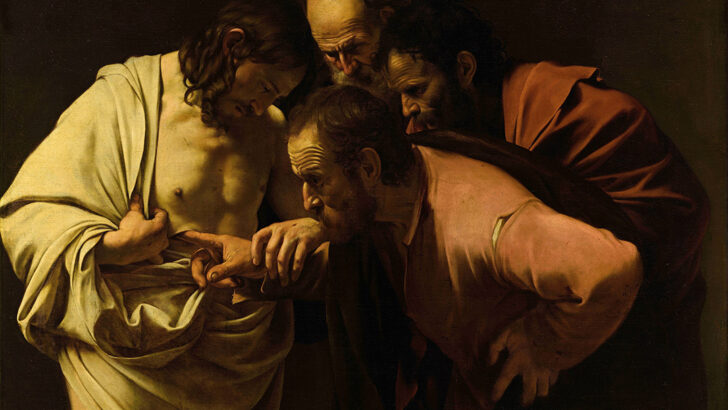
 Michelangelo Merisi da Caravaggio’s ‘The Incredulity of Saint Thomas’, c. 1604, shows the moment the apostle Thomas
came to believe in the resurrection of Jesus Christ. Photo: OSV News /Public Domain, Wikimedia Commons.
Michelangelo Merisi da Caravaggio’s ‘The Incredulity of Saint Thomas’, c. 1604, shows the moment the apostle Thomas
came to believe in the resurrection of Jesus Christ. Photo: OSV News /Public Domain, Wikimedia Commons. John 20:19 When it was evening on that day, the first day of the week, and the doors of the house where the disciples had met were locked for fear of the Jews, Jesus came and stood among them and said, “Peace be with you.”

John 20:20 After he said this, he showed them his hands and his side. Then the disciples rejoiced when they saw the Lord.
John 20:21 Jesus said to them again, “Peace be with you. As the Father has sent me, so I send you.”
22 When he had said this, he breathed on them and said to them, “Receive the Holy Spirit.
John 20:23 If you forgive the sins of any, they are forgiven them; if you retain the sins of any, they are retained.”
John 20:24 But Thomas (who was called the Twin), one of the twelve, was not with them when Jesus came.
John 20:25 So the other disciples told him, “We have seen the Lord.” But he said to them, “Unless I see the mark of the nails in his hands, and put my finger in the mark of the nails and my hand in his side, I will not believe.”
John 20:26 A week later his disciples were again in the house, and Thomas was with them. Although the doors were shut, Jesus came and stood among them and said, “Peace be with you.”
John 20:27 Then he said to Thomas, “Put your finger here and see my hands. Reach out your hand and put it in my side. Do not doubt but believe.”
John 20:28 Thomas answered him, “My Lord and my God!”
John 20:29 Jesus said to him, “Have you believed because you have seen me? Blessed are those who have not seen and yet have come to believe.”
John 20:30 Now Jesus did many other signs in the presence of his disciples, which are not written in this book.
John 20:31 But these are written so that you may come to believe that Jesus is the Messiah, the Son of God, and that through believing you may have life in his name.
Initial observations
Today we hear one of the most widely remembered stories from the New Testament: the story of doubting Thomas. It is interesting that that title has stuck, even though the point of the story is that Thomas actually arrives at faith!
In this excerpt, we hear the substantial story of Thomas, in two parts, followed by the first conclusion of the Gospel. (Scholars often hold that chapter 21, while not original was added very early, and provides a second ending.) Kind of writing
This symbolic narrative explores several dimensions of Easter faith: (1) the gifts of the Risen Lord—the Holy Spirit, peace, joy and forgiveness; (2) the identity of the Risen One with the Crucified One; (3) the blessedness of all who believe, eliminating any distinction between present believers and the very first generation of Christians. All three are important. Later generations may have been felt that earlier Christians, who actually encountered the Risen Lord were somehow more fortunate. Even more important, a later Christian heresy Docetism—which denied the reality of Jesus’ humanity and its continued significance after the Resurrection—is countered by the realism of the body of Jesus raised.
Old Testament background
“Then the Lord God formed man from the dust of the ground, and breathed into his nostrils the breath of life; and the man became a living being.” (Genesis 2:7)
“Because they failed to know the one who formed them and inspired them with active souls and breathed a living spirit into them.” (Wisdom 15:11)
“Wake up! Bestir yourself for my defence, for my cause, my God and my Lord!” (Psalms 35:23)
New Testament foreground
(1) New creation in Christ is reflected in the lay-out of this Gospel, which starts with an echo of Gen 1:1. Jesus’ last words on the cross are an echo of Gen 2:2. John 20:1 explicitly recalls Gen 1:1 again and here in the breathing Gen 2:7 is echoed.
(2) Holy Spirit / Advocate: in the Fourth Gospel, there is a wonderful and deep presentation of the Holy Spirit, the Advocate. A single verse gives an idea of what is at stake: “Now he said this about the Spirit, which believers in him were to receive; for as yet there was no Spirit, because Jesus was not yet glorified.” (John 7:39). It simply is not true that “as yet there was no Spirit”! Yet, the function of the Holy Spirit, in the light of the Paschal Mystery, is now so new, so different that it is as if there had been no Spirit before. “But the Advocate, the Holy Spirit, whom the Father will send in my name, will teach you everything, and remind you of all that I have said to you.” (John 14:26) Cf. John 16:7.
(3) Peace: “Peace I leave with you; my peace I give to you. I do not give to you as the world gives. Do not let your hearts be troubled, and do not let them be afraid.” (John 14:27)
St Paul
Therefore, since we have been declared righteous by faith, we have peace with God through our Lord Jesus Christ, through whom we have also obtained access by faith into this grace in which we stand, and we rejoice in the hope of God’s glory. (Rom 5:1–2)
Brief commentary
Verse 19 That is, the day of creation. Jesus’ self-presentation is not limited by their fear. Peace here is the Easter good news of victory over death and fear of death.
Verse 20 That is, the Risen One is the Crucified and the Crucified is the Risen One. Jesus is both the same and utterly transformed. The first gift was peace, the second gift is joy.
Verse 21 Repetition for emphasis. “As” should read “just as” and means more than a formal similarity: Jesus’ very own mission from the Father continues in the mission of the disciples.
Verse 22 Echo of creation. The third gift is the Holy Spirit, in the new role of Advocate and reminder. A new creation is Christ is a strong early Christian experience and proclamation. Gal 6:15; 2 Cor 5:17; 1 Peter 1:3)
Verse 23 The next gift—to all believers—is forgiveness of sins.
Verse 24 Thomas featured earlier in the Gospel: John 11:16; 14:5.
Verse 25 Believe what? That he is risen? That it is the same Jesus?
Verse 26 I.e. the eighth day, that is, today. The same gift of peace is underlined.
Verse 27 The Risen Lord takes the initiative, by meeting the heart-felt questions and doubts of Thomas.
Verse 28 This is the highest proclamation of Jesus’ identity in this Gospel. Thus, deepest doubt can be the direct road to deepest faith. The words also counter the propaganda of the Roman emperors, one of whom wished to be addressed as “our lord and our God”, no less!
Verse 29 This is a beatitude, one of the twenty-seven New Testament such beatitudes. Most likely, the writer is meeting an anxiety at the time of writing when the third and fourth generations of Christians feel that the difference in time from the events of salvation puts them at something of a disadvantage. As R.S. Thomas puts it,
“It’s a long way off, but to get
There takes no time and admission
Is free, if you will purge yourself
Of desire, and present yourself with
Your need only and the simple offering
Of your faith, green as a leaf.”
Verse 30 This is the first ending of the Gospel and is a frank admission that the writer has selected. The second ending is in the same vein: “But there are also many other things that Jesus did; if every one of them were written down, I suppose that the world itself could not contain the books that would be written.” (John 21:25)
Verse 31 This is a key text for understanding the nature of Gospels and in particular the kind of text which the Fourth Gospel is. The goal is a true understanding of the identity of Jesus so that believers may live in him.
Pointers for prayer
- “Peace be with you” was the greeting of Jesus on meeting his frightened apostles. Who has come to you bringing peace at times when you were afraid? To whom have you been able to bring peace?
- Thomas, doubting and questioning, is possibly a person with whom we can identify. What part have doubting and questioning played on your faith journey? How has your faith been strengthened by such moments?
- Note the way that Jesus dealt with Thomas. He did not give out because he doubted. He accepted how he felt and led him along to see the truth of his resurrection. Who has been that kind of teacher for you, gently taking you from where you were and leading you to a deeper knowledge about some truth about life? For whom have you been that kind of teacher?
- “Blessed are they who have not seen and yet believed”. That requires great trust. Perhaps you have had the experience of being trusted without having to justify every step along the way. What was it like to be trusted in that of the way? Who have you been able to trust in a similar manner?
Prayer
God of life, source of all faith, through the waters of baptism you have raised us up in Christ and given us life that endures.
Day by day, refine our faith that we who have not seen the Christ, may truly confess him as our Lord and God, and share the blessedness of those who believe.
Grant this through Jesus Christ, the resurrection and the life, who lives and signs with you in the unity of the Holy Spirit, God for ever and ever. Amen.
The Lectionary in Eastertide
| Easter 2
The path to faith |
Acts 2:42-47
Faithful to the apostolic teaching |
1 Peter 1:3-9
You do not see him, yet you love him |
John 20:19-31
Doubting Thomas; Gospel purpose |
| Easter 3
Witness |
Acts 2:14, 22-33
Peter at Pentecost: We are witnesses |
1 Peter 1:17-21
Now you have faith and hope in God |
Luke 24:13-35
Did not our hearts burn within us? |
| Easter 4
Convert and follow |
Acts 2:14, 36-41
Peter at Pentecost: repent and be baptised |
1 Peter 2:20-25
Now you have come back to the shepherd |
John 10:1-10
I am the gate of the sheepfold |
| Easter 5
Meeting Jesus |
Acts 6:1-7
Preachers are freed to focus on the Word |
1 Peter 2:4-9
Set yourselves close to the living stone |
John 14:1-12
I am the way, the truth and the life |
| Easter 6
Holy Spirit |
Acts 8:5-8, 14-17
The Samaritans receive the Holy Spirit |
1 Peter 4:13-16
You have the Spirit of Christ resting on you |
John 14:15-21
He will give you the Spirit of truth |
Commons / Public Domain.
Thought for the day
How did any of us make the journey towards faith in Christ? No doubt a great part of it is simply what we received—usually from family. At some point, did I make a conscious choice? Perhaps at other times, I felt like walking away from the faith project? What kept me going? Did a more personal ownership of faith result? Perhaps I felt the intuition of John O’Donahue, “Faith is helpless attraction to the divine.” In spite of everything, in spite of myself, somehow it is part of who I am.
Prayer
Mysterious God, we are those who have seen and at the same time not seen. Help to look beyond the simple gifts of each day to see you the giver behind—and in—every gift. Help us embrace the grace that we may know true blessedness in believing.
Now the whole group of those who believed were of one heart and soul
Acts 4:32 Now the whole group of those who believed were of one heart and soul, and no one claimed private ownership of any possessions, but everything they owned was held in common.
Acts 4:33 With great power the apostles gave their testimony to the resurrection of the Lord Jesus, and great grace was upon them all.
Acts 4:34 There was not a needy person among them, for as many as owned lands or houses sold them and brought the proceeds of what was sold.
Acts 4:35 They laid it at the apostles’ feet, and it was distributed to each as any had need.
Photo: OSV News /Gregory A. Shemitz.
Initial observations
The ideal of sharing all things in common is prevalent in the culture at the time. A few citations may illustrate:
“Among friends everything in common is quite correct, for friendship consists in sharing.” (Aristotle) “True friends cling not to private property; their wealth is shared in close community.” (Euripides) “And if you need anything that is yours, write us, for my possessions, Plato, are by all rights yours, even as they were Socrates.” (Socratics to Plato)
Kind of writing
This is a summary statement of what was supposed to have happened generally. The summary is in a simple ABA’ format, as follows:
A v.32 the community’s common life
B v.33 a response to the petition in v. 29 (see above)
Aí vv.34-35 – The common life of the community
As we see from the story of Ananias and Sapphira, it is a somewhat idealised portrait. We know rather more directly from the Pauline communities that conflict and strife (then as now) were the norm! Earlier in Acts, there is another summary statement, equally idealised, in 2:43-47.
Context in the community
Possessions and poverty are a considerable concern of the Gospel according to Luke. This may reflect either the poverty of the first Christian communities in Jerusalem (who were poor—hence Paul’s collection for them) or else the poverty of the community(ies) for which his is writing. Cf. Lk 6:20; 16:14, 18:22.
Related passages
(i) In general, to do with poverty and charity:
The poor are disliked even by their neighbours, but the rich have many friends. Those who despise their neighbours are sinners, but happy are those who are kind to the poor. Prov. 14:20-21 Cf. Prov 14:31 and 28:27.
(ii) In particular, an evocation of the Exodus story of the manna:
This is what the Lord has commanded: ‘Gather as much of it as each of you needs, an omer to a person according to the number of persons, all providing for those in their own tents.’” The Israelites did so, some gathering more, some less. But when they measured it with an omer, those who gathered much had nothing over, and those who gathered little had no shortage; they gathered as much as each of them needed. (Ex 16:16–19)
Brief commentary
Verse 32 This is the very model of Christian community (cf. Eph 4:1-6). There are, of course, tensions and issues, as may be seen in chapters 6, 10, 15 and 21. A constant theme in Luke-Acts is the role of possessions in discipleship (Lk 6:20-26; 12:13-21; 16:9, 19-31; 18:22-25; 19:1-27; 21:1; Acts 11:27-29). As we saw in the Introductory Observations, this was a widely admired ideal in Hellenistic culture at the time (not limited to religious groups such as the Essenes). The ideal is clear enough; however how it was actually put into practice is not so clear. Were all obliged? Was it an entry requirement? Would a partial sharing “do”? And so forth. Whatever the details, it was at least an aspiration of the first communities and we do know from Paul that the Jerusalem community was financially challenged as they say.
Verse 33 This is a summary statement of the proclamation, focused on the resurrection and, by implication, on the death of Jesus. The writer means the whole Christ event. Grace (lit. favour, reflecting the Old Testament word hesed, meaning the gift of the covenantal love of God) is big in the Acts: Acts 2:47; 4:33; 6:8; 7:10, 46; 11:23; 13:43; 14:3, 26; 15:11, 40; 18:27; 20:24, 32; 24:27; 25:3, 9.
Verse 34 In this case, the sharing of goods is “inward”, that is, among the members of the Christian community. In the course of time, the vision of shared goods was extended to all in need. Cf. Luke 10:25-37.
Verse 35 I.e. at the disposal of the church, under the leadership of the apostles. This means that charity was not a private virtue but a mark of the community as a whole. In a few chapters time, this role is devolved upon the deacons (literally “servants”, who are called upon not to preach but to look after material goods so as to free the apostle for precisely preaching). Cf. the citation from Paul above.
Pointers for prayer
- Luke makes a link between spiritual sharing and practical community of goods. The sharing of goods (to be read widely, including skills, energies, gifts) does contribute to a sense of spiritual oneness. When has that been the case in my experience? Prayer of communion.
- The ideal of union, oneness and communion is not always the reality I live and experience. What keeps me going when I fall short of the idea and what is that draws me back? Prayer of renewal.
- Witnessing is a key part of being a disciple. What opportunities come my way to bear witness and how do I use them? Prayer of witness.
- It is often much easier to give than to receive. As a person in need (of whatever kind), how has it been for me to find my needs met in the fellowship of believers? Prayer of thanksgiving.
Prayer
God of Jesus Christ, who prayed that all may be one, as he is one in you and the Holy Spirit, help us all to work for unity among Christians that we may be witness to the Gospel in our time.
Teach us to share all that we have in freedom and joy that kingdom may be a reality in our lives today. We ask this through Christ our Lord. Amen.
Though you do not see him now, you believe in him and rejoice!
Second reading
1 Pet 1:3 Blessed be the God and Father of our Lord Jesus Christ! By his great mercy he has given us a new birth into a living hope through the resurrection of Jesus Christ from the dead,
1 Pet 1:4 and into an inheritance that is imperishable, undefiled, and unfading, kept in heaven for you,
1 Pet 1:5 who are being protected by the power of God through faith for a salvation ready to be revealed in the last time.
1 Pet 1:6 In this you rejoice, even if now for a little while you have had to suffer various trials,
1 Pet 1:7 so that the genuineness of your faith—being more precious than gold that, though perishable, is tested by fire—may be found to result in praise and glory and honour when Jesus Christ is revealed. 8 Although you have not seen him, you love him; and even though you do not see him now, you believe in him and rejoice with an indescribable and glorious joy, 9 for you are receiving the outcome of your faith, the salvation of your souls.
Initial observations
Throughout Eastertide, we hear from 1 Peter, so a fuller introduction than usual will be appropriate for today.
The letter is presented as a document from the apostle Peter. Many scholars think this unlikely for the following reasons. (i) It combines Pauline and Petrine themes; (ii) the Greek is excellent; (iii) it reflects many later Christian common places (topoi); (iv) it seems to reflect the times of the Flavian emperors; (v) the written is familiar with Romans and there are links with 1 Clement (ad 96).
Kind of writing
Letter opening: 1:1-2
Thanksgiving: 1:3-12
Three main sections
Opening 1:13-2:10
Middle 2:11-4:11
Closing 4:12-5:11
Letter conclusion: 5:12-14
Our reading comes from the thanksgiving section of the letter. In Greek these 3-12 constitute a single sentence!
Context in the community
It is probable that “Babylon” in the letter points to Rome. This designation of Rome as “Babylon,” occurring only in literature composed after the fall of Jerusalem in 70 C.E. (Sib. Or. 5:143, 159; 2 Bar. 11:1, 67:7, 4 Ezra 3:1, 28, 31; Rev. 14:8, 16:19, 17:5, 18:2, 10, 21), constitutes further cogent evidence for the post-70 composition of 1 Peter.
The audience seems to live in cities but throughout several Roman provinces of Asia Minor, including Bithynia-Pontus and Cappodocia, places with no record of Pauline activity.
Who are these people? From the letter itself we learn a few things: free men (2:16), household slaves (2:18–20), wives with non-believing husbands (3:1–6), husbands with Christian wives (3:7), community leaders (“elders,” 5:1–4) and recent converts (“younger persons” [in the faith], 5:5). They seem to form a distinctive minority whose members were identified as “Christians” (4:16), this movement was engaged in a universal mission (2:12, 3:1–2) among the “gentiles” (non-believers including both Jews and pagans). The author calls them aliens (paroikoi and parepidemoi were regarded and treated as permanent or temporary “strangers in a strange land”). Such resident aliens formed a specific social stratum of local populaces and slaves. Constant exposure to local fear and suspicion, ignorant slander, discrimination and manipulation was the regular lot of these social outsiders.
Related passages
Humble yourselves therefore under the mighty hand of God, so that he may exalt you in due time. Cast all your anxiety on him, because he cares for you. Discipline yourselves, keep alert. (1 Pet 5:6–8)
Brief commentary
Verse 3 The opening word follows Jewish traditions of blessing or praising God for his gifts. This noble prayer enhances the whole letter, placing it in a setting of worship. Notice that God is defined as the God of Jesus Christ, whom he raised from the dead. Rebirth (being “born again”) is common religious language today and was common in the pagan religions of the time of writing. It is uncommon in the Bible, being absent from the entire Old Testament, the Synoptic Gospels, Acts and the letters of Paul. The author gives this common spiritual expression an uncommon interpretation in Jesus: our rebirth derives directly from the resurrection of Jesus. This gives believers a living hope, that is to say a powerful future dimension, marked by the “already” and “not yet” common in early Christian thinking. God’s mercy has been spelt out: new birth, living hope and (v. 4) an imperishable inheritance.
Verse 4 In the Old Testament, “inheritance” was a central part of the covenant (Jer. 2:7; Lam. 5:2; 5:22; 2 Macc. 2:17). By way of emphasising the unique marks of this inheritance, three synonyms are used, all saying more or less the same thing: imperishable, undefiled and unfading. This treasure of hope is stored in heaven—thus in a perfectly safe place!
Verse 5 This verse describes the Christians, protected by God’s power until the end of time. They need this protection on account of their neighbours (3:13–4:6; 4:12–19) and the devil (5:8–9).
Verses 6-7 Finding joy in suffering is a commonplace of early Christian spirituality. The trials are not generic “trials and tribulations of life” but harassment and discrimination precisely on account of being Christ believers. The idea of “must” (clearer in Greek) links the suffering of Christians to that of Christ. The preciousness of faith tested is often compared to precious metals (Ps. 66:10; Prov. 17:3; 27:21; Zech. 13:9; Mal. 3:2–3; Sir. 2:5; Wis. 3:4–6). Such trials are the royal road to the final revelation when Christ is fully revealed. Cf. 1 Pet 5:6–8.
Verse 8-9 These two verses are a tremendous affirmation of the faith of the hearers/readers of this letter. Believing while not seeing is prized elsewhere: John 20:29; 2 Cor. 4:17–18; 5:6–7; Heb. 11:1–3. It is clear that the basis of such confidence is faith (1 Pet 1:5, 7, 9, 21; 5:9). Outcome (telos in Greek) means purpose, goal, result. The soul (psyche) here is not the immortal soul of later Christian thinking. Rather, in conformity with Hebrew thinking, it refers to the whole person receiving salvation.
Pointers for prayer
- Has being under pressure for the faith increased your faith and joy?
- Make a personal list of all the good things you receive as a believer?
Prayer
Thanks be to God, for giving us the victory through our Lord Jesus Christ!
Themes across the readings
The first reading gives an image of the bedding down of the faith. And yet, it does not neglect to mention the increase in believers, apparently as result of the witness and joyfulness of those already saved. The second reading takes up the topic of faith in quite a strong way. The wording seems to imply a context of “pressure”—interpreted as a purification. Internally, the invisibility of faith (“you do not see him, yet you love him”) may have been felt as a negative but the writer turns it into a positive. Because we move by faith and not by sight, faith is all the stronger. Such affirmation prepares us for the great story of Thomas and, in a special way, the resounding beatitude which concludes it: Happy are those who have not seen and yet believe.
The responsorial Psalm
The verses from Psalm 118 (117) are a generic thanksgiving. However, one verse was used by the early Christians to speak of the death and resurrection of Jesus: The stone which the builders rejected has become the corner stone. It is referenced across the NT: Mt 21:42; Mk 12:10; Lk 20:17; Act 4:11; 1 Peter 2:4, 7.
Sunday introductions
First Reading
Acts 4:32-35
What does being a follower of Jesus mean? In this reading, we see that it includes a new “belonging” to the family of the faith, a belonging which implies community of goods and gifts.
Second Reading
1 Peter 1:3-9
Our reading is a prayer, praising God. Nevertheless, it names some of the challenges to faith, challenges which have not gone away. In spite of or indeed because of having to suffer for the faith, there is powerful note of joy in our reading.
Gospel
John 20:19-31
This is a justly famous and remembered story. Why was it written? To reassure people that later generations in the faith were not less fortunate than earlier generations. Perhaps we too may suspect that for people before us faith was somehow easier.
Weekday introductions
Monday 13 April
Acts 4:23-31
What happens when we are challenged in our faith? Strength in witnessing can lead to a new experience of the Holy Spirit, as we hear in this reading.
John 3:1-8
There is an important play on words in this Gospel. “From above” means both “from above” and “again.” Nicodemus misunderstands Jesus.
Tuesday 14 April
Acts 4:32-37
Here we have a general statement of how the community functioned, with a particular example given to illustrate.
John 3:7-15
The dynamic of the conversation depends on an untranslatable play on words. The Greek word anothen means both again and from above. Jesus intends from above and Nicodemus misses it.
Wednesday 15 April
Acts 5:17-26
This miraculous anecdote (not lacking in humour) illustrates how irrepressible the preaching of The Way was and how its bearers were and are still today under God’s protection.
John 3:16-21
The opening words in this Gospel are justly famous—surely one of the greatest affirmations in Scripture. They echo the story of the sacrifice of Isaac. The rest of the Gospel is difficult for us, until we remember that we are overhearing the robust dialogue between the Church and Synagogue from about ad 90. It may be best to understand the harsh line on judgment to refer to full believers who have walked away.
Thursday 16 April
Acts 5:27-33
In this passage, Peter responds to those who would silence him. The clarity of his defence might help us today: obedience to God comes before obedience to humans.
John 3:31-36
Our reading of John 3 moves forward to the teaching on the lips of John the Baptist. The writer is looking back with the 2020 vision of (theological) hindsight. Our reading gives us a rich reflection on Jesus and what Jesus means to us today.
Friday 17 April
Acts 5:34-42
As we continued the tale of the aftermath to the escape, a certain Gamaliel speaks. His advice is sound both as law and as strategy.
John 6:1-15
Today we hear a version of the multiplication of the loaves from John’s Gospel. The evangelist signals that the time is Passover—and he uses the story to explore Jesus’ identity as a Moses-type figure: he feeds in the wilderness, he acts as a prophet and is misunderstood as a king. The sensitive reader will notice that the superabundant feeding also echoes the Christian Eucharist: bread, took, gave thanks, gave.
Saturday 18 April
Acts 6:1-7
Acts is quite realistic in that it reports tension between two groups of Jewish Christians, those who spoke Aramaic and those who spoke only Greek (the Hellenists). The Greek-speaking members complain and an arrangement is arrived at. Notice, however, that the “deacons” are not for preaching but for practical work!
John 6:16-21
John 6 continues the exploration of Jesus’ identity by means of allusions to the stories of Moses. In particular, the expression “It is I” evokes the name of Go, I am who I am. For the calming of the storm and the sudden arrival at the seashore, see Psalm 107:23-32.