 Mary Kenny
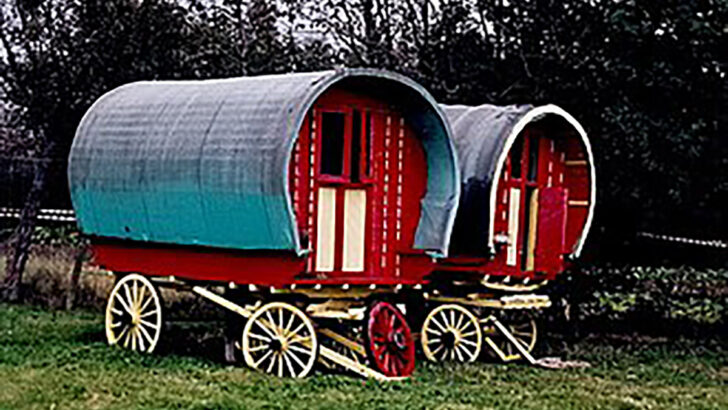 Traveller Wagons. Photo: Wikimedia Commons / Joseph Mischyshyn.
 There’s to be a new strategy to protect and preserve the cultural heritage of the Travelling community, announced as part of National Heritage Week, just coming to a close.
It’s made me reflect on historic attitudes to Travellers, which many of us may have inherited. I grew up with several mixed attitudes to Travellers, who’d been called Tinkers, and then Itinerants.
One attitude was negative: resentment by a property-based society for a nomadic people who might not have the same respect for private property. Hostility to Gypsies, now called Roma, was similar throughout Europe.
Romantic
But another attitude was romantic. I devoured the stories of Patricia Lynch, in which the “Tinkers” were exotic, creative and free: they had proper skills, like tinsmithing and repairing things.
The popular Dubliners’ song starting “I’m a freeborn man/Of the Travelling people” invoked the lyricism of the rover’s “country roads and bye-ways”, the natural life “when time was not your master”.
But there was also an unspoken, and sometimes a spoken, fear of Travellers, possibly arising from their apparent disconnection with settled property. Few Travellers would win a Tidy Towns award for their halting sites’ order.
I heard it said they were more unruly, especially with drink taken, than other Irish people. I saw pub notices – ‘No Travellers’”
Then again there was ambiguity. There was also pity for the Travelling people, because of their living conditions: their large families by the side of the road, in winter as in summer, and their lower life-expectancy. We were encouraged to give charity to Travellers if they called.
But I heard it said they were more unruly, especially with drink taken, than other Irish people. I saw pub notices – “No Travellers.”
Rituals
Travellers were often religious, placing great emphasis on rituals like First Communion, and the Church supported the Travelling community. John Charles McQuaid was critiqued by many, but he privately helped Travellers quite generously, and had a compassion for them.
It was sometimes said that the Travellers were the descendants of Famine victims, made destitute by that catastrophe. Perhaps a settled middle class carried some feelings of survivors’ guilt.
Owen Ward, a Galway Traveller spokesman, is keen to encourage pride in heritage among younger Travellers – understanding how they were an essential part of Irish history and tradition, especially in music. That’s so true, and surely every aspect of the Traveller experience should be an explored part of that heritage.
===
On dress codes
When prompted to criticism, I try to remind myself of Pope Francis’s words “who am I to judge?”
During the recent hot spells, I couldn’t help noticing that some ladies in the pews at Mass were wearing decidedly skimpy tops, along with equally brief shorts. (Men seem to cover up more.)
“Who am I to judge?” I tell myself. I wore plenty of mini-skirts and décolleté frocks, in my day. Just not to a church service.
Yet it probably doesn’t occur to the ladies in question that beach apparel and plunging necklines may not be viewed by everyone as suitable. We live in an age when people wear whatever feels comfortable. And anyway, it’s what’s in your heart and soul that matters, not outward appearance.
And yet, dress codes are still a thing elsewhere. Invitations to social occasions often stipulate a dress code, such as ‘smart casual’, or even ‘formal’. French cathedrals and churches often post notices to visitors about appropriate clothing.
But do we have an agreed dress code for attending Mass? If so, it’s never spelled out.
===
That terrible Kildare motorway collision has been blamed, in part, on social media – as some teenagers post reckless acts on these platforms.
But teenage lads have always done crazy dangerous things, alas. Back in the 1940s, my brother badly crashed a car he’d “borrowed” for speeding madness. This tragedy is heartbreaking, but it’s not just due to social media.
===
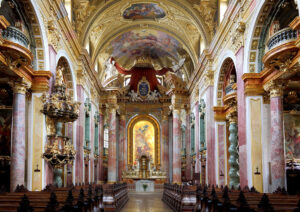
There’s a beautiful baroque Jesuit Church in Vienna (constructed by the architect Andrea Pozzo SJ in 1631). It was recently the location of a royal wedding, attended by the cream of Europe’s Catholic aristocracy.
The matrimonial union was between Archduchess Isabella of Hapsbourg-Lorraine, and Carlós de Palacio y Gaytán de Ayala. The bride’s mother is Maria Paloma de Bourbon-Two Sicilies and her father Archduke Simeon of Austria, grandson of the last Austrian emperor.
Guests included the Belgian monarchs Philippe and Mathilde, with two of their children, Elisabeth and Gabriel, archdukes, archduchesses and princes of the royal families of Luxembourg, Lichtenstein, Austria, Spain, France, Bulgaria and Portugal.
The Duke of Porto, Dinis of Braganza, heir to the defunct Portuguese throne, graced the occasion with his fiancée, Anna Schaffgotsch von und zu Kynast und Greiffenstein.
The bride, 25, wore a gown in ivory satin and lace and a tiara made by the jewellers to the Empress Sissi. The Jesuit Church, known for its rose-marble pillars, abounded in flowers.
Some people like to watch Downton Abbey for posh escapism; I am entertained by old European dynasties, whose names evoke the pages of history.