

 Martina Purdy
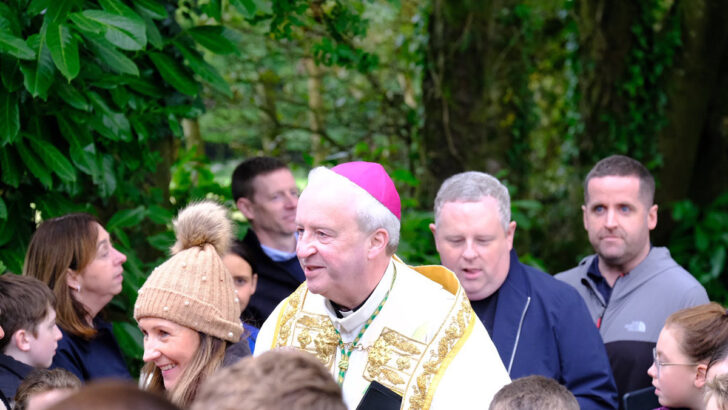 Bishop Router pictured at a Season of Creation event in Dromintee Parish, a file photo from October 2025. Photo: Archdiocese of Armagh.
 In March 18, Bishop Michael Router was in Rome, where he met the Pope as part of his work around healthcare and ethics. He described the Pontiff as a serene presence. “Pope Leo was very calm, very quiet, a good listener,” said Bishop Router, “Someone that you would take seriously, a very strong character.”
It was announced four months later that the auxiliary Bishop of Armagh, had accepted Pope Leo’s invitation, issued on July 1, to go to Derry – a diocese with a quarter of a million Catholics, stretching north-south from Malin Head to Omagh and, east-west from Killygordon to Bellaghy.
Over lunch, after he had addressed a group of prisoners taking a ‘Life in the Spirit Seminar’ at Maghaberry Prison, I asked him about his new role as Bishop of Derry, covering fifty parishes. “Fifty-one!” he interjected, calling it both an honour and a daunting task.
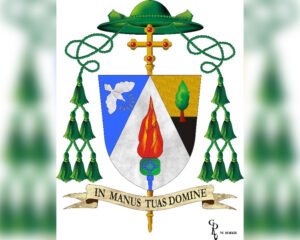
A clue to the Bishop’s spirituality can be found in his Episcopal Coat of Arms; the central symbol is a torch representing the flame of faith – passed from St Patrick, assisted by St Benan, who founded a church in Bailieborough, Co. Cavan where Bishop Router served as a priest for five years.
Will Bishop Router invite the ordination of men to the permanent diaconate, something his predecessor has resisted?”
On September 20, he will be installed as Bishop of Derry at St Eugene’s Cathedral, the seat of one of Ireland’s oldest dioceses.
His in-tray is packed with issues, including the future of the diocese itself, as the Holy See is set on a plan of rationalisation in Ireland.
Will Derry be merged with Raphoe? And if so when and how soon? Will Bishop Router invite the ordination of men to the permanent diaconate, something his predecessor has resisted?
He wouldn’t be drawn just yet on the ordination of deacons – but noted that Ossory and Ferns were recently placed under a single bishop, while retaining their identity and independence. “A good model,” he said. “But it’s difficult on the bishop. Everything is doubled up. It’s difficult on everybody, priests and laity, as these dioceses have been part of their lives for a long time.”
The future of Derry Diocese is a matter that will take some time to resolve.
Then there’s the whole issue of renewal, something Bishop Router is tasked with as a member of the National Synodal Team. Its first major assembly will be in Meath on October 17.
Critics and cynics suggest the Synod is just a ‘talking shop” with an agenda to change Catholic beliefs – a description the bishop firmly rejects, insisting it is “a great opportunity”.
“It’s about building relationships,” he said, “particularly reaching out to those who have moved away from us. It’s a missionary task, an evangelical task.”
“People won’t come to church nowadays unless they really feel that it benefits them so we’re preaching to the converted most of the time. To me, synodality is a way to reach out to those who have walked away from us.”
Synodality
When introduced correctly, synodality, he said, creates unity, not division. “It actually brings people together, gets them sitting down, talking about the issues of faith. Now, they may say things that we don’t agree with, but I think, actually, they learn a lot from that. Because they’ve talked that out, very often, people say, ‘I can begin to understand why the church teaches what it does’.”
Bishop Router acknowledges that priests – “caught up in the daily grind of life” – are among the critics. “A lot of them are looking after two, maybe even three parishes, doing the work that two or three people did in the past. So, I suppose, like a lot of things, synodality can be seen as just another thing, another addition to their work. There’s a feeling that ‘it’s just another talk shop’.”
How did Jesus spread the message? He sat down with people. He sat down with the sinners at the dinner table, and talked to them”
He said priests are already “living synodality” through their pastoral councils and co-responsibility with the laity.
He said synodality is not a new concept.
“How did Jesus spread the message? He sat down with people. He sat down with the sinners at the dinner table, and talked to them.”
“It’s been part of the church, right since the very beginning. It›s not something new. It›s a way of learning our faith, that’s not very bookish, that doesn’t talk too much about rules and regulations, that brings people into a relationship with each other, in community which is so important. We›ve lost that importance of community in the modern world.”
“It’s bringing people together, to discuss these issues, to talk about, to be fed – to be fed the teaching, the doctrine of the church.”
Some people, he said, are approaching the Synod with the “wrong expectation” – coming from both the “liberal” and “conservative” media.
“Getting the balance right between the two is very important,” he said.
According to the Bishop, the challenge is reaching out to everyone. “We are all trying to work together, to talk together, because there are so many views and opinions and diversity. We have to find unity in diversity because we are all on the one mission. And mission is the most important element of it all.”
“How do we become missionaries? How do we evangelise in the twenty-first century, facing all the challenges that we do? We’re not going to do that by just allowing everything to happen, and just say, ‘Oh, everything’s okay, it’s what you think yourself’. Or going back to the sixteenth century, and trying to reenact that. We have to find the middle way.”
The Bishop has five nephews and nieces and has just baptised his first grand-nephew Naoise. He is encouraged by studies which show that the younger generation is interested in faith.
Fight
Though deeply disappointed about abortion law in Ireland, he is not giving up the fight. However, he estimates that it will take “years” before there is a change in legislation. “It is going to be a difficult battle to reverse but we shouldn’t be disheartened. We must keep on fighting the good fight, and never let go of that belief that we hold dear, the principle that life is sacred from conception to natural life. Without that, there is no true peace in life. We will never have personal peace or communal peace until we accept that.
It is worth fighting for.”
As Chair of the Family Addiction Support Network, he is also focused on supporting families in the battle against drugs. “That’s a huge, huge issue,” he said. “Families are suffering big time. And oftentimes, in fear, fear of what’s going to happen, to their loved one, who is an addict.”
But, in a milieu that engenders “hopelessness and despair”, he believes the Christian message still stands out, loud and strong. “It really gives people hope, and that is the most important gift – having hope for the future.”
===
Stuck in Belfast traffic the other day, I couldn’t miss the ad in front of me. “We’re worth following…” was painted on the back of a van belonging to a local family-owned business. I thought of Jesus – and wondered if Catholics weren’t missing a trick when it comes to advertising. What if we all had signs, or bumper stickers on our cars promoting the Gospel or the pro-life message? Perhaps it is a mad-summer idea, but I can still quote bumper stickers spotted years ago in America, particularly this one: “Honk if you love Jesus! Drive with your mobile phone if you want to meet him right away…”
===
At our parish baptism course the other day, I realised just how high-tech baby prams had become. Of course I had noticed fathers walking around with push-chairs and looking at their mobile phones at the same time. But then one mother expressed delight that her new pram, not only had a USB port for charging mobile phones but its own lights for safety on evening walks. It gives a whole new meaning to ‘the light of the world’!