

 Fr Barry White
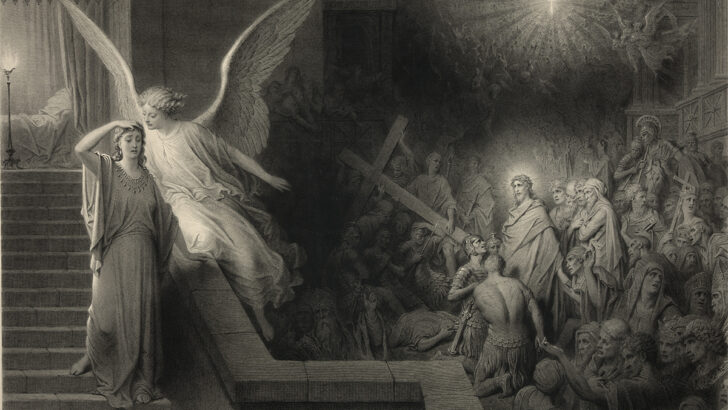 The Dream of Pilate’s Wife, an engraving by Alphonse François after Gustave Doré. Photo: Wikimedia Commons/Public Domain.
 During the Palm Sunday Passion this year, one seemingly incidental detail caught my attention. As Jesus stands before Pontius Pilate, Matthew inserts an unexpected interruption: “Now as he was seated in the chair of judgement, his wife sent him a message: ‘Have nothing to do with that innocent man. I have been greatly troubled today by a dream about him’” (Matthew 27:19). Pilate’s wife appears only briefly. Unnamed, she sends her husband a warning received in a dream.
Dreams occupy a unique place in Matthew’s Gospel. Joseph is guided through dreams, the Magi are warned not to return to Herod, and now Matthew records one final dream during Jesus’ trial, this time given to a Gentile woman at the heart of Roman power. Throughout Scripture, God often acts when human beings are no longer in control. Adam sleeps as Eve is fashioned; Jacob dreams of a ladder joining heaven and earth; Joseph and Daniel receive dreams revealing God’s purposes.
Faith
This Gospel episode inspired a 19th century poem: ‘Pilate’s Wife’s Dream’ by Charlotte Brontë (1816-1855). Brontë imagines the unnamed Roman woman waking after a vision: “I am wrapt in utter gloom”. Looking from Pilate’s palace, she sees torches flickering through Jerusalem and hears preparations for execution. Something dreadful is unfolding. Her husband, she knows, is consumed by “a triple lust of gold, and blood, and power”. She begins questioning the religion into which she was born: “Our faith is rotten, all our rites defiled…” Yet she senses that this mysterious prisoner possesses something greater than all the splendour of Rome: “The ray of Deity that rests on him / In my eyes makes Olympian glory dim”. As dawn breaks over Jerusalem, faith begins to dawn within her: “I feel a firmer trust—a higher hope / Rise in my soul—it dawns with dawning day”. Brontë transforms Matthew’s single sentence into the spiritual awakening of a woman whose heart is gradually opened to Christ.
Pilate’s wife is remarkable not only because she dreams, but because she is a woman and a Gentile. Matthew’s Gospel repeatedly highlights unexpected outsiders: Tamar, Rahab, Ruth and Bathsheba in Jesus’ genealogy; the Magi; the Canaanite woman; and finally, Pilate’s wife, who recognises Jesus’ innocence while leaders condemn him. Matthew dismantles attempts to restrict salvation by race, nationality, gender or status.
Pilate’s wife’s dream was never about herself. It pointed beyond one household, one people and one empire”
Dreams are not only what happen while we sleep. They also express our deepest hopes. Pope Francis often spoke of God’s dream for humanity. Addressing young people in 2022, he said: “He has a dream for your life, for my life, for the life of each of us”. Later he explained in Fratelli Tutti that this is ultimately God’s dream “of a world in which we can all live as brothers and sisters in full dignity”. Our dreams are often individual. God’s dream is always universal. Pilate’s wife’s dream was never about herself. It pointed beyond one household, one people and one empire. Its horizon was the salvation of the world.
That vision also illuminates the difference between patriotism and nationalism. Pope John Paul II, in Memory and Identity, distinguishes patriotism from nationalism. Patriotism is a virtuous love of one’s homeland, rooted in gratitude for its history, culture and people. Nationalism becomes dangerous when it excludes others, denying the equal dignity and rights of migrants and other nations. We witness this increasingly in our own country and amid growing global conflict.
Humanity
This year also marks the centenary of The Plough and the Stars. In the play, Seán O’Casey has the character Covey declare: “Look here, comrade, there’s no such thing as an Irishman, or an Englishman, or a German or a Turk; we’re all only human beings”. Though spoken in a particular context, the line echoes John Paul II: love of one’s country must never come at the expense of our common humanity. The Gospel carries this vision further. Our deepest homeland is neither Rome nor Jerusalem, neither Ireland nor any earthly nation. Through Christ we become children of one Father and heirs to one eternal inheritance.
Pilate ignored his wife’s warning. Yet Matthew preserved her dream, perhaps because it still speaks. In a world divided by nationalism, violence and fear, God continues to call us beyond narrow loyalties into the wider family of humanity, a kingdom that embraces every nation and every people.
Pilate’s wife never became a disciple, so far as the Gospels tell us. But before the Resurrection, before the empty tomb, she had already glimpsed the truth that Easter would reveal to the world: the innocence of the One who would overcome death itself. She appears only briefly in the Gospel, speaks only through a message, and then disappears from history. Yet Matthew remembers her because even a fleeting witness can bear lasting truth. Sometimes faith begins not with certainty or power, but with the courage to recognise light when it appears in the darkness. As dawn broke over Jerusalem, Brontë imagined the Roman woman greeting the morning: “I feel a firmer trust—a higher hope… / Oh, opening skies, I hail, I bless your light!” The darkness gives way to dawn. The Cross gives way to Resurrection. And God’s dream, for one family gathered in Christ, continues to unfold.