

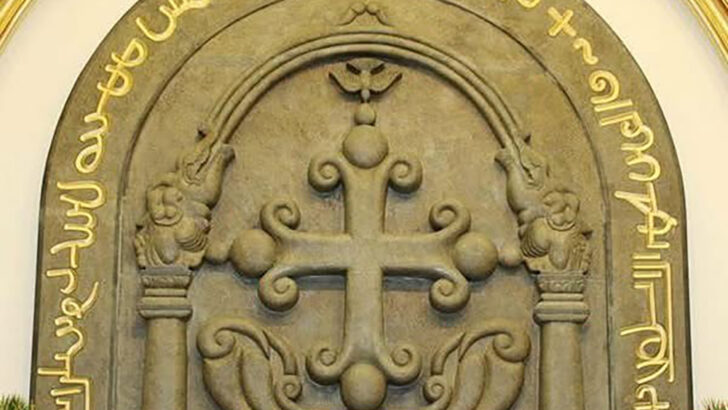
 The St Thomas Cross, or Mar Thoma Sleeva, at St Thomas Syro-Malabar Catholic Church, Doha-Qatar. Photo: Fr Jomon Kakkanattu.
 Jesus, ‘remember’ me when you come into your kingdom (Lk 23:42).
The prayer of the Good Thief on Calvary is one of the most profound expressions of the human longing for remembrance. Facing death, he does not ask for power, privilege, or earthly consolation. He asks to be remembered.
Human existence is inseparable from memory. We understand ourselves through memory, communities are formed through shared memories, and religious traditions are transmitted through acts of remembrance. The East Syriac Christian tradition captures this reality through the term Dukhrana, meaning “remembrance,” “commemoration,” or “memorial.” The annual Dukhrana of St Thomas the Apostle is therefore not merely a recollection of a historical figure but a theological celebration of memory itself – a remembrance that shapes identity, sustains faith, and participates in God’s saving action.
Memory and identity
Memory is constitutive of human identity. Our memories tell us who we are, where we come from, and provide the resources for who we may become.
Modern philosophy emphasised human consciousness as the foundation of existence. René Descartes famously declared, Cogito ergo sum – “I think, therefore I am.” Yet from a theological perspective, one might equally affirm: “I remember, therefore I am.”
To be remembered is to continue participating in a network of relationships and meaning. Human beings are not merely what they remember. We are also what others remember about us. More importantly, we are what God remembers. Human memory is fragile, selective, and subject to forgetfulness, but divine memory is faithful and eternal.
God remembers
The biblical understanding of memory begins not with human remembrance but with God’s remembrance. The Hebrew root zkr “to remember” occupies a central place in Israel’s faith. In Scripture, God’s remembrance is not passive recollection but active intervention. When God ‘remembers,’ He acts. God remembered Noah and brought him safely through the flood (Gen 8:1). God ‘remembered’ His covenant with Abraham, Isaac, and Jacob and liberated Israel from Egyptian bondage (Ex 2:24).
Israel is repeatedly commanded: “Remember that you were slaves in Egypt” (Deut 5:15). Memory becomes the foundation of covenant fidelity.
The first sin in salvation history may itself be understood as an act of forgetfulness. Adam and Eve forgot God’s command and trusted their own judgment. Sin, therefore, is fundamentally a rupture of memory – a forgetting of God and His word. Salvation history begins as God’s response to humanity’s forgetfulness. God’s memory and God’s mercy are inseparable realities. Divine remembrance is the concrete manifestation of divine mercy.
Memory in the Gospels
The New Testament continues and deepens the Old Testament theology of remembrance. The infancy narratives of Luke explicitly connect memory and salvation. Mary proclaims: “He has helped his servant Israel, in ‘remembrance’ of his mercy” (Lk 1:54). Similarly, Zechariah blesses God who acts: “to show mercy to our ancestors and to ‘remember’ his holy covenant” (Lk 1:72).
The culmination of this theology appears on Calvary. The Good Thief’s plea, “Jesus, remember me,” expresses confidence that God’s remembrance transcends death itself. Christ’s response, “Today you will be with me in Paradise” (Lk 23:43), reveals that divine memory is stronger than death. The Christian hope of eternal life rests ultimately not upon the permanence of human memory but upon the faithfulness of God’s memory.
Memory and faith
Faith is fundamentally an act of remembering. In Israel, faith was preserved through the remembrance of God’s mighty deeds. Parents taught their children the story of the Exodus, the covenant, and the promises. Through memory, Israel maintained its identity as God’s chosen people.
The Church continues this pattern. Christianity is an apostolic faith because it remembers. The apostles witnessed Christ, preserved His teaching, and transmitted their testimony to future generations. Apostolic tradition is therefore a sacred memory entrusted to the Church. The Church does not invent the Gospel anew in every generation. Rather, she remembers Christ through Scripture, liturgy, doctrine, and sacramental life.
The Church’s memory
The Church Fathers consistently recognised the theological significance of memory. St Augustine understood memory as one of the deepest dimensions of the human soul and as a privileged place of encounter with God. For Augustine, memory was not simply psychological storage but a mystery revealing humanity’s orientation toward the eternal. The Syriac Fathers similarly emphasised remembrance as participation in salvation history. St Ephrem the Syrian viewed liturgical commemoration as a means of entering into the saving mysteries of Christ.
Pope Benedict XVI repeatedly emphasised that Christianity is fundamentally a religion of remembrance. As Benedict XVI observed: “The Church represents the memory of what it means to be human in the face of a civilisation of forgetfulness. Yet just as an individual without memory has lost his identity, so too a human race without memory would lose its identity.”
Do this in memory of me
The fullest Christian theology of memory is found in the Eucharist. At the Last Supper, Jesus commanded: “Do this in memory of me” (Lk 22:19; 1 Cor 11:24).
The Eucharistic memorial is not merely psychological recollection. In biblical thought, memorial (anamnesis) makes present the saving event being remembered. Through the Eucharist, the Church enters sacramentally into Christ’s death, resurrection, and glorification. The Eucharist therefore stands at the intersection of divine memory and human memory. God remembers His covenant and offers salvation; the Church remembers Christ and participates in that salvation. This Eucharistic remembrance heals the forgetfulness introduced by sin.
The Church exists as the community that remembers God and proclaims His saving deeds.
Dukhrana of St Thomas
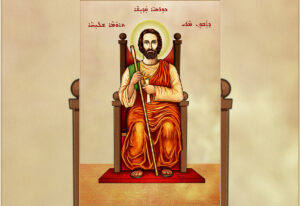
Within this theological framework, the Dukhrana of St Thomas acquires profound significance. The annual celebration of the Dukhrana is not simply an anniversary of the Apostle’s martyrdom. It is an act of ecclesial memory. St Thomas came to India as an apostle of Jesus Christ. Through his preaching, he reminded our ancestors of the living God and introduced them to the saving Gospel. Through his apostolic mission, he established communities of faith that preserved the Catholic and apostolic tradition for generations. When the Church celebrates the Dukhrana of St Thomas, she remembers the apostle who remembered God and who taught others to remember God.
This theology is beautifully expressed in the Syro – Malabar Holy Qurbana during the commemoration hymn:
“Let the people of God proclaim Amen, Amen. Let us celebrate the memory of our father St Thomas, all the just who have triumphed, and the martyrs who have been crowned in glory.”
The Dukhrana reminds us to remember God’s saving deeds, remember the faith handed down by our ancestors, and remember our apostolic identity. St Thomas remains such a reminder. His life, mission, martyrdom, and enduring witness call the faithful to become visible personifications of God’s remembrance in the world.
Remembered by God
The theology of memory reveals a fundamental truth of Christian existence: we live because God remembers us. Human memory shapes identity, but divine memory guarantees destiny.
The Dukhrana of St Thomas stands as a privileged expression of this theology. It celebrates the apostle who brought the memory of God to our ancestors and whose witness continues to shape the identity and mission of the Church today.
In an age often described as a civilisation of forgetfulness, the Dukhrana calls Christians to recover their deepest identity through remembrance – remembering God, remembering His saving deeds, remembering the faith of the apostles, and becoming living reminders of God’s presence in the world. Therefore, with the Good Thief, the Church continually prays: “Jesus, remember me when you come into your kingdom.” For to be remembered by God is the ultimate meaning of human existence and the eternal foundation of Christian hope.