

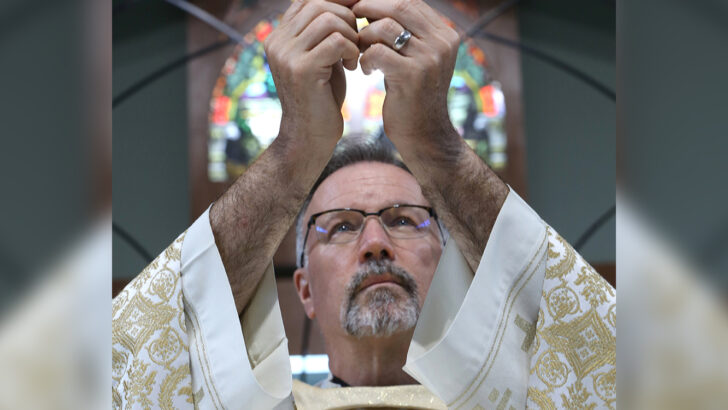
 A priest raises the Eucharist in this illustration. Photo: OSV News photo/CNS file, Bob Roller
 Should I offer the sacraments to a parishioner with a limited lifespan?
A man who lives in one of my parishes was given six months to live last February. He is an ordinary simple man, who likes nothing more than farming his land. In fact, the thought of dying would not be as hard for him as the thought of not having the energy to farm.

Naturally, our small rural parish has him all but buried. I had heard so many wild stories around the place, that when I visited him, I half expected he would be in bed on a morphine drip. In fact, he was in the sitting room watching television, snacking on tea and biscuits.
His siblings were anxious I should visit him in an official capacity, with oils and Communion and prayers. My problem was that he himself showed no inclination to ask me for this and I don’t entrap people into the sacraments when they are not ready to receive them.
Another Saturday I got an inspiration to call round and bring Holy Communion after the Vigil Mass. It was one of those evenings when the parish team was playing, an event he would normally be attending. All the way from the church to his house, doubts assailed me: he would be gone to the match, the house would be deserted, it would be a waste of a trip (the Evil One can be very clever in putting pastors off the scent!)
In fact, it was anything but. The man was having an ‘off’ day, so had not gone to the match. He felt a need for sacraments and welcomed my pastoral visit. What’s more, because the parish team was playing, the usual set of visitors who filled the house were all absent; just the man and his wife were there to pray with me. So, I assured them both that this was no ‘extreme unction’ but a healing sacrament; I gave them both Communion also, food for the journey on the road of life and beyond.
Next time I called, he was missing: back out, farming the land once more. Maybe the sacrament ‘worked’, after all!
***
Sea Sunday was a great celebration in our maritime parish
The best Sunday we had in our seaside parish on the west coast this summer was based around liturgies for ‘Sea Sunday’. I am sure this festival has a set date, but we usually pick one that suits us (and our Church of Ireland counterparts, who participate in the blessing of boats afterwards). Lucky for us in 2025, it was one of those lovely fine days, when all seemed right with the world, and storms stayed far away.
In one of our churches, a creative liturgist designed a beautiful procession of mementoes to start things off. A fine script was produced and read in a calm measured way from the altar. Bearers of mementoes made their way slowly from the main door forward. And what they brought spoke of everything the sea means to our harbourside community; fisheries and livelihood, leisure and swimming, RNLI and emergency responders and all the many ways each contributes to community life. It was a liturgical treat, with suitable music following, notably the Lifeboat Song and finally, always, ‘Hail Queen of Heaven’ — the ocean star….
***
Celebrating a Requiem Mass for ashes is tricky
A funeral director in a nearby town phoned in mid-July, to arrange a burial of ashes at the end of August. I’ve often conducted these kinds of services, usually for people whose full Catholic funerals have taken place in the UK. This time it was different: the gentleman in question had had no religious services in England, but his family wanted ‘the works’ in our rural Irish parish, the place where his great grandparents were buried.
Two things were strange about this funeral. First, there was the lack of a link between this family and the local place: they were so long gone that the memory of this family had faded. The great grandparents’ grave was known and marked, but the headstone showed these people’s passing had been over 100 years ago. Secondly it was strange to conduct full funeral rites centred on so small a link with a person — the timber box containing the ashes more closely resembles a baby’s coffin than a grown-up’s. It was hard to get used to it, visually; moreover, the words of the service had to be adapted to the different reality. Our final commendation service at the end of Mass seems so centred on the body of the person (incensed, blessed etc) that it seemed more appropriate to leave that out and instead to process the remains to the door and the waiting cars there.
It’s remarkable that the Order of Christian funerals for Ireland, with all its confusing choices, and all the turning of pages and placing of ribbons involved in deploying it, contains so little for dealing with cremated remains: time for a new edition, I presume.
***
We got to know our heritage in August
Celebrating Heritage Week in August is a good choice for Ireland. August now has much to recommend it for the stay-at-home holidaymaker (or the stay-at-home pastor).
History talks and walks multiplied, and there were numerous opportunities to get to know the area where I minister in an in-depth manner. Those opportunities are not to be sneezed at: understanding the past often gives clues to the present. Past pains are the backdrop to present sorrows. Today’s extreme anger about the treatment of Palestinians finds an echo in the way the people of our parishes suffered at the hand of British colonists, just as our famine helps us feel the pain of Gazans. Turning that anger and pain into something positive is the pastor’s duty, his constant challenge.
***
A rare treat: a visiting funeral presider
The bereaved daughter had a ‘massive’ favour to ask of me. Could Fr N, a family friend, do her mother’s funeral? Of course he could! It is such a rare joy now to have a visiting presider to lead a funeral Mass. Time was when practically every second family seemed to have a Franciscan or a Capuchin on hand for family funerals – but those days are no more. Fr N was more than welcome to do the needful. I turned up of course, as I was expected to, was sympathetic and helpful to Fr N, but had to speak none of the words and particularly had to leave him the joy of crafting a suitable funeral homily, which indeed he did. And at the end of all, the funeral director kindly handed me a white envelope, containing exactly the same amount as if I had done all the work. Rarely am I paid so well for doing so little. No complaining though…..
One down
A few years ago the parishes who work together around here had four full time ministers, now we have three. Everyone looks with some pity (and much Schadenfreude) on the parish which lost its priest, not realising that all will lose in his going. No man is an island, nor is any parish either.