

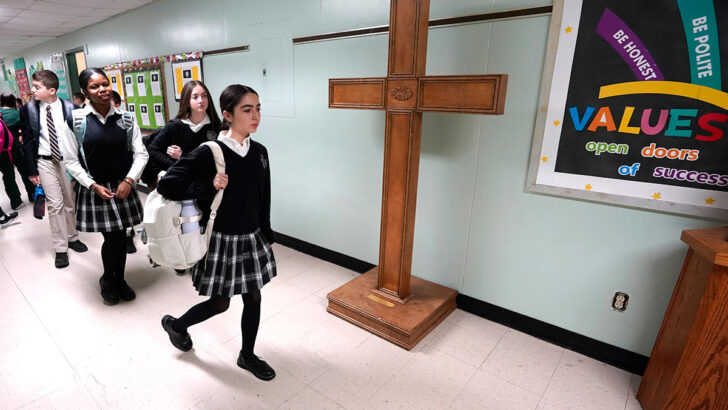
 Students walk near a cross as they change classes at St Patrick School in Smithtown, NY, US. Photo: OSV News /
Gregory A. Shemitz.
Students walk near a cross as they change classes at St Patrick School in Smithtown, NY, US. Photo: OSV News /
Gregory A. Shemitz. ‘In a world that is often disturbing, damaging and dehumanising we cannot fail young people’
Speaking to The Irish Catholic, Irish theologian Fr Eamonn Conway said that “The present moment in history is disturbing, damaging and dehumanising in many respects—but for that very reason the need and opportunity for a genuinely Catholic education have never been greater.”

And he added: “While aware of past failures and humbled by them, we cannot risk failing young people today who are searching for meaning and purpose in their lives. That should give us the motivation and courage to make the tough decisions that need to be taken to reposition Catholic education in Ireland for future generations.”
Fr Conway was speaking in the aftermath of a Conference held in Marino College in Dublin for education leaders to mark the third anniversary of the Grace Report. The Conference was sponsored by All Hallows Trust.
Speaking at the conference, Fr Eamonn Conway challenged Catholic education delegates to confront what he called the “red lines” question facing denominational education, insisting that “there is a role for a state education system, it’s just not our role to provide it”.
Fr Conway told the gathering that the question of formation in Catholic education had to be expanded to ask “what kind and degree of support for those involved in Catholic education will most strengthen our schools”, arguing that the task facing the Irish Church was “not managing decline, but repositioning itself, with courage and creativity, for service to a wider and more diverse humanity”.
Fr Conway reserved some of his sharpest criticism for the new primary curriculum, recounting the experience of a former student, eight years a primary teacher, who asked him: “How could you infer from these pages that this is a Catholic school?”
He noted that the curriculum’s only reference to spiritual wellbeing states that it “enables children to experience a sense of awe and know that life has a meaning” — a framing Fr Conway said operates “within an entirely immanent frame”, incompatible with the Christian understanding not just of God but of what it is to be human.
There is no neutral approach to education, he insisted: “There is always formation going on” — including hidden or “shadow” formation through iconography, school spaces and curriculum messaging.
Drawing on the GRACE research and the INTO’s 2025 report on religion in primary schools, Fr Conway pointed to a widening gap between teachers who respect a school’s Catholic ethos — a willingness to work positively within it — and those who witness to it, meaning a personal, embodied identification with the Catholic vision, with younger teachers seemingly more reluctant to do either.
The GRACE data shows that at primary level 77% of teachers said they respected the Catholic ethos of their school to a large extent, but only 62% said they witnessed to it to the same degree. At second level the figures were 68% and 57% respectively, with a marked age gradient: among secondary staff aged 18–29, 28% said they did not witness to the Catholic ethos at all or did so only to a limited extent.
The INTO findings, Fr Conway said, made the point “still more starkly”. Just 4% of teachers surveyed believed preparation for the sacraments should be the responsibility of primary schools, while 57% held that faith formation should not take place at all during school hours. Among respondents under 24, not a single teacher supported faith formation in schools.
This, he argued, points not simply to a softening of confidence in personal witness but to “a deeper erosion in willingness to see schools as contexts for faith formation in any robust sense”.
He also highlighted GRACE findings on diocesan oversight, with 20% of principals reporting that a diocesan adviser had not visited their school in the past three years, and a quarter of primary teachers saying they had no idea what the role involved or had never heard of it.
Concluding, Fr Conway urged Catholic educators against complacency but also against losing nerve. Those taking a stand were “going to be unpopular”, he said, but should “be so for the right reasons”.
He cautioned that while some 60% support the ‘status quo’, the real question was how many would genuinely support intentional Catholic education — suggesting that at present that’s probably only about 20%, the other 20% wanting faith out of schools altogether.