

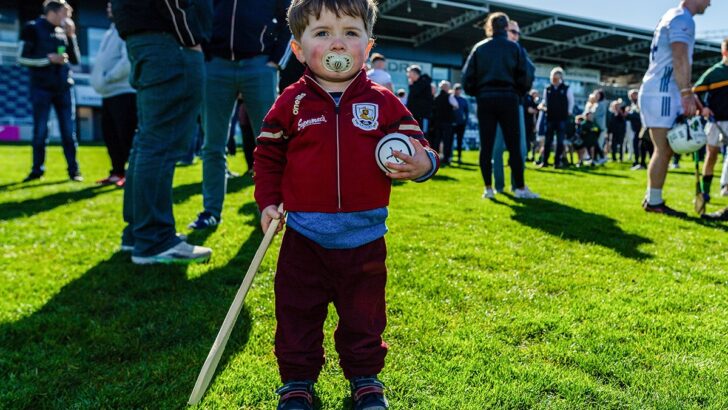
 Galway supporter Joseph Gormally, aged two, who attended his first Galway match, pictured after the Leinster GAA Senior Hurling Championship round 3 match between Kildare and Galway at Cedral St Conleth’s Park in Newbridge, Kildare on May 9, 2026. Photo: Tom Beary / Sportsfile.
 Since the introduction of the Munster round-robin championship in 2018, Waterford have failed to emerge from the province even once. Their only appearance beyond Munster came in the unique circumstances of the 2020 straight knockout Covid championship, when they reached an All-Ireland final behind closed doors.

Once again, the Déise’s summer is effectively over before mid-May. Defeat to Cork all but confirmed another early provincial exit, while star forward Stephen Bennett suffered yet another cruel injury setback, battling through a hamstring problem before jarring his knee in Waterford’s do-or-die clash at Walsh Park.
In many ways, Bennett’s situation feels symbolic of Waterford hurling itself: worn down by the relentless nature of a structure that leaves little room for recovery once momentum is lost.
That, increasingly, is the contradiction at the centre of modern hurling. Munster is unquestionably the sport’s greatest spectacle. The intensity, jeopardy and quality are unmatched anywhere else in the game. Every county is capable of beating another on a given day, and every weekend feels season-defining. Yet the very structure that creates such drama may also be exposing wider problems within hurling itself.
Unparalleled
The Munster championship is simply unparalleled when it comes to finances. Crowds sell out weeks in advance, while the province’s historic rivalries are fuelled further by repeated face-offs in championship deciders. In 2025, the eleven-game championship series generated an astounding €8.4 million in gate receipts alone, accounting for 88% of the Munster Council’s revenue that year.
That money filters down in the form of county funding, infrastructure grants and club investment, but beyond hurling’s crown jewel, all is far from healthy.
Outside Munster, however, the imbalance has become increasingly stark. Leinster feels split between contenders and participants. Galway, Kilkenny and Dublin operate at one level, while the remaining counties struggle to bridge the gap. Donal Óg Cusack once described it as “the best of the rest of Ireland championship”, and at times the phrase feels difficult to dispute.
Galway have already underlined their credentials under Micheál Donoghue, dismantling Kilkenny twice this year, while Dublin’s resurgence has added another layer of competitiveness at the top end. Beyond that, however, the province lacks the week-on-week drama and attrition that defines Munster.
More concerning is the trajectory of some of hurling’s traditional counties. Antrim’s recent collapse has been painful to watch, with the Saffrons fighting merely to stave off successive relegations. Offaly, who not long ago found themselves in similar trouble, have shown signs of revival through an outstanding under-20 generation now beginning to feed into the senior setup.
The idea that Kilkenny might fail to emerge from Leinster would once have seemed unthinkable. It no longer does”
Wexford, appear stuck in decline. For much of the past decade, Lee Chin has carried the county through sheer force of personality and ability, but the core of the current side still stems from the successful under-21 teams of the mid-2010s. There are legitimate concerns about what follows when that generation fades, many of whom are already entering the twilight of their careers.
Even Kilkenny, hurling’s great standard-bearer, suddenly look vulnerable. Eleven years have now passed since their last All-Ireland title, an extraordinary statistic for a county that once measured success almost exclusively in Liam McCarthy Cups. The idea that Kilkenny might fail to emerge from Leinster would once have seemed unthinkable. It no longer does.
While, in terms of sheer excitement and fanfare, the current format creates an incredible spectacle, and its revenue generation is unmatched, the wider concern is whether the structure truly allows hurling to grow outside its strongest regions.
By July, the inter-county game has largely disappeared from public view, and, after the first weekend of June, there will be only five games remaining in the championship. Outside of club campaigns, hurling effectively surrenders the second half of the sporting year to soccer, rugby and other competing sports during the months when visibility matters most.
When there are no major matches to watch, no inter-county stars regularly on television and no sustained national conversation around the sport, attracting the next generation inevitably becomes more difficult. Waterford perhaps illustrate that danger most clearly. With their senior inter-county season over almost before summer has begun, attention in the city will increasingly drift elsewhere.
Drifting
Waterford hurling, in particular, appears to be drifting towards a dangerous cycle of decline. Without meaningful change, there is a genuine danger the county could follow the trajectory of some of their struggling neighbours to the east and across the Suir.
Yes, every county ultimately has a responsibility to get its own house in order, but the current calendar has effectively ceded much of the sporting year to rival codes, allowing other sports to dominate the public conversation long after the inter-county hurling season has disappeared from view.
Ironically, Waterford FC, rooted to the bottom of the League of Ireland Premier Division and still without a league win, may now command more of the city’s sporting attention for the remainder of the year simply because they remain visible, active and part of the sporting conversation long after the county hurlers have disappeared from it.
While sustained excellence deserves admiration, such overwhelming control also raises uncomfortable questions about competitiveness”
Ballygunner’s dominance of the local club scene only reinforces the sense of imbalance. The club are chasing a thirteenth consecutive county title and, for the first time, will field two teams in the senior championship, having already won eight of the last nine minor titles. While sustained excellence deserves admiration, such overwhelming control also raises uncomfortable questions about competitiveness and the overall health of the game locally.
Munster remains hurling’s great theatre, and likely will for some time, with ten of the last twelve All-Ireland finalists hailing from the southern province. But beyond the noise, colour and intensity, there are growing questions about what the modern championship structure is leaving behind.
Visibility
That issue of visibility extends beyond the structure itself and into how the game is now consumed, particularly through the renewed controversy surrounding GAA+. With marquee games once again placed behind paywalls, the organisation has been accused by critics of prioritising finances over the wider good of the sport.
The arguments against the streaming service are familiar by now: the paywalling of big championship encounters; reduced accessibility for supporters, particularly older audiences; and growing concerns over the commercialisation of what remains, at its core, an amateur and community-based organisation.
What has changed now, however, is that the GAA and RTÉ are no longer simply partners in broadcasting the games; they are effectively competitors”
As of 2026, the GAA has taken full ownership of the platform, transforming it from a joint venture with RTÉ under its previous name, GAA GO, into a fully GAA-controlled service built around the exclusive broadcasting of 40 championship games.
The decision to place inter-county games behind a paywall has long been one of the GAA’s most divisive issues, with controversy arising almost every championship summer over major matches being unavailable on free-to-air television. What has changed now, however, is that the GAA and RTÉ are no longer simply partners in broadcasting the games; they are effectively competitors.
It has even reached government level, with former Minister of State for Sport Jack Chambers acknowledging that placing games behind paywalls is directly damaging the visibility and popularity of hurling and Gaelic football across the country.
At a time when counties are facing greater challenges than ever in attracting attention and recruiting the next generation at grassroots level, any reduction in the visibility of championship matches feels like a significant own goal, regardless of the short-term financial benefits involved.
The Déise, in particular, have felt the effects of that this season, with three of their four round-robin fixtures streamed exclusively on the platform. For a county already struggling more than any of its provincial rivals, it feels counterproductive that access to those games is restricted behind a paid subscription service.

Difficult
Realistically, without sustained on-field success and regular free-to-air exposure, attracting passing supporters or inspiring younger audiences becomes increasingly difficult. Those on the fringes of the sport simply drift elsewhere.
Even the restricted 12,000 capacity of Walsh Park, making it one of the smallest county grounds in the country, is guaranteed to sell out for major championship occasions. That leaves casual supporters, young viewers and potential new followers unable to attend in person, making national free-to-air coverage arguably more important than ever for counties outside of the top table like Waterford.
However, for all the concern surrounding hurling’s future, there are also counties beginning to move sharply in the opposite direction. If Waterford, and to a more severe extent, Wexford and Antrim, highlight the dangers of stagnation, then Offaly and Kildare increasingly represent what can still be achieved through long-term strategic planning, investment and visibility at the highest level.
Offaly’s resurgence should be viewed as something of a blueprint for developing and struggling counties across the country. Not long ago, the Faithful County had fallen as far as the Christy Ring Cup, an extraordinary collapse for a county with four All-Ireland titles and such a rich hurling tradition.
Yet through sustained underage investment, improved coaching structures and a conscious effort to modernise their approach to the game, Offaly have slowly rebuilt themselves from the ground up.
Draws against both Kilkenny and Dublin this season, counties that reached last year’s All-Ireland semi-finals, were not symbolic moral victories but tangible evidence of progress”
The county’s breakthrough All-Ireland under-20 triumph in 2024 looks less like a once-off success and more like the foundation of a genuine revival. Promotion from the Joe McDonagh Cup followed a week later, and back amongst the top table, Offaly are beginning to show they belong there.
Draws against both Kilkenny and Dublin this season, counties that reached last year’s All-Ireland semi-finals, were not symbolic moral victories but tangible evidence of progress. And yet the challenge of survival remains enormous.
Despite those performances, Offaly are still widely viewed as relegation candidates, illustrating just how difficult the leap from participant to genuine contender has become within the modern championship structure.
Kildare’s rise has perhaps been even more remarkable. Traditionally viewed as one of Leinster’s strongest football counties, hurling existed largely on the margins within the Lilywhite County for decades. Under Brian Dowling, however, Kildare have climbed rapidly through the divisions, securing successive championship promotions and consolidating their Allianz Hurling League Division 1 status for the first time since the early 1980s.

Progress
That progress has not happened by accident. Years of investment into underage development, coaching standards and integrating hurling into traditionally football-dominated clubs have slowly begun to reshape perceptions within the county. Swelling populations as Dublin’s commuter belt sprawls ever outward has also helped.
Their recent clash with Galway in Newbridge underlined just how important exposure at an elite level can be. Kildare, made up of largely the same core who defeated Derry two years ago to secure their fifth Christy Ring Cup, stunned Galway in the opening half, building a commanding ten-point lead before the Tribesmen eventually stormed back after the interval.
Munster’s intensity has elevated hurling to extraordinary levels at the top, both in terms of skill and spectacle”
While Galway’s greater experience ultimately told, the significance of the occasion extended well beyond the result itself. For counties like Kildare and Offaly, competing regularly on major championship stages is not simply about immediate success. It is about visibility, momentum and convincing younger generations that the national game is indeed the sport that they want to play.
Even further down the hurling pyramid, there are examples of counties doing tremendous work individually to grow the game well beyond its traditional strongholds in the south. Derry and Donegal have both made significant strides in recent years, while Down are now emerging as a serious force at the second-tier level.
Further down, counties such as Louth and Fermanagh have progressed enormously through the efforts of dedicated coaches, volunteers and hurling people determined to expand the game in areas where it continues to struggle for relevance.