 Peter Costello
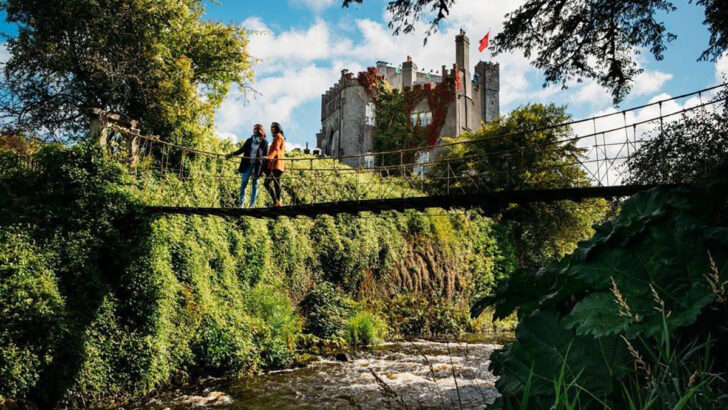 Judith Hill’s Gothic explores castle-building in post-Union Ireland and the architectural imagination of a changing Irish society.
 Gothic: Building Castles in post-Union Ireland,
by Judith Hill
(Four Courts Press, € 50.00 / £45.00)
Castles have an immediate appeal to many people, myself among them. I can still recall as a special moment of my childhood my first visit with my family to Charleville Castle near Tullamore in a now long distant summer.
The empty castle was everything I would have hoped for as a ghost-ridden pile. Yet to the right of the main door there stood a large beech tree which the gamekeeper was using as a “rooks gallows”, hung with the carcasses of the pillagers of the game birds he was rearing.
I shivered at them then, and still do in memory, for they are evocative of the wider dimension of the gothic strain in the whole realm of the imagination which we call romanticism, including as it does such disparate things as Horace Walpole’s The Castle of Otranto (1764), the first Gothic novel, The Rime of the Ancient Mariner (1797), and Sheridan Le Fanu’s Uncle Silas (1864), written in an almost deserted house on Merrion Square.
And, of course, that passage in the history of architectural taste, derived in devious ways from the Catholic middle ages, but transformed in so many ways during its passage through the dark woods of the human mind over the centuries, riddled with fear and terror of the ways of the world. Coleridge’s Mariner it will be recalled, in the true medieval spirit, purged at last by God’s forgiveness of his sins against man and nature, “ A sadder and a wiser man, / He rose the morrow morn.”
Gothic
Gothic in this larger sense is a very serious affair. This book by English-born established architectural historian and biographer Judith Hill, now of Limerick city, explores some Irish aspects of it, filled indeed with aspects of fear and terror in many ways, but also sadness and wisdom.
First off it must be said that this is a magnificent and well informed and informing book. Through supporting grants from the Apollo Foundation, Offaly History, the Irish Georgian Society, Offaly County Council, and Ceangal – a Heritage Council programme, the author and publisher have been able to create a finely planned book in full colour that does real justice to the well-researched images and scholarly text. The support now provided by local authorities to such heritage projects is a very welcome development of recent years.
Francis Johnson is one of the most influential and creative architects to have worked in 19th century Ireland”
The book falls into three sections, the first dealing with Gothic taste in general, the second with the perception of the vogue by patrons and architects, Francis Johnson in particular, the third part dealing with focused studies of the creation Charleville Castle (1800-12) and Birr Castle (1801-1806), both in Offaly.
Francis Johnson is one of the most influential and creative architects to have worked in 19th century Ireland. He was the initiator of the use of the gothic style by the Church of Ireland for parish churches during a great building spree in the first decades, which was followed by an even greater post-Famine building boom by the Catholic church across Ireland that have left us with many of the churches of today that are demoted or barely functioning. Think of Christ Church Leeson Park and St Andrew’s in Westland Row. One modelled on the pagan Roman temples of old, the other on the medieval cathedrals of Northern Europe.
Treatment
The trend of the treatment here is to see the style as an expression of the special position of the Bury and Parsons families in the context of the union of Ireland into the United Kingdom on January 1 1801, as a direct outcome of the French invasion and risings in 1798.
Though the book as it stands had not managed to break free of the rigid form and style of the academic thesis which earned Judith Hill her doctorate, being in a style that may prove less congenial to many ordinary readers than the 140 pages devoted to the more biographical treatment of the families.
To return to Charleville Castle. An English visitor unmentioned by Hill, the writer and biographer Tom Rolt, on seeing Charleville Castle in the summer of 1946 referred to it as “Scots Baronial”; a term which raises an aspect of the gothic style unexplored by Judith Hill.
It was from this source that flowed the enthusiasm of late Georgian and early Victorian England for all things Scottish, espoused principally by Queen Victoria herself”
The enthusiasm for castle building was due in large measure to the novels and life of Sir Walter Scott, the author of Waverly (1814), about the aftermath of the Jacobite rising of 1745, and the creator of a castle of his own at Abbotsford, begun in 1817. He was a great reconciler of conflicts through his novels.
The huge success of his novels (a key element in the creation of the historical novel right across Europe) had been inspired in Scott by the writings of Maria Edgeworth, such as Castle Rackrent (1800).
It was from this source that flowed the enthusiasm of late Georgian and early Victorian England for all things Scottish, espoused principally by Queen Victoria herself and the building of Balmoral Castle on the edge of the Highlands, completed in 1856.
Aside from Castle Rackrent, readers wishing to gain some insight into the mentalité that lay behind the theme of gothicism at the end of the 18th century and the middle of the 19th century, could not do better than to read the gentle satires of Thomas Love Peacock, an associate of Shelley, more especially Nightmare Abbey (1817) and Crotchet Castle (1831), both of which illuminate the attitudes among the aristocracy, the gentry and intellectuals of the period
Crotchet Castle concludes with a Christmas party in a Welsh castle mounted by the owner, Mr Chainmail, an enthusiastic medievalist, to celebrate his marriage, which is attacked by a party of insurgent Welsh farm workers in 1830. Every aspect of the castle, the lifestyle of food and wine, religion, authenticity in all things, are all debated by Peacock’s characters in an intellectual satire that is far removed from the merely academic.
Overawe
These castles were an attempt to overawe the peasantry, and became the objects of attack by nationalists in Scotland, Wales and Ireland. In Ireland the struggle for independence and the murderous campaign against the members of the first Senate in 1923 left many castles and great houses in ruins. But also brought to an end the union which, as Judith Hill points out, the castles had been created sustain.
However, in the course of “the march of mind”, the victory has gone to the castles. Nearly every wedding one gets an invitation to these days is to one of those weekend-long affairs that go on forever, held in the reconstituted castles across Ireland; think of Castle Leslie, Dromoland and so many others.
Judith Hill’s book, rich as it is in information and family history, merely opens a subject of great complexity, which many readers will become fascinated by. After all the revival of Catholicism in England, Newman’s “Second Spring”, also belongs to the same theme, an interest in all things medieval inevitably leading many to an interest in Catholicism, often in its most human and colourful aspects.