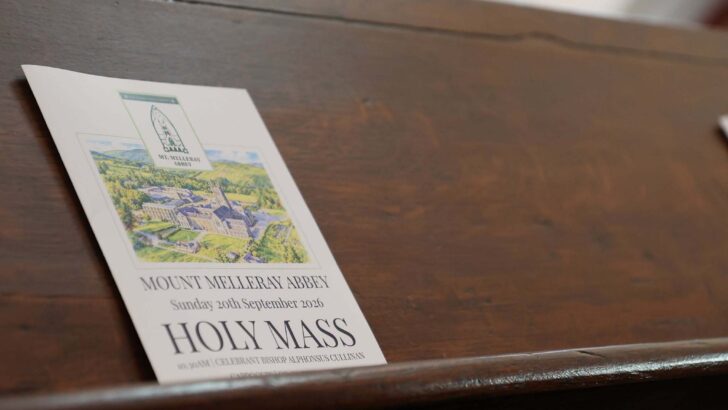
 The programme for the opening Mass at Mount Melleray Abbey on September 20. Photo: Diocese of Waterford and Lismore.
Cars began lining both sides of the road long before Mount Melleray came into view. By the time visitors reached the abbey itself, almost anywhere which might hold a car had become a parking space. The grass was covered, while emergency personnel and volunteers waited outside as people continued toward the church.

The Mass had spilled beyond the church doors. Mount Melleray’s long central nave and side sections were packed. Chairs had been placed along the arched corridors behind the church walls and down toward the smaller chapel. Outside, others stood around a speaker to follow the liturgy.
Thousands had come to mark a new beginning for a place which, little more than a year previous, had faced an uncertain future.
When The Irish Catholic visited in March, long before the renovations had begun, Fr Martin Keogh PP of Cappoquin described the local mood as “a lot of hope, but not a lot of knowledge”. Word had begun spreading that “the lights are on in Melleray”. Six months later, Fr Keogh was among the priests concelebrating Sunday’s Mass, and there was no mistaking the place for empty.
One section of the church was occupied by the Ave Maria University students who will call Mount Melleray home for the coming months. Young men wore suits and ties; some young women wore chapel veils. Most striking was the attention and reverence with which they followed the mass. Elsewhere were university staff and families, religious, visitors and large numbers of locals. Four local choirs had come together to sing from the choir loft.
Family
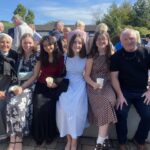
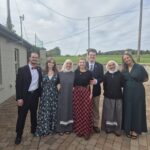
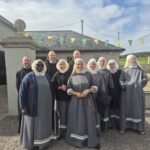
There was something of a family gathering about it: Americans and Waterford locals, students and religious, those who had known Melleray all their lives and those seeing it for the first time.
For Lizzie Shephard, Ave Maria’s residence director, part of what the American students have come to encounter is precisely what was here before them. “America is incredibly beautiful and the Catholicism in America is beautiful. But there’s something so deep here and so rooted here in Catholicism, which they don’t have,” she said. She hopes the students will leave “incredibly transformed” by Ireland, even as they bring something of their own.
Matthew O’Shea who works in campus operations and student support noticed something else in his time at Melleray. “You can tell that people have been praying in these buildings every single day, multiple times a day for 200 years,” he said. “You can feel it so much.” His hope is that the students can “enter into that peace” and add something to it themselves.
Anisa, one of the students echoed this, speaking of “finding peace through contemplation like the monks did here”, and being surrounded by places simply to “sit alone and pray and just reflect”.
Rebecca hoped studying philosophy and theology in such surroundings would leave its own mark. “I’m hoping some of the holiness will rub off on me and we can spread it to the rest of Ireland as well,” she said.
However, when The Irish Catholic first visited the site in March, much remained to be done to make the monastery ready for almost 100 students.
Connections
Ned O’Rourke lives only a few miles from Melleray and has family connections to the abbey grounds going back decades. He came into the project as a contractor and project manager and has now stayed on as facilities manager.
Asked what it meant to have taken part, his pride was difficult to miss. “Wonderful, wonderful,” he said. “The best thing ever happened. I enjoyed every day I was here.”
The work also produced a friendship with American project manager Kim Schreck, who joked that when Ned once mentioned he would like to work permanently at Melleray, he thought: “I can make that happen.”
That mixture of preservation and new life was central to how Daniel Schreck, Ave Maria’s Chief Strategy Officer, described the work. The aim, he said, had been to preserve “the continuity of the legacy of prayer, education, hospitality”, while the buildings were “polished, renewed, restored”.
“And it’s still a monastery.”
“Our students are not here to be tourists,” he added. “We’re here to live in this sacred monastic site and to allow that charism to infuse what we do every day.”
Community
Another aim was “to open it up back again to the local community”.
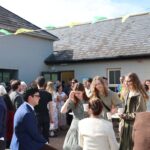
After Mass, that became more visible. Everyone was invited down the drive to a reception at the community centre, where the formality of the opening gave way to a joyous occasion filled with food, conversation and sunshine.
Two young men from Cappoquin, Cian and Jack, joked about what their new neighbours could expect. Traditional music, scenic spots and the town’s pubs were all on the proposed itinerary.
Jack reckoned the influx could practically “double the population of young people in the town”.
But when asked about faith, the joking paused. Cian admitted he had not been particularly practising but was “starting to kind of get into it a little bit again”.
Jack looked towards the Americans saying, “I’d say we can really even learn something off these people.”
Bishop Alphonsus Cullinan, who spent much of the afternoon among the crowd, speaking with families and blessing those who approached him, put the same idea more simply. “Young people know how to talk to each other,” he said. “You just put them together and the Lord will look after the rest.”