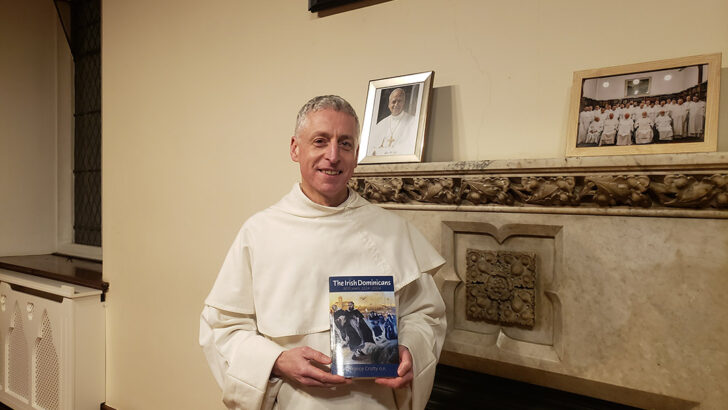
 Fr Terence Crotty OP with his book, The Irish Dominicans: 800 Years, 1224–2024. Photo: Pedro Esteva.
 The Irish Dominicans: 800 Years, 1224–2024 traces a history of preaching and scholarship through centuries of suppression, martyrdom, decline and remarkable revival.

Its author, Fr Terence Crotty OP, initially thought the book might take him about two weeks.
The 800th anniversary of the Order’s arrival in Ireland was approaching, and it had been suggested that a new account of the Irish Province should form part of the celebrations. Fr Crotty had previously prepared a talk on Dominican history, spending three days on research and reaching the middle of the 17th century.
Two weeks of concentrated work, he reasoned, should be enough to tell the entire story properly. “It actually took about two-and-a-half years,” he told The Irish Catholic.
Yet the long view allowed certain patterns to emerge. There were periods when Dominican life in Ireland appeared almost finished, the flame reduced to little more than embers. What survived in those moments was not size or security, but particular people tending the tradition until renewal became possible.
“What endures is simply people, really,” Fr Crotty said. “You have a tradition of people who, however well or badly, maintain a presence and maintain a tradition somehow or other.”
Three moments of vitality
Across the centuries, Fr Crotty identifies three periods of particular vitality. “We’ve got three glory points,” he said. “The 1200s, the 1600s and the 1800s again.”
The first was an age of extraordinary innovation. Founded in 1216, the Dominicans arrived in Ireland only eight years later, not simply as another monastic community establishing houses. “The 1200s would be a time of huge innovation,” Fr Crotty said. The early friars were engaged in what he described as an almost industrial-scale effort to make Scripture, theology and preaching more widely available.
They compared biblical manuscripts in search of the most reliable text and helped develop the earliest pocket Bibles, small enough to be carried in a pouch by a travelling preacher. One associated with the Dominican priory in Limerick survives in the library of Lambeth Palace.
Dominicans in Paris also developed the verbal concordance, listing each occurrence of a particular word in the Latin Bible. It enabled preachers and scholars to find at a glance what might otherwise have required years of searching.
They produced manuals of moral cases for confessors and collections of stories for preachers. The most famous was the Golden Legend, the immense collection of saints’ lives compiled by the Dominican James of Voragine. At the same time, St Thomas Aquinas was composing the Summa Theologiae, drawing the Catholic faith together into a systematic and interconnected whole. “These would all have been for the use of ordinary preachers,” Fr Crotty said.
Nor was this intellectual movement confined to continental Europe. Surviving Irish-language texts show that preaching resources were adapted and used in Ireland.
The first Dominicans succeeded not by refusing change but by responding creatively to it. Europe was becoming increasingly centred upon towns and universities, and it was into these new centres of life that the friars moved.
The Dominicans came to Dublin before establishing themselves anywhere in England”
“The movement of the Church through the orders of friars into the cities and the universities” was central to both the Dominican and Franciscan renewal, Fr Crotty said. Through preaching and hearing confessions, they brought forms of spiritual and intellectual formation once associated with monasteries into the daily lives of urban communities.
Their expansion across Ireland was rapid. Although England had larger cities and the universities of Oxford and Cambridge, the Dominicans came to Dublin before establishing themselves anywhere in England apart from London and Oxford. “They spread rapidly across the country,” Fr Crotty said.
The medieval landscape they inhabited was also more colourful than the ruins suggest today. Archaeology has uncovered painted plaster, decorative tiles and stained glass in former Dominican sites, including at Trim. “They’re full of colour,” Fr Crotty said, “and in their attitudes as well.”
Tested mettle
It was not success alone, however, that proved the strength of the Dominican vocation. The real test came when the friars lost the churches, priories and social position that had sustained them.
“When their mettle is tested at the Reformation, they prove their worth,” Fr Crotty said. “What’s amazing here is that it would have been easy for the brothers simply to retire, go back to their families or find jobs. Instead they go underground.” Some remained hidden in cities. Others took to the hills and countryside, continuing to celebrate Mass, hear confessions and serve the people.
Other friars lived as cowherds or labourers, resuming their priestly ministry after darkness fell”
The Province came close to extinction. By 1613, Fr Crotty estimates there may have been only about 20 Irish Dominicans. Yet within roughly 30 years, the Province was approaching 400 members. Twelve houses had been re-established by 1627, while young Irish friars travelled to Spain and elsewhere in Europe for formation before returning home.
“They leave a war-torn country and all of a sudden they’re in the centre of civilisation,” Fr Crotty said. “And they bring it back.”
During a period of relative freedom in the 17th century, five houses of study were planned. Funding was received for some 200,000 books to replenish Dominican libraries and distribute devotional material throughout Ireland.
That revival was again shattered by Cromwellian persecution, the period in which the Irish Dominicans count most of their martyrs. The stories Fr Crotty encountered reveal a Church stripped of almost everything except personal courage and trust in God.
Fr Gaspar Boyton worked near Cashel as a shepherd for three years, administering the sacraments in secret. He later posed as a blind beggar, moving from house to house and village to village while hearing confessions. Other friars lived as cowherds or labourers, resuming their priestly ministry after darkness fell.
Fr James Wolfe OP had escaped from Limerick and reached safety. When he heard that no priest remained in the city to minister to the people, he returned in disguise. He was captured while celebrating Mass and executed.
In later penal times, priests sometimes offered Mass with their faces veiled so those present could not identify them if interrogated. On other occasions, Mass was celebrated inside a closed room while a window was left open, allowing Catholics outside to hear the priest’s voice without seeing him. People signalled the hour of Mass to one another using their fingers, then knelt at a distance and followed it mentally.
For Fr Crotty, these are not merely dramatic stories from a heroic age. They reveal what remains when structures disappear. “What endures is simply people,” he said.
Seeds of renewal
Even in less dramatic periods of decline, individual friars continued doing whatever good was possible in their own place. “What we see in times of decline is this man here doing his best, this man here doing his best, and over here doing his best,” Fr Crotty said.
Such people did not necessarily bring about an immediate revival. Often they worked without knowing whether their efforts would lead anywhere. Yet they maintained the tradition, repaired churches, taught the faith and preserved a Dominican presence.
“Seeds being planted and a tradition maintained,” he said. “It’s waiting to come back to life again.”
When renewal eventually came, the great leader did not create it from nothing.
“What the great leaders do, who make such a difference, is that they pull these forces together.”
That was the pattern of the 19th-century revival.
By 1853, only 44 Dominicans remained in Ireland. The Province was impoverished and disorganised, and some within the Church hierarchy questioned whether the old religious orders had any role in the modern Church. Then came two men of very different gifts.
“You get two extraordinary men,” Fr Crotty said. “One completely different, but they work together.”
The first was Fr Bartholomew ‘Batt’ Russell OP, born on Blarney Street in Cork in 1799.
When he became prior in Cork in 1829, the Province was “dying on its feet”. He nevertheless undertook the construction of St Mary’s on Pope’s Quay. Where Dublin’s Pro-Cathedral had been built discreetly in a back street, St Mary’s was placed prominently at a bend in the River Lee. Its white limestone exterior, high steps and grand portico could be seen from a considerable distance.
“He’s making a statement that we’re back,” Fr Crotty said.
Fr Russell later became provincial and established Tallaght as the centre of a renewed common life. He restored the Dominicans in Waterford, built in Dublin and revived preaching missions that had not been seen in that form for centuries.
Fr Crotty described him as “the master of the grand gesture”, but his achievement was not merely architectural. He gathered the surviving energies of the Province and gave them direction.
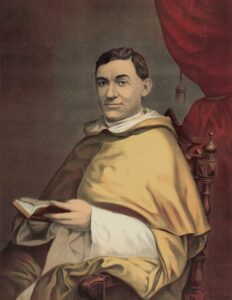
The second great figure was Fr Tom Burke OP.
A Galway native, Fr Burke became one of the best-known public speakers of his age”
“If Batt Russell restored, in a sense, the interior life — rebuilding the churches and things like that — then Tom Burke was the one who, you know, this is the Order of Preachers: this man can preach.”
A Galway native, Fr Burke became one of the best-known public speakers of his age. He delivered Daniel O’Connell’s funeral oration in Glasnevin Cemetery before tens of thousands of people and later spent approximately a year and a half touring the United States.
Crowds queued to hear him, while Protestant ministers attended to study how he preached. His reputation endured long after his death. Writing about a highly sought-after priest in Scotland, Fr Willie Doyle SJ described him simply as “the Tom Burke of Scotland”.
Fr Burke’s sermons also complicate the idea that 19th-century Catholic preaching consisted only of fear and condemnation.
“As you can imagine, these were people who were conscious of being ruled by the British, just after the Famine, with huge emigration,” Fr Crotty said. “And yet he talks to them about the beauty of their souls.” Fr Burke described the human soul as a musical instrument created to sing to God.
Between them, Fr Russell and Fr Burke restored both the common life and the public voice of the Province.
More than a cycle
It would be easy to reduce the Dominican story to a reassuring cycle in which every decline is inevitably followed by revival. Fr Crotty is wary of that interpretation.
“Cycles give the impression that you’re dealing with fate or invisible forces,” he said. “Whereas really what you’re dealing with, to be quite honest, is great men. You’ve got men who take something that’s in decline, in severe decline, and they grab it by the shirt and they make something out of it.”
“Once you’ve got a leader in the right place, things begin to happen. Not even a leader, not even the boss. Sometimes it’s just an individual. It’s this person and a small group of friends who change everything.”
Fr Crotty remembers a more recent time when many Irish Dominicans believed the Province itself was effectively finished. Properties were sold or given away, partly in the belief that other organisations had a future while the Order did not.
“In 2004, we had a visitation from the Master of the Order,” he said. “One of the things he said was, ‘It seems to me you’re all depressed. You don’t know where you’re going, and if you did know where you were going, you wouldn’t have the men to do it anyway.’
From a human point of view, it’s really leadership that makes the big difference”
“But around that time we began to get a trickle of vocations, which has completely turned things around. When I was young, there was a sense that the Order was finished. The fact that we’ve had some sort of revival and we’ve got some sort of future is quite miraculous.”
Looking back, Fr Crotty sees both human leadership and the hand of providence.
“Sometimes you get the impression that the Lord flicks the switch and all of a sudden things grow again,” he said. “From a human point of view, it’s really leadership that makes the big difference. When you’ve got great men to lead, things tend to revive. Also, when the Province was strict, it revived. When it was lax, it declined. But one always has to see that providence is there.”
Fr Crotty concludes his book with the “Praise of the Ancestors” from the Book of Sirach, which remembers those through whom divine wisdom guided Israel’s history. The passage does not end in a remote heroic age, but reaches into the writer’s own time. For Fr Crotty, it is a statement of trust that the God who guided previous generations has not ceased to guide the present.
“May he continue to guide the Irish Dominicans and, indeed, the entire Church in Ireland, through these times,” he writes, “so that we will have that other 800 years which might be worthy of the great men of the last 800 years.”