

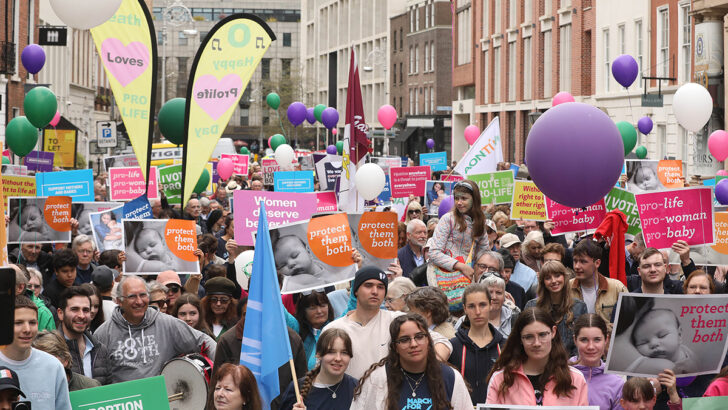
 Thousands joined the annual March for Life on Bank Holiday Monday, May 4, in Dublin. The event started in St
Stephen’s Green and ended in Molesworth St with talks. Photo: John McElroy.
Thousands joined the annual March for Life on Bank Holiday Monday, May 4, in Dublin. The event started in St
Stephen’s Green and ended in Molesworth St with talks. Photo: John McElroy. Thousands gathered in Dublin on Monday for the annual March for Life, with this year’s demonstration focusing on rising abortion numbers and opposition to proposals to remove the three-day waiting period.
The event began with Mass at the Newman University Church, where Bishop Kevin Doran of Achonry and Elphin told worshippers: “Once there is a living body, even one as small as an embryo, there must be a soul.”
Marchers then moved from St Stephen’s Green to Molesworth Street, where speeches were delivered by campaigners and public representatives, including Cllr Ellen Troy, Caroline Simons of the Pro Life Campaign, and Cork North Central TD Ken O’Flynn.
Despite overcast conditions, the atmosphere remained upbeat as crowds of all ages made their way through the city centre, accompanied by music, banners, conversations, and prayer.
Among those attending were Bishop Donal Roche of Dublin and Bishop Phonsie Cullinan of Waterford and Lismore, both of whom pointed to current legislative proposals as a key concern.
Bishop Roche said he felt “angry” at efforts to remove safeguards introduced following the 2018 referendum. “They said it would be safe, legal and rare,” he said. “Now it’s 10 or 11,000 a year and it’s not rare by any means.” He added that the waiting period gives women time “to maybe change their minds”.
Bishop Cullinan, who said he has attended the march “for years”, described the situation as “utterly sad”, adding that the removal of safeguards had been “inevitable”.
Speakers echoed concerns about current policy. Ms Simons warned that removing the waiting period would reduce protections for women, while Mr O’Flynn raised questions about babies born alive following abortion procedures.
Among participants, there was both conviction. Sinéad Tracey, from Leitrim, described the right to life as “the most fundamental of all human rights”, adding: “If we’re not granted the right to life, no other rights matter.”
For others, the issue was deeply personal. Mary T. Sweeney, from Letterkenny, said her involvement began more than 25 years ago after the premature birth of her son at 25 weeks. “That changed my whole perspective,” she said. “We just don’t know the miracle that life can lead to.”