

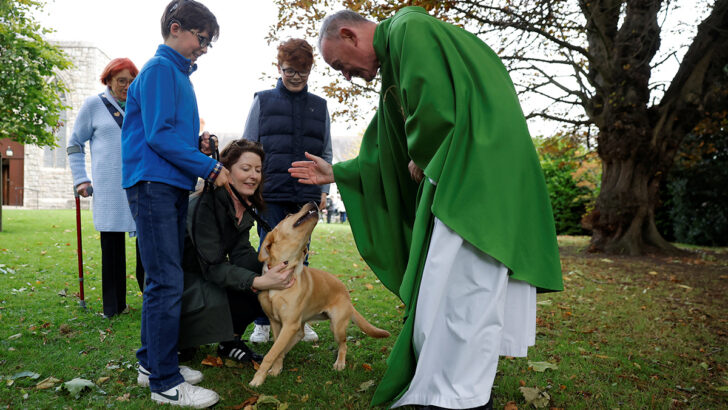
 Fr Enda Cunningham blesses a family dog at St Mary’s, Star of the Sea church in Dublin October 5, 2025, a day after the Feast of St Francis, patron saint of animals. Photo: OSV News/Clodagh Kilcoyne, Reuters.
An uncompromising challenge for parishes amid priestly shortages
My this stage of the year, whatever “clerical changes” there have been will have taken effect across Irish dioceses, and those most directly impacted will be adjusting to their new or their amended circumstances. Such changes have generally become less newsworthy throughout the country, reminding us of the reduced engagement with Church on the part of many in Irish society. Another reason for the lack of interest is the growing perception – even among those committed to the Church – that clergy appointments nowadays offer little that might really qualify as serious “change”.
Not that many years ago, annual clerical changes could unleash surprises and cause stir within a diocese. Nowadays they follow a fairly predictable pattern, evident for at least two decades now: The retirement of certain Parish Priests will be announced. The parishes vacated will increasingly be entrusted to existing PPs. The arrival of additional priests from abroad will typically feature and, often, the appointment of permanent deacons to support these arrangements. Clergy and laity alike appear to expect, and largely accept, this approach to appointments. They share an awareness that priestly “numbers” simply aren’t there anymore – and are sympathetic to the difficulties a bishop faces in trying to keep things ticking over from year to year.
Status
quo
At a deeper level, too, this approach to clergy deployment has helped stave off more significant change and maintain a certain status quo. Entrusting responsibility for a second, or maybe even a third parish to an individual priest – rather than, say, merge or rationalise – enables such parishes, and their sense of themselves, to remain largely intact. Bishops have often gone out of their way to emphasise this, assuring parishes that – while they may not have a resident priest – they continue to have pastoral and finance councils and their distinctive identity is being neither threatened nor undermined. Parishioners are typically exhorted, at the same time, to enhance their own involvement in their local parish to help ensure this.
The scandals engulfing the Church would have dramatically affected both the amount of work, and the kind of work, facing most diocesan bishops”
The increasing recruitment of clergy from overseas, meanwhile – alongside permanent deacons and dedicated parishioners – has enabled a certain pattern of sacramental life and Church-based ritual to sustain itself as well. While there have been rationalisations of Mass times probably everywhere in Ireland, and concrete cut-backs in schedules of this kind, there has still been a remarkable continuity to parish life on the ground throughout the country. The accommodation of baptisms, funerals and other rites of passage has continued pretty much as before, alongside other annual parochial highlights such as First Communion Days and Cemetery Sundays.
Maintaining continuity where possible was an understandable pastoral approach over recent decades. Alongside their impact at many levels, the scandals engulfing the Church would have dramatically affected both the amount of work, and the kind of work, facing most diocesan bishops. What’s more, the fall-off in vocations resulting from these scandals gradually left bishops without the support of previous levels of clerical personnel. There would likely have been little time or energy for the serious reorganisation of a diocese, even if a bishop was inclined to embrace this. Those critical of the seeming reluctance of authorities to initiate change sooner can appear somewhat blind to these realities. At ground level, meanwhile, a considerable degree of continuity in parish life may well have been the best approach to pastoral provision, when so much else unfolding in the experience of Church was unprecedented and unsettling.
It is hardly by chance, for example, that the process of pairing and amalgamating dioceses is only taking off in Ireland of late years. The demographic considerations generally cited to justify these measures are not of especially recent provenance. However, the relative space and stability needed to address and proceed with them probably are.
There is a very obvious recognition among the bishops that the dominant response to clergy shortages, for some years now, is gradually running out of road”
It does seem a cause for concern, nonetheless, that just at the point when bishops might be finding themselves freer to undertake similar processes of review and restructuring within their dioceses, a growing number of them are acquiring responsibility for a second diocese. Much like the parish priest being asked to stretch further to plug the latest gap, one fears that such an approach to episcopal deployment – at this particular moment – could well jeopardise the necessary work of reorganisation and renewal long overdue at more local levels.
“Necessary” and “long overdue” seem not unwarranted terms in this context, as these merely reflect what our bishops, themselves, are implying. Indeed, the messages emanating from diocesan offices – often attached to notice of clerical changes – increasingly voice an urgency as to how chronic things are becoming. There is a very obvious recognition among the bishops that the dominant response to clergy shortages, for some years now, is gradually running out of road. This is typically illustrated by their drawing attention to statistics regarding the age profile of serving diocesan priests, with projections about the consequences for the years and decades just ahead.
Suspicion
Such statistics appear to confirm the suspicion that there will not be sufficient numbers of diocesan priests available to act as pastors for such parishes as will become vacant – even with the practice of “doubling-up” and “tripling up” on the part of PPs. Meanwhile – as a headline in this newspaper indicated a fortnight ago – many of our foreign-born priests are beginning to articulate an awareness that their presence here is not the long-term solution to problems arising from the fall-off in homegrown clergy.
As has been outlined above, Irish bishops have responded to priestly shortages – for several years now – by accessing clergy from abroad, by introducing and promoting the Permanent Diaconate, and by taking advantage of options available to them in Canon Law. That law enables a “vacant” parish to be entrusted to the care of a neighbouring PP, or to a group of such clergy. Dioceses here have, for the most part, implemented the former of these measures.
In view of this extraordinary remedy, the People of God should be adequately prepared in this regard, cognisant that it is a temporary and not a permanent measure”
Canon Law contains a further provision which allows for the “pastoral care” of a parish to be “entrusted to a deacon, to another person who is not a priest, or to a community of persons” by the diocesan bishop. The bishop must, in such circumstances, “appoint some priest” who is “to direct the pastoral care”, and who effectively carries the responsibilities of Parish Priest in this situation. This seems a much more appealing alternative than the aforementioned, as it appears to offer figures other than the priest a significant role in the leadership of a parish – which is surely welcome from various perspectives. Having said this, in still relying on priestly oversight to a significant degree, it could inevitably encounter – in the long run – the same constraints which the other canonical options, currently operative within Ireland, are increasingly facing.
Furthermore, while it is not at all obvious from the Code of Canon Law itself, a 2020 ‘Instruction’ from the Holy See – approved by Pope Francis – appears to suggest that this provision should not, normally speaking, become a permanent arrangement for any parish. That instruction states: “It should be remembered that we are dealing here with an extraordinary form of entrusting pastoral care, due to the impossibility of appointing a Parish Priest or a Parish Administrator”. It adds how: “In view of this extraordinary remedy, the People of God should be adequately prepared in this regard, cognisant that it is a temporary and not a permanent measure.” This appears to leave its viability, as a widespread or durable option, somewhat unclear or – at the very least – requiring considerable clarification. Such clarification would help further discussions around the care of parishes in Ireland.
The 2020 instruction cited above has, as its title, The Pastoral conversion of the Parish Community in the service of the Evangelising Mission of the Church. While it reiterates relevant canonical provisions in some detail, its predominant emphasis is around the renewing of parishes for more effective witness and mission in today’s world. In articulating its vision – it might be said – the instruction does not pull its punches. While acknowledging “territorial configuration” as a typical characteristic of the parish, it is emphatic that in a time of “increased mobility” and “digital culture” this is of much less relevance. It laments, in particular, parish cultures which appear “more interested in preserving a nostalgia of former times”.
Instruction
“If the Parish does not exude that spiritual dynamic of evangelisation”, the instruction argues, “it runs the risk of becoming self-referential and fossilised”. The parish must avoid the risk, it says, of “an offering of services that do not express the dynamic of evangelisation, but rather the criterion of self-preservation”. Adamant that “the current Parish model no longer adequately corresponds to the many expectations of the faithful”, the instruction insists on the need for “the renewal of ‘traditional’ Parish structures in terms of mission.”
While there may be something quite idealistic, even overwhelming, about the tone of the Holy See’s instruction, its uncompromising challenge – and its invitation to renewal – should perhaps guide any reflection on the future of our parishes. While the instruction speaks warmly of the “generous dedication” evident throughout so much of parochial life – and there can be little doubt about that – it is equally clear that appreciation of this should not deter from a critical evaluation of prevailing models of parish. While falling clergy numbers may well demand a creative re-think as to how we staff our parishes going forward, a more fundamental issue surely is – as the instruction suggests – their ongoing effectiveness in terms of the mission of the Church. Do our parishes typically embody, in a ‘post-Catholic’ Ireland, a “dynamic of evangelisation” or, are they – in the words of the instruction – more exercised by the challenges of “self-preservation”?
Various arguments can, in consequence, be made for the value of one’s parish – as both a worthy social and ecclesial entity – and various interests would be served by its ‘preservation’”
Irish parishes, as we know, have a long and venerable history – most of them able to trace their origins to the Middle Ages. Closer to our own time, they re-emerged as the basic unit of community life for both Church and society in a largely rural, post-Famine Ireland. The GAA’s organising of itself around parish structures, from the late 19th century onwards, served to reaffirm this. Given this history, it is inevitable that – especially within rural settings – the parish would still carry real significance as a source of continuity and collective identity at local level. Various arguments can, in consequence, be made for the value of one’s parish – as both a worthy social and ecclesial entity – and various interests would be served by its “preservation”.
Alert
This instruction could be said to alert us, nonetheless, to the potential weaknesses of the model which has evolved here. Its function as a source of local identity can obscure the parish’s purpose as a setting for evangelisation. While there may have long been a sense of maintenance over mission, in the typical Irish parish, circumstances today make the neglect of the latter more serious in its consequences. When a majority who live within its boundaries and draw identity from the parish are no longer meaningfully active in the life of the Church, a certain ‘Cultural Catholicism’ can predominate.
An overseas priest serving here was quoted, recently in this paper, as emphasising the need to move from the ‘cultural’ to a ‘real depth of faith’”
It is interesting to note how relative “newcomers” to ministry in Ireland quickly recognise this trend in parish life and are prepared to call attention to its shortcomings. An overseas priest serving here was quoted, recently in this paper, as emphasising the need to move from the “cultural” to a “real depth of faith.” Another spoke of sacraments being approached “for compliance” or “for the show”, while “the heart is not there”. ‘Letter of the Week’, in that same edition, saw one of Tuam’s newest priests call out the futility of what he describes as trying to “maintain a sacramental service industry, built for the maintenance of a cultural Catholicism.” “Much of the present discussion about priest shortages”, wrote Fr Mark Quinn, “begins with the assumption that we must somehow preserve the existing ecclesiastical machinery, only with fewer men to operate it.” There is surely much in his concerns which merit wider attention at this point in time.
‘Cultural Catholicism’ should not be dismissed lightly, of course – for the cultural Catholic may well be open to that deeper engagement which a parish exists to offer. How many of our parishes, however, have the readiness and the resources to enable that deeper engagement to successfully happen? This is another matter which ought to concern us – every bit as much – at this juncture.