

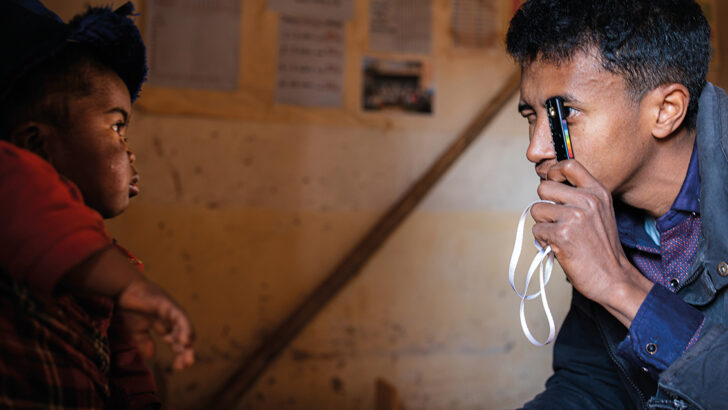
 The Arclight allows community health workers to screen children from when they are born with preventable eye-health issues. Photo: CBM
On the second Thursday in October every year, World Sight Day is celebrated. Or at least it should be celebrated because sight is hugely important. Everyone has an eyesight story that is close to their heart. If you don’t, then you are very, very lucky.

Almost everyone will be affected by an eye health or vision problem in their life. It is a whole-of-life issue that requires a proactive, coordinated and integrated whole-of-government response. Proven, cost-effective policy solutions are already available to support the prevention, treatment, and rehabilitation of eye conditions and vision impairment across all stages of life.
Yet, in 2025, eye-health is a growing global challenge rather than one that is diminishing. Over 2 billion people are living with poor vision and, for over 1 billion of these people, this vision loss could have been avoided or treated.
This year, the theme of World Sight Day is ‘Love Your Eyes’. Now, more than ever is this important. Ironically, it is in the wealthier countries that eye-health is diminishing most quickly but so much of that is of our own making.
Uncorrected refractive error is the leading cause of vision impairment in school-aged children and teenagers, with rates rising due to increased and excessive screen time, close work in education, poor lighting and reduced time spent outdoors. In 2020, 60% of children in Asia and 40% of children in Europe had myopia (nearsightedness) with more than half of the world’s population expected to be affected by 2050.
Love
Love your eyes and love your children’s eyes. Get them off the screens and get yourselves off your screens. The power is in your hands. Not everyone in the world can prevent eyesight issues with such an easy fix. Most of the children in the developing world don’t yet have this ‘first world’ problem. The solutions for their eye problems are not in their hands. Despite all the challenges, there are still reasons to be hopeful. But first, it is worth listing some of the challenges.
There are not enough trained doctors, opticians, optometrists and ophthalmologists to provide the care needed in many of the world’s poorest countries. There is the simple problem of affordability – governments do not have the integrated health systems that we have. They do not have the economic tax-base to provide them. There are not the training colleges- and when there are trained eye-doctors, the countries suffer from ‘brain-drain’ as their brightest and best are lured by good jobs in places like Ireland and elsewhere.
A couple of hundred euro may seem manageable to you and me but when that amount is six-months income for a family in rural Madagascar, parents are truly offered a Hobson’s choice”
Where treatment is available, often parents do not have the money to get their children (or themselves) the treatment they need. Day-to-day living, subsistence living, means there is no money put away for a rainy day. A couple of hundred euro may seem manageable to you and me but when that amount is six-months income for a family in rural Madagascar, parents are truly offered a Hobson’s choice.
I don’t know if we ever really sit down and take time to think about what it would be like to know one of our own children or grandchildren needed treatment to save their sight – or any other condition, that such treatment is available and possible – and that the reason he or she cannot be treated is simply a matter of a few hundred euro.
Rare
It is rare in Ireland nowadays that a child is in such a situation where available healthcare is just out of reach of the smallest of us. It happens but these instances are rare. And when they occur it is rightly considered outrageous. It used to be the reality fifty or one hundred years ago when access to the best healthcare was for the few – those with means. Nowadays, we expect that our social contract ensures that no one should miss out on essential healthcare.
Yet, this is still the case in places like Burkina Faso or Zimbabwe. Money is what makes the difference. And so many more illnesses are treatable and preventable today than 50 years ago. This treatment is much more affordable than it once was. Whereas in the past, the lack of access to necessary treatment was an impossibility, now it is possible but dangling just out of reach.
Being in that position, for a parent, must be devastating. There are no easy fixes to the structural problems. We live in a world where the rich are getting richer. The poor may not be getting absolutely poorer but the gap is widening between the haves and the have-nots.
The cycle can be virtuous and it can be vicious. Good vision is fundamentally connected to both educational attainment and access to employment”
But in some places – driven by war and conflict – the poor are getting poorer. Infrastructure is being destroyed and services no longer exist. Hospitals and healthcare systems that functioned (however imperfectly) a few years ago are gone. I remember working in West Africa in 2010 where there was stability and slow, if imperfect, progress. And I remember watching, helplessly, as the region went up in flames. Almost literally. Mali, Burkina Faso, Cameroon, Nigeria, Ivory Coast, the Central African Republic – these were all seeing positive changes before the countries were turned upside down by war and their economies knocked backwards.
The cycle can be virtuous and it can be vicious. Good vision is fundamentally connected to both educational attainment and access to employment. Currently, unaddressed vision impairment is estimated to result in an annual global productivity loss of approximately €411 billion. Those figures are so large as to be meaningless. Yet, economic regress and stagnation means that unaddressed vision impairment is growing, rather than diminishing.
It isn’t all doom and gloom of course. We cannot give in to despair.
Nepal
On the outskirts of Biratnagar a small village in Nepal, 27-year-old Goma Bista was struggling to raise her two young sons, Buddha (9) and Chanas (5). All three had congenital bilateral cataracts who were treated in a CBM supported clinic, with the help of donations from supporters in Ireland.
These single stories cannot be forgotten even while waiting for the systems and structures to change. Nor can the community-based solutions that can save lives and become a national policy.
Earlier this year, CBM Ireland benefited from a grant from the Tom Cunningham Trust which has allowed us to begin to expand this programme into five districts in Madagascar. We will screen over 110,000 children and likely many more. The sight and lives of many children will be saved. Tom Cunningham was a CBM supporter while he was alive, and upon his death, he asked that a Trust be established for the prevention or relief of poverty. We were delighted to be part of that Trust.
On World Sight Day, you are invited to #LoveYourEyes and help make the case for eye care that is accessible, available, and affordable for everyone, everywhere. We can aspire to it and help one child at a time, one community at a time, district by district.
Dualta Roughneen is the CEO of CBM Ireland, an international disability rights organisation, committed to improving the quality of life of people with disabilities and those at risk of disability, in low-income regions of the world.
www.cbm.ie/donate/ : Please visit here if you’d like to donate.