

 Fr Barry White
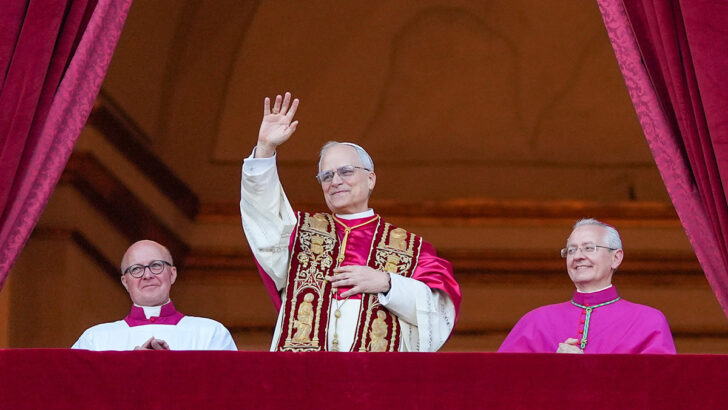 Pope Leo XIV greets the faithful in St Peter’s Square from the loggia of St Peter’s Basilica after his election on May 8, 2025. Photo: OSV news/Vatican Media.
 Authority as service lies at the heart of Pope Leo XIV’s Augustinian formation, writes
Fr Barry White

We are marking the first anniversary of the election of Pope Leo XIV on May 8 2025, when Robert Francis Prevost stepped onto the loggia of St Peter’s Basilica. He appeared calm, if visibly moved, introducing himself simply as a “son of St Augustine”.
For me, one detail stood out. The new pope is a canon lawyer. He studied canon law at the Pontifical University of St Thomas Aquinas in Rome, and his doctoral thesis—published in 1987—focused on authority within the Augustinian religious order. That might sound like a narrow academic topic. It raises a broader question: what kind of Church does a canonist, formed in the Augustinian tradition, imagine? The last pope with formal canonical training was Paul VI. Without overplaying the point, it is reasonable to wonder how a legal and theological formation shapes someone who now serves as the Church’s supreme legislator.
Structure
His doctoral thesis, The Office and Authority of the Local Prior in the Order of St Augustine, explores how authority works in a religious community. At its heart is a distinctly Augustinian vision: authority is not domination, but service. The superior is not simply a decision-maker, but a guardian of unity—someone who listens, discerns, and acts for the common good. The Order of St Augustine, founded in the thirteenth century under Popes Innocent IV and Alexander IV, blends active ministry with a contemplative life shaped by the Rule of St Augustine. This Augustinian understanding of authority reflects a model of communion, inspired by the shared life of the early Church in Jerusalem, as portrayed in the Acts of the Apostles. This helps explain the focus of Prevost’s early research. Writing in the years after the Second Vatican Council, he examined how the Augustinian constitutions—revised in 1968—should be understood in light of the then-new 1983 Code of Canon Law. It was an attempt to reconcile tradition and renewal: to ensure that structures of governance served the deeper reality of communal life. That concern feels strikingly contemporary.
Where Pope Francis drew on the Ignatian tradition of discernment—communal, prayerful, attentive to the Spirit—Leo’s Augustinian background may offer something complementary: a vision rooted in fraternity, unity, and structured participation. In the Augustinian model, the local prior is not isolated. He works with his council, consults the chapter, and remains accountable to his community. Authority remains real, but it is relational. The prior is, in a classical phrase, primus inter pares—first among equals. This Augustinian approach reflects the dynamic relationship envisaged in canon law between authority and participation, where governance remains relational yet intrinsically ordered toward communion.
While such work may not predict where a pope is going, it does reveal where he is coming from. And that matters”
What emerges from Pope Leo’s early work is a theology of listening. Not listening as a management technique, but as something deeper: attentiveness to the Word of God, to tradition, and to the lived experience of the community. Leadership begins there. We heard echoes of this in Pope Leo’s first Urbi et Orbi address: “We must look for ways to be a missionary Church, a Church that builds bridges and encourages dialogue”.
And again: “We want to be a synodal Church… a Church that always seeks peace, that always seeks charity”. Fraternity, listening, unity—these are not new themes for him. They are part of his intellectual and spiritual formation.
Of course, we should be cautious. As theologian Thomas Joseph White OP has noted, it would be a mistake to treat a young priest’s doctoral thesis as a roadmap for a future pontificate. Context matters. People change. Leadership evolves. But while such work may not predict where a pope is going, it does reveal where he is coming from. And that matters.
Formation
Pope Leo’s formation is deeply Augustinian: shaped by a vision of the Church as a community held together not by uniformity, but by charity. His papal motto, In Illo uno unum—“In the One, we are one”—captures this beautifully. Unity is not something imposed; it is something discovered in Christ. That emphasis feels particularly significant today. The Church, like much of the wider world, is marked by fragmentation and polarisation. Internal ideological divisions—liturgical, theological, cultural—can easily harden into opposing camps.
Against that backdrop, an Augustinian instinct may offer a quiet corrective. It does not begin with power, but with relationship. It does not eliminate differences, but seeks to order them toward communion. This is where Leo’s background as both canonist and Augustinian may prove decisive. Law, rightly understood, is not an instrument of control but a framework that makes communion durable—sustaining participation, clarifying responsibility, and ordering the Church’s life toward mission. If Pope Francis has helped the Church rediscover the importance of discernment, Pope Leo may help it rediscover the importance of communion—structured, sustained, and lived. That is not a dramatic shift. It is a deepening of synodality.
Ultimately, the value of Leo’s early work lies not in prediction but in illumination. It offers a glimpse into the instincts that shape him: a preference for attentiveness over assertion, for relationship over control, for unity over division. In a time when both Church and society are tempted by fragmentation, that may prove to be no small gift.