

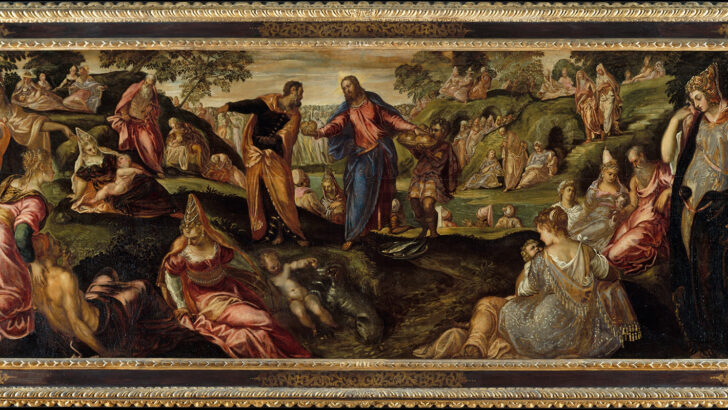
 ‘The Miracle of the Loaves and Fishes’ by Jacopo Tintoretto, circa 1545-50. Photo: Wikimedia commons/ Public domain.
 Jesus invites us to give and not count the cost, writes Fr Chris Hayden
‘Zero-sum game’ is a term used in gaming theory and economics, to describe a situation in which one person’s gain is perceived to be another person’s loss. Sports and games are, pretty much by definition, zero-sum, because the victory of one player is the defeat of the other; it is, by definition, impossible for both teams to win.
In sport, zero-sum reasoning is appropriate, but as an approach to life and relationships, zero-sum thinking is toxic. It is simply not true that if someone is shown respect, admiration and affection, then there is less of those things to go around. It is not true that if I admire your achievements, then my own achievements risk being ignored. On the contrary, when we show each other sincere and genuine respect, esteem, affection, admiration, and encouragement, then far from depleting the amount of such ‘goods’ in circulation, we actually increase them. Love (and respect, admiration, etc.) increases as it is given.
If I give you a larger slice of cake, there will be less left for me. That is a zero-sum reality. But if I give you the larger slice of cake out of my love and affection for you, then there will be more love and affection in the room – even if there is less cake.
Consider the words of Jesus, “Give, and it will be given to you. A good measure, pressed down, shaken together and running over, will be poured into your lap” [Luke 6:38]. These words invite us to consider life as the opposite of a zero-sum game. As St Francis of Assisi put it: “It is in giving that we receive.”
Depleted
I am not depleted when my friends and family and colleagues are praised, promoted, recognised or successful. If my approach to life is that of Jesus, and his follower St Francis, then far from being depleted, I will be – and I will feel – blessed by the goodness and success of those around me, especially those closest to me. But if, instead, I feel threatened or depleted, then I am inhabiting a bleak, zero-sum reality, and this, with all the sadness, bitterness, envy and resentment it brings, will turn my negative impressions into a series of self-fulfilling prophecies.
‘God knows,’ the serpent told the woman, ‘that if you eat the fruit of this tree, you will be like him’”
There are all kinds of reasons why unfortunate individuals approach life as a zero-sum game: unhealed hurts, disappointment, trauma… But the wisdom of Jesus, as modelled by St Francis and by so many others, urges us to take the opposite approach. And don’t we all know, in our bones, that life is not a zero-sum game? Don’t we know that when we visit the sick, we are not losing some precious inner resource of ours, but gaining something precious? Don’t we know that when we lend a helping hand, our day is blessed? That when we share a smile, we stand to gain a dozen more?
Perhaps the original zero-sum thinker was the serpent in the Garden of Eden, who suggested to Eve that the relationship between her and God was really a zero-sum game. The serpent – which is to say, the Original Voice of Temptation – told the woman that despite what God had said about having free and full access to all the glories of creation, God was actually jealous of his status, and did not wish to share it with her. “God knows,” the serpent told the woman, “that if you eat the fruit of this tree, you will be like him. You will take some of his glory; you will have a slice of God’s cake – and God will have less.”
Temptation
What a masterful temptation: to portray our relationship with God as a zero-sum game! To insinuate that we have been given our share, and that He is jealously guarding the rest; that God’s commandments are not for our blessing; that they are not his wise guidance, but arbitrary confinements, to keep us in our place – to limit us to our paltry slice of the cake; that contrary to what we have been told by the clerical ideologues, praise of God does not cause our hearts to expand, but that it subtracts from our dignity and transfers the subtracted amount to God, who already has more than his share; that our freedom, our dignity and our glory require that we turn from God, guard what we have, and seek more and more for ourselves.
When this sad, primordial zero-sum conditioning governs our approach to life, it’s only to be expected that we should see more and more of our relationships through the zero-sum lens; that we should praise others, yes, but only strategically and not from the heart; that we should recognise excellence, indeed, but only insofar as such recognition reflects positively on ourselves.
But the wisdom of Jesus invites us to something far better: “Give, and do not count the cost; give, and it will be given to you.” Let’s shake off any zero-sum conditioning; let’s spot what is good and lovely; let’s name it and praise it and bless those who are behind it. We won’t be depleted. Our hearts will expand. There will be more, not less, love in