

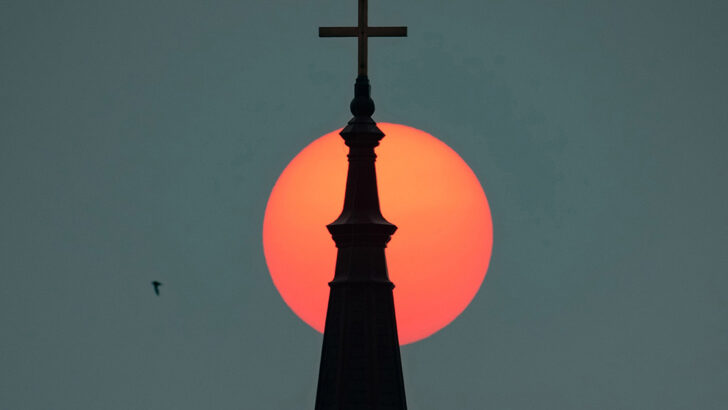
 A cross is silhouetted against the setting sun. Photo: OSV News / Sam Lucero, The Compass.
 He looked up at the dark sky, with no twinkle of stars, as he walked slowly. He had never felt quiet, as quiet as tonight. The dim lights along the road helped him navigate the connecting road between the main gate and the majestic building whose towers rose into the sky. For more than one hundred and twenty full moons, he had been in this place, his living space. He is very familiar with the refreshing air, even when the sun is shining brightly on the earth. He is very familiar with the rainfall that diligently waters the earth, making the grass and trees beautiful green. He is very familiar with the gusts of wind that penetrated the cold on his skin. He is very familiar with the cross at the end of the tower, decorated with blue sky and sometimes decorated with white mist. He is very familiar with the pillars in churches, which are decorated magnificently but in simplicity, without colour. He is very familiar with every stained glass with thirty saints painted on it, beautifully decorated like a window that allowed sunlight to enter and illuminate the inner room. He is very familiar with the local inhabitants who came for a moment to offer prayers by lighting small candles. He knows everything because that place is his living space. A living space that gave him comfort, but now he has to let go.
Space of will
Throughout life, we are trained to achieve something with the utmost effort. For example, from elementary school through university, our parents urge us to study as hard as we can to succeed in our formal education. There’s nothing wrong with that; in fact, we might even say it’s natural. However, we need to realise that life’s journey in this world isn’t just about acting to achieve what we desire but also teaches us to let go of many things that hinder our spiritual journey.
Life sometimes presents itself differently than we expect. And our initial reaction to such situations is rejection, and even if we feel injustice, resistance may arise. It is in this context that letting go is an important aspect of the spiritual journey. Letting go is the act of submitting our will to God’s will. This does not mean we have no will.
We must always ask that our will be in harmony with God’s will, even though it is not always easy for us, sinful humans”
We still have a will, but we trust that if our will is not in line with God’s, let God’s will be done because we believe that God has the best plan for His people, even if it does not align with our will and even if God’s plan is not always easy to understand. That is why letting go is an act of faith. God Himself said to His people through the prophet Jeremiah: “Do I not know the plans I have for you? They are not for your harm but for your well-being and to give you a future filled with hope” (Jeremiah 29:11).
But as humans, it is not always easy to subordinate our will to God’s will. There is a tendency within us as sinful humans to walk according to our own will and plans. This was done earlier by the first two humans, Adam and Eve, causing them to fall into sin. So, we must always ask that our will be in harmony with God’s will, even though it is not always easy for us, sinful humans. We often reject God’s will because of fear, doubt or feeling inadequate. The psalmist strengthens us with prayer: “Teach me to do Your will, for You are my God. You are kind and will guide me on the right path” (Psalm 143:10).
In the attitude of letting go of one’s will, we learn from Jesus Christ when He was in the Garden of Gethsemane. He cried out in prayer: “Abba Father, all things are possible for You. Take this cup away from Me; yet not My will, but Yours be done” (Mark 14:36). His life was an obedient response to God’s will. From Jesus’ example, we realise that letting go of one’s will is an act of faith. An act of faith is not the absence of fear, but rather obedience despite fear. An act of faith does not mean we already know all the answers, but rather that we dare to take the step because we trust in Him who never leaves us.
Space of wound
Life sometimes confronts us with conflict. We could say that conflict is part of this imperfect journey. Conflict can leave wounds in the heart. And when humans are bound by wounds in the heart, it can make life’s journey very difficult. Forgiveness is a powerful tool to release attachment to wounds, emotions, and anger. Ultimately, it leads us to a life filled with peace and joy in the heart. Letting go of attachment to wounds with an attitude of forgiveness does not mean we approve of the injustice that occurred, but rather because we trust that God will give us peace in the wounds in our hearts, and we grow in our spiritual journey.
While on the cross, Jesus prayed, “Father, forgive them, for they do not know what they do” (Luke 23:43). A prayer that came from a heart full of love, even though it was wounded. Through His example, we are called to forgive, so that our hearts may be transformed from wounded hearts to hearts of love and forgiveness. We need His grace and help because forgiveness is not always easy.
The fidelity of our faith is tested when God’s Word asks us to forgive those who have caused the wound in our hearts”
Releasing a heart wound doesn’t happen overnight, but rather a gradual process that requires time and patience. This process opens the door to profound healing and personal transformation. Releasing attachment to a heart wound through forgiveness is an act of faith. The fidelity of our faith is tested when God’s Word asks us to forgive those who have caused the wound in our hearts.
Let go
The night grew quieter, and a sense of loneliness filled his heart. The hope he once held is not in line with the reality he is facing now, making him feel lost. He turned and moved away from the main gate, slowly walking along until he approached the church tower. He stared at the tip of the tower. Although it was invisible due to the lack of light, he knew there was a cross at the end. He paused for a moment while continuing to stare at the invisible cross, then he heard his innermost self whisper silently, asking him to willingly let go. “For we have no permanent home on earth, but we seek the home that is to come.” (Hebrews 13:14). There is sadness and sincerity side by side in the space of his heart, but there is no longer room for negotiation, replaced by a space of trust, even though he did not yet fully understand it.
Fr Bavo Benedictus Samosir, OCSO is a Monk and Priest of Our Lady of Silence, Roscrea Co. Tipperary.