

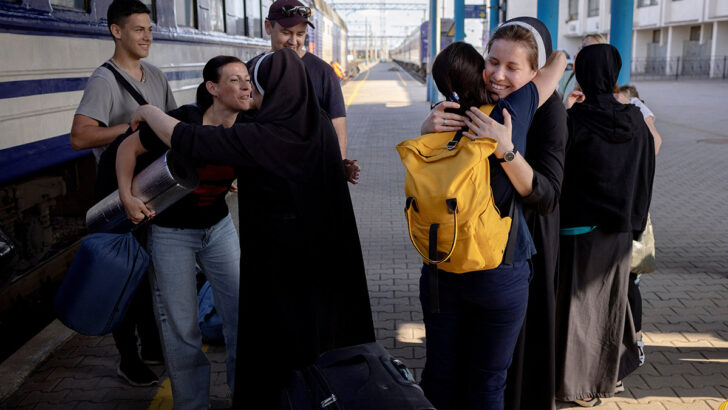
 Sr Bernadeta Dvernytska welcomes members of her church community in Zaporizhzhia, Ukraine, where faith is lived through service and solidarity amid war. Photo: OSV News / Thomas Peter, Reuters.
It is up to the Ukrainians to decide their course of action, and us to support them
Dear Editor In a thoughtful piece on Catholic ‘just war’ principles, Breda O’Brien wrote that an entirely just war might never have been fought. And she finds fault even with some aspects of Ukraine’s valiant defence against Russia’s barbaric invasion.
I think it worth mentioning that Washington DC’s Archbishop Robert McElroy, made a bishop and cardinal by Pope Francis, offers a complementary perspective.
At a meeting of the American episcopate in November 2022, while stressing the Church’s primary position of active non-violence, he said the situation in Ukraine “is an instance where justice requires resistance.”
In addition, the cardinal, who wrote a doctorate on moral norms in foreign policy, pleaded with lawmakers to continue the US’s military and humanitarian aid to Ukraine.
Is the way to reconcile those two perspectives to urge Ukraine, if they fight, to do so in a scrupulously just way?
However, some might say the way of peace talks is better. But what should Ukraine do when it agrees to every unconditional ceasefire and Russia refuses and carries on its brutal campaign?
Others will say we must force Ukraine to agree to Russia’s terms, but what coercive measures would we have to take to break the back of Ukraine’s resistance? And what right would we have to inflict such measures on Ukraine and violate their national sovereignty?
Surely, it is up to the Ukrainians primarily, not us, to decide in accord with right reason what they should do, as they ask: Are they justified in resisting? What sacrifices are they willing to make? And can they conduct a defensive war in a scrupulously moral way?
It is up to us to decide, in accord with justice and generosity, how best we might support them, to help them survive and gain a just and lasting peace.
Yours etc,
Paraic Maher
Listowel, Co. Kerry
Synod assemblies fighting to make the church less clerical
Dear Editor I notice that the Vatican has issued a guide for 2027 Synod evaluation assemblies. Although a member of a large parish that regularly has visiting priests I have never heard any priest mention a Synod, I have never met anyone who has had anything to do with a Synod, and I have only read about the make up of these Synods.
Invented to make the Church less clerical we now have committees of lay people, many with less than normal Catholic beliefs. The Church is to be less clerical because “clericalism” and “abuse of power” were responsible for the huge number of homosexual sex abuses in the Western world.
With the Freedom of Information laws in the USA we actually have extremely detailed reports on the perpetrators and their victims. I always thought that the Vatican line that sex abuse was not due to sex was a bit weird. Still, that’s another story about the types of individuals who predominate at the Vatican.
I don’t expect that I will ever hear about Synods or meet anyone with a connection to a Synod because people don’t actually take this new theology seriously.
Yours etc,
- Mckenna
Dumbarton
Israel only democracy in the Middle East where Christian population is rising
Dear Editor It is absurd to claim that Hamas was founded by the Israeli Prime Minister Benjamin Netanyahu. Hamas was actually founded in December 1987 nine years before Netanyahu became Prime Minister on June 18 1996.
Incidentally 20% of the Israeli population are Arabs who enjoy the same economic, political and religious rights as their Jewish neighbours.
As regards to the Holy Land, Israel is the only democracy in the Middle East and the Christian population is increasing whereas in the Palestinian West Bank and all other Arab countries it is in rapid decline.
Christians made up around 12–14% of the Middle East’s population in the early 1900s, compared with about 3–5% today.
Around 1947, Christians comprised about 85% of Bethlehem’s population. Today, they make up roughly 10–15% of the city’s residents.
In the early 20th century Christians made up roughly 10–12% of the population of historic Palestine.
Today in the West Bank Christians account for approximately 1–2% of the population.
However the Christian population in Israel has increased from 34,000 in 1949 to over 184,000 (79% Arab) in 2025
Yours etc,
Liam de Paor
Carrickane, Co. Cavan
‘Out of evil, good came’ – stories from Rachel’s Vineyard Retreats
Dear Editor I write this letter in deep gratitude to you for publishing the names and photos of the 86 TDs behind the vote to remove the three-day wait before an abortion.
I am one of many, many people who feel the wrongness/the evil of abortion due to my involvement in Rachel’s Vineyard Retreats and also due to having many good and beautiful women who deeply lament and are brokenhearted due to a hasty decision to obtain an abortion. I have listened to their stories of regret and also blame for those who encouraged them to go ahead with this drastic decision. I also have listened to others who are so grateful the three-day wait helped them to reconsider their initial hasty decision and through prayer, good guidance and love they are blessed today with a lovely daughter or son that helps them cope in this troubled world.
I have been present at post-abortion retreats and have seen the change in these brokenhearted good women where they hear words of understanding, compassion and forgiveness. They leave the retreats after years of carrying pain due to an abortion possible 20, 30, or even 40 years previously. Rachel’s Vineyard Retreats are such a blessing for them and they hear the loving words of Jesus – “Father, forgive them for they know not what they did.”
Most of them were in a state of panic, fear and anxiety as to how family, friends and society would judge them and felt the way to avoid all this was to go ahead and have an abortion. Some of them begged others not to do the same and I know that helped them cope with their own loss. Some of these beautiful ladies will say at least I helped stop another from going ahead with plans to visit an abortion clinic. So for them “out of evil, good came.”
Yours etc,
Sr Susan Evangelist
Ballyshannon, Co. Donegal
How accessible is working from home?
Dear Editor The main idea behind working from home was originally to give workers a better work-life balance and, at the same time, save on long commuting times to and from the workplace, which in many cases meant a worker spending hours in their car, causing traffic congestion in all our major cities. This idea was first tried out by major companies during the Covid lockdown.
It has since then become commonplace for many workers with workers having the right to request the ability to work from home where feasible. Major companies have the technology to be able to monitor staff to ensure that the work assigned is being carried out, with employers and employees finding the practice very successful.
But one has to ask the question if the Civil Service and Local Authorities have the technology or the structures to be successful in monitoring staff working from home, or have they evaluated the fact that it ends up with a reduced public ability to have ‘face time’ with members of the public.
Many elderly people don’t use email and are not online; they are having difficulty getting through on phone lines that always seem to be busy and when they get through they don’t get to speak to the person relevant to their queries. They are totally disenfranchised. Their only chance to get answers on issues is to have ‘face time’ with a relevant staff member. Also, how is a staff manager able to monitor staff from home or is the status of staff manager just part of a career path?
The whole thing is a sad day for the public. While working from home works for highly digitised multi-nationals where even toilet breaks are monitored, it would be surprising if it works at all with government departments or local authorities staff, where the public are forced to spend weeks waiting for answers that should only take an hour or two if key staff were present in the workplace.
Yours etc,
Nuala Nolan
Bowling Green, Co. Galway