

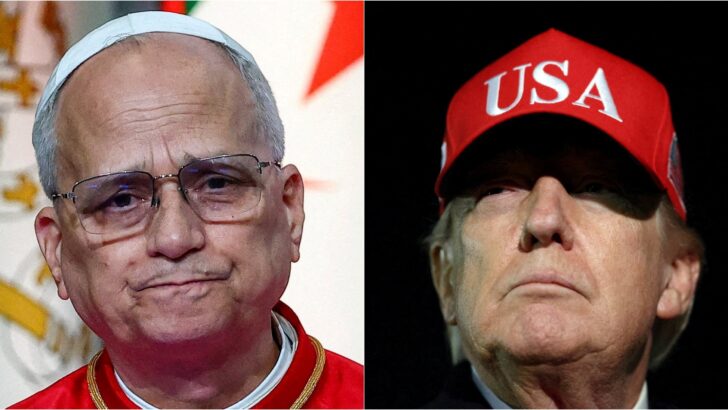
 A combination picture shows Pope Leo XIV addressing Algeria's political leaders at the cultural center of the Great Mosque of Algiers in April 13, 2026, where he criticized violations of international law by "neocolonial" world powers, in the Mohammadia of Algiers, Algeria, April 13, 2026, and U.S. President Donald Trump after disembarking Air Force One at Joint Base Andrews in Maryland April 12, 2026. Trump said April 13 that he would not apologize, as Bishop Robert E. Barron had requested, for the online tirade against the pontiff Trump made April 12. (OSV News photo/Guglielmo Mangiapane/Kevin Lamarque, Reuters)
 ‘The New Evangelisation’ in Ireland
Dear Editor, I write to comment on Pedro Esteva’s interesting article on new style formation for student priests at Maynooth (The Irish Catholic, April 2). There are many excellent ideas in the article; e.g. that formation should include such topics as parish finances, communication and team building, collaborative leadership and counselling. However, there are important pastoral issues which are not mentioned and I wish to draw attention to them.
Every Pope since Vatican II has identified evangelisation as the essential mission of the Church and the top priority for all who wish to renew the Catholic Church by building strong, convinced, personal faith in Jesus Christ in its members. I recognise the great potential of what the late Pope John Paul II called “The New Evangelisation”.
We are fortunate in Ireland to have several experts on how to do New Evangelisation; e.g. Fr Michael Hurley (Inspiring Faith Communities), Fr Pat Collins CM (Basic Evangelisation) and Msgr Pat Lynch (Awakening the Giant). These priests have dedicated their lives to evangelisation because they realise that many Catholics left the church because they were sacramentalised but not properly evangelised. They did not know Jesus because they had never met Him, and mature personal faith comes from an encounter with Christ. People who know Christ and have a living relationship with Him will not be led astray by secularisation or new social media.
I wish to suggest that the New Evangelisation needs to be the top priority in any formation programme for student priests. I have met too many priests who complain that they do not know how to evangelise in their parishes because they got no training on how to evangelise when they were in the seminary. It is time we all enlisted the expertise of Frs Hurley, Collins and Lynch to help our student priests.
Yours etc,
Peter Boucher
Derry, Co. Derry
Real prayer comes in many forms
Dear Editor, Matt Talbot, a regular visitor to the Dublin Diocesan Library, was seen reading the works of St John Henry Newman. When asked about that, he replied, “I do not understand much of it but I always get something from it.”
What is real prayer? I will present two differing approaches to this question based on the following books, Difficulties in Mental Prayer by Fr Eugene Boylan, a Cistercian Monk and A Comedian’s Prayer Book by Frank Skinner. Fr Boylan directs his book mainly to those in religious orders but also to priests living in the world. However, the laity are not overlooked, as they, like Matt Talbot, will undoubtedly gain some insights from reading this book, which is divided into many short chapters of a few pages each.
Frank Skinner being who he is, comedy is not absent as these extracts show: “They say the devil has all the best tunes. But I bet he hates music. So even the having of all the best tunes is, for him, a punishment” and “They should have heard me sing ‘Soul of my Saviour’, when I was nine, snotty and awkward but with a feeling of something pure flowing through me”. Frank’s wisdom is evident as this extract illustrates: “St Paul, hero as he was, was too angry, too grown up, for kindergarten wisdom”. Referring to the moment when the children at Mass are taken into an ante room to hear a simpler version of the Gospel. Frank points out that “it is the adults who should be led to the door while the children remain to just believe on their own terms”.
The Rosary is important to Frank: “I love the jingling beads and the way the repeated Hail Marys fuse into a mantra, a backdrop of word-sounds to meditate in front of”.
Yours etc,
Daithi Ó Muirneachain
Drumcondra, Dublin 9
Remaining ‘politically correct’ threatens core Catholic beliefs
Dear Editor, I just want to make a few statements that need to be made clear from the beginning, that we as Catholics do not believe in transgenderism or even the idea of transitioning. We only have two sexes as taught by the Bible.
Although this case I have checked stems from contempt of court order, Enoch Burke is right in not wanting to use pronouns as a Catholic and I support him. He should not have been suspended from school either as probably he had no other way than confrontation with regard to this matter.
One thing the Church must make evident: transgenderism or transitioning is not an option as a Catholic and it will not support this for Catholics.
Keeping quiet as an archbishop or washing hands of the topic to remain politically correct is wrong. Ireland is known as a Catholic nation and there is much laxity, woke-ism and liberalism that has crept into it, corrupting the purity of St Patrick’s preachings and teachings.
The courts may act in a secular manner but the injustice done to a man who is fighting so that Ireland’s children would not be transitioned as per his core Catholic belief must be supported. In time let’s hope this stupidity of transgenderism is not recognised anymore even by the courts. Let Ireland be known as a Catholic nation and remain a Catholic nation.
Yours etc,
Peter Anthony
Seremban, Malaysia
Looking back can’t be our only solution for present challenges
Dear Editor, In your article of April 2 on Eucharistic Adoration you find fault with “a leading member of the Association of Catholic Priests (ACP)” for dismissing “the ancient practice of prayer before the Blessed Sacrament as of the past”. This you contrast with Pope Leo, whom you report “has urged young people to make time for Eucharistic adoration”.
Fr Brendan Hoban, who is a leading member of the ACP, wrote in the Western People newspaper on March 17 last, about an emerging subset of young Catholics who share conservative perspectives “and often promote them through strong religious devotions of the past such as Adoration of the Blessed Sacrament and youth pilgrimages”.
I do not believe it would be fair to accuse Fr Hoban of dismissing Eucharistic adoration in the contemporary Church simply because he referred to it as a strong religious devotion in the past. To say, for example, that snooker and tennis attracted mass television audiences in the past is not to dismiss the smaller audiences those sports continue to attract.
Moreover, Eucharistic adoration, while a wonderful spiritual privilege for those who practise it, must be optional, in the sense that it only emerged in the second millennium. A devotional practice that did not feature in the first thousand years of the Church’s existence may not feature as prominently in the third millennium of the Church’s existence.
Fr Hoban’s broader point–surely correct–in his article referred to above is that a retreat to the past is not necessarily a solution to current challenges. That said, it is also true that, for both moderns and conservatives in the Church—and there is room for both—adherence to a common body of doctrine is essential.
Yours etc,
John Redmond
Mount Merrion, Co. Dublin
Is the US fighting a ‘Holy War’?
Dear Editor, Pope Leo XIV failed to hold back as he denounced the “delusion of omnipotence” that is powering the US-Israel war on Iran urging political leaders to stop and engage in peace processes. During an evening prayer in St Peter’s Basilica Pope Leo XIV did not mention the US nor did he mention US President Donald Trump, however, his tone and message appeared directed at US officials and Trump, who highlighting achievements such as military dominance, in a way seen as arrogant or abrasive to justify war using religion.
“Enough of the idolatry of self and money!” Leo said. “Enough of the display of power! Enough of war!” The US Military Religious Freedom Foundation (MRFF) announced it had received more than 200 complaints from military personnel from various branches of the armed forces–including the Marines, Air Force and Space Force–accusing their commanders of using extremist Christian rhetoric to justify war against Iran. Praying for peace, Pope Leo XIV said, it was a way to “break the demonic cycle of evil” to build instead the Kingdom of God where there are no swords, drones or “unjust profit, it is here that we find a bulwark against that delusion of omnipotence that surrounds us and is becoming increasingly unpredictable and aggressive,” he said. “Even the holy Name of God, the God of life, is being dragged into discourses of death.”
The Vatican is concerned about Israel’s war with Hezbollah escalating in Lebanon, where Maronite Christians constitute 25% of the population. The Maronite Church, an Eastern Catholic rite in communion with Rome, is concentrated in Mount Lebanon and Beirut, having a central role in Lebanon’s sectarian power-sharing system, with the President himself being a Maronite.
Yours etc,
Gerry Coughlan
Kilnamanagh, Dublin 24
RTÉ reporting on primary school surveys misleading
Dear Editor, The results of the recent survey on schools revealed that 40% of 41% of parents (those who replied) would like their children to be at a multi-denominational school. This works out at approximately 16% of parents.
However, the reporting of the survey, by RTÉ, makes it sound as if a majority of parents want a change.
Yours etc,
Judith Leonard