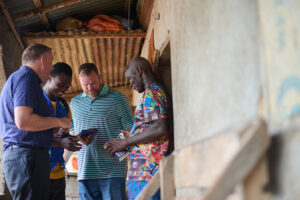
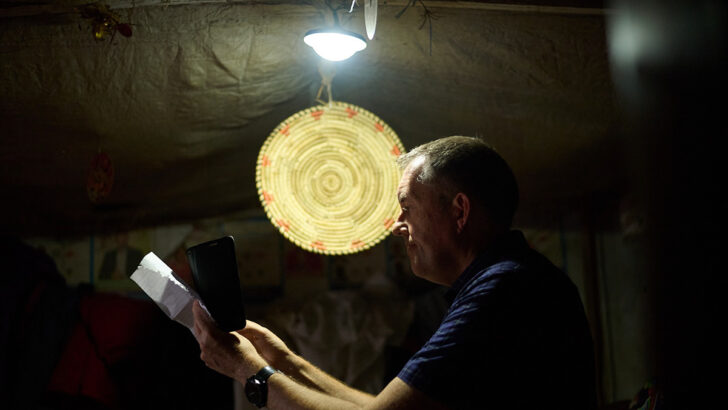
 Trócaire CEO Seán Farrell sees one of the solar-powered lights installed in a home. Photos: Trócaire.
 For many people in rural Sierra Leone, nightfall still signals the effective end of the day. “Life largely finishes at six o’clock when it gets dark,” Trócaire CEO Seán Farrell told The Irish Catholic, just days after returning from Kambia in northern Sierra Leone.
However, in thousands of homes across the rural district, things are beginning to change because of a Trócaire-backed solar programme. The project, Lite Salone, has already installed solar panels across 10,000 households with another 8,500 expected over the coming months. Mr Farrell estimates that once those are in place more than 100,000 people could be benefitting.
To see the project first hand, he travelled to Kambia, describing how the need becomes obvious when looking at Sierra Leone’s wider electrical system. “So few people have access to the electricity grid and the country, even the main city, has lots of times where they don’t have power,” he said.
It’s clearly going to be decades before rural communities are on the grid because they don’t have the power generation capacity yet”
In fact, when driving through Freetown, one can see a big ship sitting out in the bay. This ship is fitted with diesel generators which can be connected to the electrical network when additional power is needed.
For rural communities, Mr Farrell described, waiting for the grid to reach them is simply not a realistic answer. “It’s clearly going to be decades before rural communities are on the grid because they don’t have the power generation capacity yet. And yet what they want is to get rural communities to have access to power.”
So the solution being tried in Kambia is simple and small scale.
The Lite Salone project is a single solar panel fixed to the roof of a home, generally a modest two room house. From it comes three indoor lights and a motion activated security light outside. There are also connection for charging a mobile phone and a small radio, which is provided with the system.
On the whole, families roughly pay the equivalent of two dollars a month, with Sierra Leonean company Easy Solar providing maintenance and repairs.
Significance
But Mr Farrell said it was only inside people’s homes that the significance of those few lights became clear.
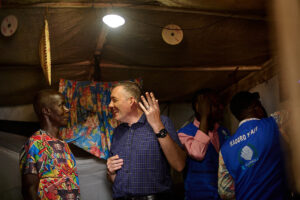
“I stood in a house and listened to a man saying, ‘We never thought we’d have lights.’ And we were standing under a solar light and he was showing me around his house.
“He was like, ‘The kids study in this room at night-time. I sit outside and I listen to the radio. I know what’s going on in my district because I can listen to the news.’
“I suppose standing in a house listening to somebody saying, ‘This made a difference to me’, that brought it home.”
Children being able to continue studying after dark was repeatedly raised during the visit, and Mr Farrell said the communities were even able to point to improvements in exam scores.
One story he recalled was of a blind man who strongly supported the programme, despite never being able to benefit directly from the light himself. What mattered to him was what it mean for his children.
And there were other less expected changes too.
They come home in the evening and they have their brooms and they make brooms and then sell them. And all of that work is done under the solar lights at night-time”
Families said the lights made it easier to spot dangerous scorpions and snakes around their homes at night. For some women, meanwhile, the extra hours of light have become an opportunity.
“They were talking about women setting up small businesses at night-time. The one they showed us was they had a broom-making business. So a number of women get together in the evenings after they do the farming and whatever, they come home in the evening and they have their brooms and they make brooms and then sell them. And all of that work is done under the solar lights at night-time.”
Another immense change is the ability to charge one’s phone in their own home. Before the panels, some people had to travel around five kilometres and pay simply to charge their phones. “Because all of them would have family members maybe working in the capital Freetown or in another part of the country, staying in contact is so important,” Mr Farrell said.
Connected
In staying connected, the radios matter as well. “It seemed to me to be bringing more life to these communities. Radios were on, they were listening to bulletins, listening to news, listening to what was going on, as well as having their phones.”
This wasn’t the first time Mr Farrell had been involved in a small scale solar project. While working in north-east Uganda in 2009, he ran a programme providing handheld solar lamps for rural communities. Looking at the systems now being installed with Lite Salone, he found himself thinking of how far technology has come.
“I wish I’d had access to these units that they had,” he said. “All we had was little handheld solar lights. But these units are just so much better. It’s the integration of light, phone, radio and the security light.”
Demand in Kambia suggests households themselves have come to a similar conclusion. Some families initially decided against joining the programme, preferring to see whether it worked for their neighbours first. “They thought, let my neighbour take the risk, let them take it. I’ll see how it goes,” Mr Farrell said.
Yet this hesitation appears to have disappeared. At a community meeting attended by around 50 or 60 people, those who had originally stayed out were now asking: “When will I get it if I sign up today?” Mr Farrell believes that if he returns in two years, practically every house in the area could have one.
The next 8,500 systems are expected to be installed within about four months. After that comes the larger question of whether the model can expand beyond Kambia.
Already, he believes, its scale has outgrown the language originally used to describe it.
“We’re calling that a pilot, but it’s not really a pilot anymore. A pilot is a few hundred, right? When you’re in the 18,000 scale, it’s not a pilot – it’s a programme.”
For Mr Farrell, the case for expanding it comes back to the families he met: “On every level I just thought, yes, this project is having a huge impact on people’s lives. The point of those programmes is to have an impact on people’s lives. That’s what we do.”