

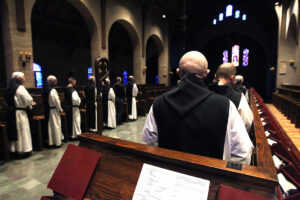
 La Trappe Abbey in Normandy, France, is seen
in an undated photograph. Photo: OSV News /
courtesy La Trappe Abbey Facebook page.
La Trappe Abbey in Normandy, France, is seen
in an undated photograph. Photo: OSV News /
courtesy La Trappe Abbey Facebook page. The monks of La Trappe Abbey have announced they are considering leaving their historic monastery by 2028, citing a shortage of vocations and the difficulties of maintain the site.
In a statement released earlier this month, the community said the possibility of departure would mark “a page of history that is about to be turned,” while stressing that monastic life at the abbey continues. The monks also emphasised that “the brothers are always there, faithful to prayer and work.”
Reacting to the news Bishop of Winona-Rochester Robert Barron expressed “real sadness”, describing the possible loss of the monastery as a sign of what he called “the spiritual disaster that has befallen Europe in the last hundred years”, the result of “an ideological secularism that is rotting the soul of the West.”
Bishop Barron himself has also often spoken about the influence of the great Trappist writer Thomas Merton on his own spiritual journey. Merton’s works introduced many readers to the contemplative tradition from which La Trappe itself emerged. His spiritual autobiography, The Seven Storey Mountain, published in 1948, details his restless search for meaning before entering the Trappist monastery of Gethsemani in Kentucky.
The mid 20th century was a moment when Catholic thought in America seemed ascendant with figures such as Dorothy Day, Flannery O’Connor, and Venerable Fulton Sheen shaping the spiritual imagination of the age. The Seven Storey Mountain, likewise, captured the attention of readers far beyond the abbey walls and inspired a generation of young men to consider the monastic life.

Catholic authors of the 20th century, is pictured in an undated
photo. Photo: OSV News/Merton Legacy Trust and the
Thomas Merton Center at Bellarmine University.
Monastic origins
Less widely read today, however, is Merton’s later work The Waters of Siloe, which traces the history of the Cistercians and the reform that eventually produced the Trappists and onto their new world settlements like Gethsemani. In it Merton recounts how one of the most austere forms of Benedictine life emerged from the unlikely monastery of La Trappe in Normandy.
Under the leadership of St Bernard of Clairvaux, the movement spread rapidly across medieval Europe, leading to hundreds of monasteries being established devoted to prayer and work”
Christian monasticism stretches back to the early centuries of the Church, with figures like St Anthony the Great seeking to withdraw into the Egyptian desert for a life of prayer and solitude. Over time communities formed, and monks began to live under a common rule – most famously the Rule of St Benedict of Nursia in the sixth century.
Centuries later in 1098, a group of Benedictines monks seeking a return to greater simplicity founded the monastery of Cîteaux in Burgundy, giving rise to the Cistercian Order. Under the leadership of St Bernard of Clairvaux, the movement spread rapidly across medieval Europe, leading to hundreds of monasteries being established devoted to prayer and work.
From the beginning, monasteries were not intended simply as places of retreat, but as signs that human life ultimately points beyond the concerns of the world toward God. Paradoxically, communities that sought to withdraw from society often ended up shaping it profoundly, as monasteries became centres of prayer, learning, agriculture and hospitality throughout medieval Europe.
Like many institutions, however, the order experienced cycles of fervour and decline. By the 17th century a new reform movement emerged within the Cistercians in France, seeking to restore a stricter interpretation of monastic rule. Because of the prominent role played by the abbot Armand-Jean de Rancé, the reform became closely associated with the monastery of La Trappe. Over time, the monks who followed this stricter discipline came to be known simply as “Trappists”.
Abbey in Spencer, Massachusetts. Photo: CNS photo/Chaz
Muth.
La Trappe and De Rancé
Founded in the 12th century in the forests of Normandy, La Trappe was originally one of many Cistercian monasteries which over time had fallen into a period of decline. In The Waters of Siloe, Thomas Merton describes how the abbey had endured centuries of upheaval only to be weakened by the system of ‘commendatory abbots’ or churchmen who held the revenues of monasteries without living the monastic life.
“La Trappe had been in commendam for about a hundred years,” Merton wrote, noting that the system ultimately “did what war and pestilence failed to do.”
The abbey’s fortunes changed in the 17th century with the arrival of the young nobleman Armand-Jean de Rancé. Who, after a dramatic personal conversion, set about restoring what he believed to be the original austerity of Cistercian life.
Under his leadership the monastery became known for its radical emphasis on silence, manual labour and penance. De Rancé believed the Cistercian vocation had been weakened by comfort and worldliness. His reform sought to recover what he saw as the “original severity of the Rule of St Benedict”: strict silence, long hours of prayer and manual labour carried out in a spirit of penance. The reputation of the community soon spread across Europe, attracting men who were drawn to the seriousness of its way of life.
Merton describes how the reform transformed the abbey into a place of “radical penitence” where monks sought “to shut the door upon the world and descend into the depths of penitential silence.”
In time the name ‘La Trappe’ itself would become a kind of shorthand for a more austere form of monastic life.
From age to age
The influence of La Trappe quickly spread across Europe. In the decades that followed De Rancé’s reform, visitors travelled far and wide to see the community whose monks moved through their daily routine of prayer and labour in near silence.
Yet its history was far from peaceful. Like many European monasteries, Abbey of La Trappe endured periods of upheaval that threatened its existence. The abbey survived plague and war in the medieval period. Like many religious houses in France, La Trappe was suppressed during the French Revolution when monastic communities were dissolved and their property confiscated. The monks were forced into exile, but after the Bourbon Restoration they returned and gradually rebuilt the monastery.
The exile of Trappist monks during this period also helped spread the reform beyond France. Some communities eventually settled elsewhere in Europe, including at Koningshoeven Abbey in the Netherlands, where monks later began brewing what is now known as “La Trappe” beer, another reminder that the influence of the reform spread far beyond the forests of Normandy.

by monks at Koningshoeven Abbey
in the Netherlands. Photo: Wikimedia
commons / Janne47.
In the centuries that followed, the Trappist reform continued to spread, eventually forming the modern Order of Cistercians of the Strict Observance in 1892. By the 20th century the Trappists had established monasteries across Europe and North America, becoming one of the most recognisable contemplative orders in the Catholic world.
In the years following World War II many monasteries experienced what appeared to be a flourishing of vocations, with young men entering communities across Europe and North America, often inspired by writers like Merton and the wider Catholic intellectual revival of the period. For some, the search for a life of prayer and contemplation was also shaped by the trauma of the war which had left the world morally and spiritually shaken. Yet the mid 20th century surge of interest in monastic life would not last.
In Ireland, declining numbers have led to closures and mergers among the Cistercians, including the historic Mount Melleray Abbey in Co. Waterford”
By the 1960s and 1970s, the trend had begun to reverse as cultural changes and declining religious practice reshaped the landscape of Western Christianity. Monastic communities gradually grew smaller and older, making it increasingly difficult to sustain large historic monasteries.
In recent years several monastic communities have already faced similar decisions. In Ireland, declining numbers have led to closures and mergers among the Cistercians, including the historic Mount Melleray Abbey in Co. Waterford. In Austria, Engelszell Abbey, the country’s only Trappist monastery, was suppressed in 2023 when the community dwindled to just four monks.
Recover
As the monks of La Trappe Abbey discern their future, the question being asked is one which extends beyond the walls of a single monastery. Bishop Barron has frequently argued that Western society must recover a sense of the transcendent, an awareness that ultimately life points beyond itself to God. In many of his talks, he has warned that modern culture often reduces religion to something merely therapeutic or moralistic, losing sight of the radical call to holiness that traditions like monastic life embody.

keynote address during the USA
National Jubilee Pilgrim Gathering at
the Basilica of St Paul Outside the Walls
in Rome, 2025. Photo: CNS/Lola Gomez.
Yet the Christian tradition has long understood decline and revival as part of the same story. In the Gospel of John, Christ compares the Kingdom of God to a grain of wheat that must fall into the earth and die before it can bear fruit. The broad history of monasticism itself suggests that even moments of apparent loss may become the soil from which new life grows.