

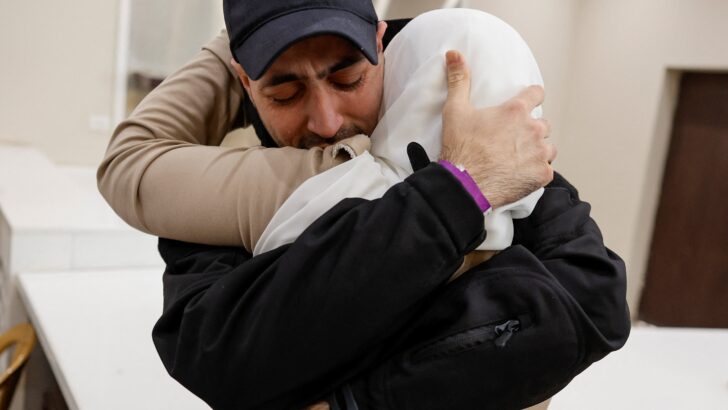
 A freed Palestinian prisoner is embraced by a family member in Ramallah, in the Israeli-occupied West Bank, Oct. 13, 2025, after being released from an Israeli jail as part of a hostages-prisoners swap and a ceasefire deal in Gaza between Hamas and Israel. (OSV News photo/Ammar Awad, Reuters)
“No war against Israel without Egypt, no peace without Syria” – for a long time this was the geostrategic rule of thumb for the conflict in the Middle East. But it has changed dramatically. While Syria is facing an uncertain future under Islamist leadership and is currently out of the picture in terms of power politics and diplomacy, Israel and the terrorist organisation Hamas wanted to sign US President Donald Trump’s peace plan on Monday in Sharm el-Sheikh, Egypt.
In addition to the USA, Qatar and Turkey are also among the mediating states in the long-awaited agreement, but Egypt has always played a key role in the Middle East conflict as the most populous Arab country with great cultural influence and Israel’s direct neighbour. Cairo has waged war against the Jewish state on several occasions. As the supreme power of the Arab allies, it suffered devastating defeats in 1948 and in the Six-Day War of June 1967. At that time, it lost control of the Gaza Strip and the Sinai.
Pioneer for peace
However, his successor Husni Mubarak continued the course of détente and at the same time supported the idea of an independent Palestine. Egypt thus increasingly became a mediator: as early as 1995, Israelis and Palestinians signed the second agreement of the Oslo process in Taba, Egypt.
Deep-rooted hatred of Israel
After the “Arab Spring” in 2011, even Egyptian President and Muslim Brother Mohammed Morsi upheld the peace treaty with Jerusalem. After his overthrow by the military, his successor Abdel Fattah al-Sisi largely silenced the fundamentalists, had hundreds of Hamas tunnels blown up for the smuggling of people and materials and further expanded economic cooperation with the neighbouring country. Egypt also diplomatically supported the reconciliation of other Arab states with Israel in the so-called Abraham Accords.
For the future of the Gaza Strip
In contrast, the Egyptian government vehemently rejected Trump’s proposal to relocate the 2.2 million Palestinians to neighbouring countries, including the Sinai, and insisted on aid money for a future for the people in Gaza – above all because al-Sisi’s regime cannot have any interest in the influx of hundreds of thousands of traumatised, often radicalised war refugees.
With a view to the upcoming reconstruction of the coastal region, Egypt is also likely to play a decisive role in the future. After two years of war, more than 90 per cent of the Gaza Strip has been destroyed. Following the peace summit, the Nile country is also due to host an international conference on reconstruction in a few weeks’ time – a task almost as big as peace itself.