

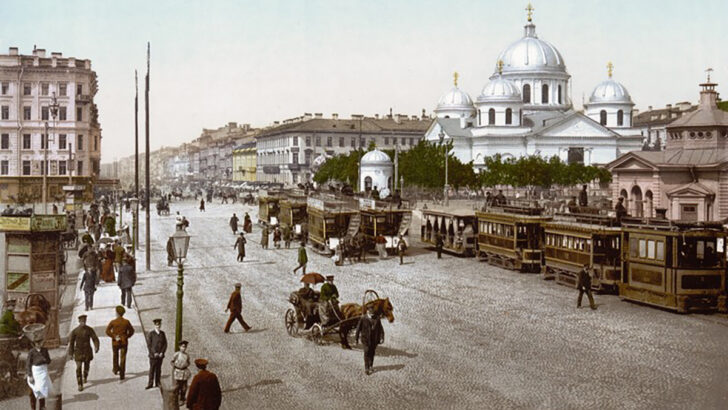
 - St Petersburg as it was in Dr Dillon’s time
 Dillon Rediscovered: The newspaperman who befriended kings, presidents and oil tycoons,
by Kevin Rafter
(Martello Publishing, €20/ £16.99)
Emile Joseph Dillon, born in Dublin in 1854, seemed from his early youth to be destined to become a Roman Catholic priest. He was the only surviving son of modest, pious parents living close to the quays in Dublin – and at his father’s insistence he entered the Dublin diocesan seminary, Clonliffe College, to train for the priesthood at the age of 14.
Leaving after six months, he then pursued a religious vocation successively in monasteries in Wales and the French Alps and with the Paulist Fathers in New York. After almost six years, he finally – in his own words – “renounced the soutane after profound reflection”.
The primary attraction of the priesthood for Dillon was the education it brought. In the years immediately after abandoning his priestly ambitions he spent time at a number of European centres of learning deepening the knowledge of languages and philosophy which he had begun to acquire while studying for the priesthood.
He was a brilliant student, reputedly the master of 26 languages. While studying in Leipzig University in 1875, he adopted the name ‘Emile’ and was subsequently known as ‘E. J. Dillon’; he had been baptised Joseph. The name ‘Emile’ was clearly intended to put distance between his impecunious origins in Dublin and the scholar he had become.
Career
An academic career now beckoned, and he secured a professorial appointment in the Imperial University of Kharkiv in north-east Ukraine in the early 1880s. He was, however, dismissed from that post in 1887 apparently as a result of a false allegation of sexual abuse. Once again, his life had to change direction. Having explored other academic opportunities without success, he drifted into journalism and found his true vocation.
His first experience in journalism was with two newspapers in Odessa, but he was soon invited to join the staff of the Daily Telegraph in London as their correspondent in St Petersburg. He remained with the Telegraph for thirty years – and, though based in St Petersburg, he travelled widely at the behest of his editors to cover most of the major stories of those years.
He reported inter alia on the Turkish massacre of Armenian Christians in 1894-5, the second Dreyfus trial in 1899, the Boxer Rebellion in China in 1900, the decline and fall of the tsarist regime in Russia, the First World War and the Versailles Peace Conference.
His linguistic abilities facilitated his work, and he developed a considerable talent for cultivating contacts. His reportage was regarded by politicians and others in authority as definitive. The Telegraph regarded Dillon’s exposé of the Armenian massacres to have been his greatest achievement.
In addition to his work for the Telegraph, Dillon wrote several books on public affairs and regularly contributed articles to the leading journals of the day – sometimes under a pseudonym. His employers at the Telegraph naturally resented this and, following a change in the newspaper’s management in 1916, they tried unsuccessfully to curtail it.
The new management were also uneasy about how much Dillon was costing them: he had a lavish expense account on top of a generous salary, and they paid for secretaries to accompany him on his travels. They terminated his employment in 1919.
He was afterwards engaged by a wealthy US oil tycoon, Edward L. Doheny, to act as publicist for his business interests in the US and in Mexico. Mexico was then the largest oil producer in the world.
Contract
His contract with Doheny also required him to study the political situation in Mexico and then publish his findings, the assumption being that his findings would coincide with Doheny’s business interests.
When this proved not to be the case and Dillon nevertheless insisted on freedom to publish the facts as he saw them, his relationship with Doheny ended acrimoniously after less than two years.
He retired to Barcelona, where he died in 1933. The obituary published in the Daily Telegraph, his long-time employer, stated – without exaggeration – that “the record of his services to this paper reads like chapters out of Marco Polo or Mandeville”.
The remarkable story of his life is told with great verve by Kevin Rafter, Professor of Political Communication at Dublin City University, in this well-produced book.