

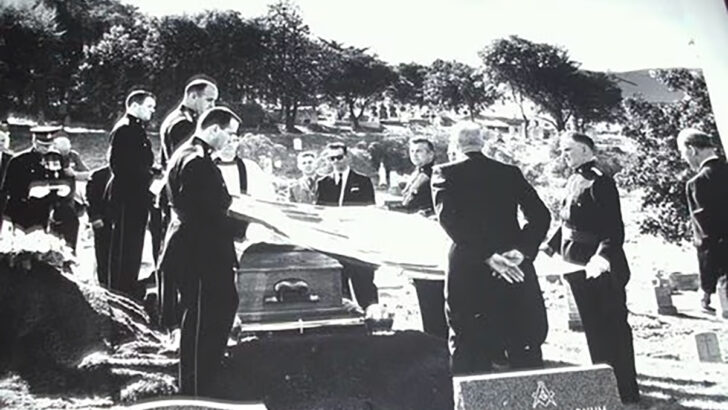
 Death comes for all, the Newfoundland funeral of Sir Henry Tudor
 An Accidental Villain: A Soldier’s Tale of War, Deceit and Exile,
by Linden MacIntyre
(Random House Canada, £22.00 / €18.99).
Ireland connections with Newfoundland are one of those topics readers are aware of, but rarely seem to receive detailed exploration. Here, however, is a book by an eminent Canadian writer and television reporter which will put this centuries old connection into a new perspective, focused on Ireland’s war for independence, constructed around the career of a British soldier.
Major General Sir Henry Tudor, a son of the Manse, was born at Newton Abbot, Devon, England, in 1871. After passing out at the Royal Military Academy at Woolwich he was deployed to India. There he began his life-long friendship with a fellow-officer, Winston Churchill. During the Boer War (1899-1902) he was severely wounded but recovered sufficiently to return to duty and was subsequently stationed in Britain, India and Egypt.
Tudor served on the Western Front in World War I, commanding the artillery of the Scottish Division and earning a reputation as a military tactician. He held command of the division until it was disbanded in March 1919 and was promoted to the rank of major general. As veterans sometimes say: ‘He had a good war’. He was honoured with a multiplicity of military decorations.
Through the influence of Churchill, Tudor was appointed to head the police and carry out the plan to pacify Ireland”
The Irish War of Independence began in 1919. From the outset it was clear it was to be a guerrilla war in which the role of the police would be as crucial as that of the army. The British government was determined to keep Ireland in the United Kingdom no matter what the cost and formulated an aggressive strategy to defeat the republicans. Through the influence of Churchill, Tudor was appointed to head the police and carry out the plan to pacify Ireland.
Measures
Tudor proposed strong measures: the introduction of identity cards, communal punishments, replacement of courts with courts martial and the deportation of prisoners. He expanded the RIC, adding to their ranks, with hundreds of veterans of the World War and he militarised the force by providing it with military equipment. He developed the Auxiliary Division. This was a 1500 striking-force composed of demobbed British officers.
As the conflict with the IRA intensified the police and the Auxiliaries became more and more reckless and ill-disciplined. IRA ambushes prompted reprisals in which villages, towns and the centre of Cork City were committed to flames. There was large-scale intimidation of the nationalist population. To the dismay of his military colleagues, Tudor failed to impose discipline on the police. When Brig-General Frank Crozier, OC of the Auxiliaries, dismissed those who burned down Trim town, he reinstated them, this leading to the resignation of Crozier.
Tudor opposed the Anglo-Irish truce on the grounds that the suspension of activity would benefit the IRA in the event of resumed hostilities. Following the Anglo-Irish treaty he oversaw the disbandment of the RIC and successfully encouraged hundreds of them to join the Palestine police force then being established. He ended his Irish assignment in June 1922.
He ignored directions from above and failed to establish an effective working relationship with the other senior figures in the Administration in Palestine”
Again, owing to the influence of Churchill, he was appointed to a similar position in the British Administration in Palestine which involved overseeing the new paramilitary police force. Subsequently the civil servants in London complained that he was not ‘a successful appointment’ as he ignored directions from above and failed to establish an effective working relationship with the other senior figures in the Administration in Palestine’. There was widespread relief when his service in Palestine ended in March 1924.
In the meantime Tudor’s marriage had ended and the differences between him and his wife had been aired in the popular press. He also had another issue with which to cope.
Assassinated
Field Marshal Sir Henry Wilson was assassinated by the IRA as he exited his home in London on June 22, 1922. Tudor had good reason to believe that he also was high up on the IRA death list.
On November 18, 1925 he travelled to St John’s in Newfoundland and settled there until he died on September, 25 1965. In his new home he was a well-regarded member of the British Expat community. He was involved in the international salted cod-fish trade, having become a business associate of George Barr, a leading fish exporter.
This book is beautifully shaped, meticulously researched and well written. It provides a splendid account of the Irish War of Independence and a riveting account of the courage and devastating losses suffered by the Newfoundlanders who served in the Great War, so it is fitting memorial not so much to Tudor, but as to the brave and hardy men from Newfoundland.
The Irish War of Independence began in 1919. From the outset it was clear it was to be a guerrilla war in which the role of the police would be as crucial as that of the army”