

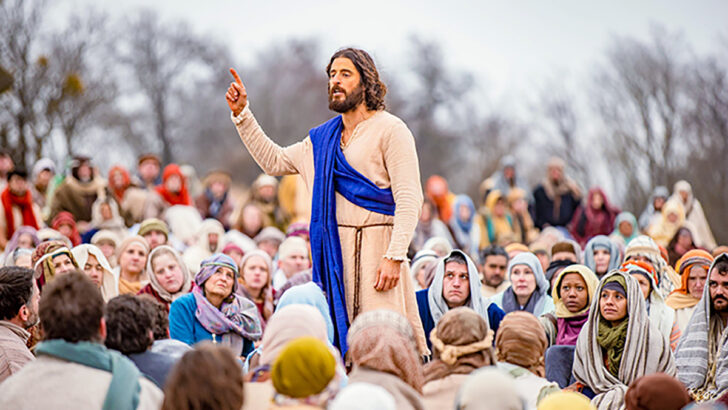
 Actor Jonathan Roumie, who plays Christ in the series The Chosen, is pictured in a scene depicting the sermon on the
mount. Photo: OSV News /Vidangel Studios.
Actor Jonathan Roumie, who plays Christ in the series The Chosen, is pictured in a scene depicting the sermon on the
mount. Photo: OSV News /Vidangel Studios.
Blessed are the poor in spirit, for theirs is the kingdom of heaven
Matt 5:1 When Jesus saw the crowds, he went up the mountain; and after he sat down, his disciples came to him.

Matt 5:2 Then he began to speak, and taught them, saying:
Matt 5:3 “Blessed are the poor in spirit, for theirs is the kingdom of heaven.
Matt 5:4 “Blessed are those who mourn, for they will be comforted.
Matt 5:5 “Blessed are the meek, for they will inherit the earth.
Matt 5:6 “Blessed are those who hunger and thirst for righteousness, for they will be filled.
Matt 5:7 “Blessed are the merciful, for they will receive mercy.
Matt 5:8 “Blessed are the pure in heart, for they will see God.
Matt 5:9 “Blessed are the peacemakers, for they will be called children of God.
Matt 5:10 “Blessed are those who are persecuted for righteousness’ sake, for theirs is the kingdom of heaven.
Matt 5:11 “Blessed are you when people revile you and persecute you and utter all kinds of evil against you falsely on my account.
Matt 5:12 Rejoice and be glad, for your reward is great in heaven, for in the same way they persecuted the prophets who were before you.”
Initial
observations
(i) There are many Beatitudes in the New Testament. The first is in Matthew 5:1 and the last is in Rev 22:14. Happiness is offered from beginning to end!
(ii) The Beatitudes in Matthew (invitation texts) are to be interpreted within the Sermon on the Mount and alongside the corresponding narrative section, chs. 8-9. Matthew leaves out the corresponding woes of Luke, but he has his own dire warnings!
Kind
of
writing
(i) In rhetorical terms, this text is an introduction, designed to get the attention, good will and ‘docility’ or receptivity of the hearers. It achieves these aims (a) by awakening a desire for happiness, (b) by naming the present situation and (c) by proposing attitudes and actions that lead to happiness and final salvation.
(ii) Matthew’s Beatitudes are chiefly apocalyptic, promising reversal. They thus reveal a difficult situation in his community, perhaps a result of the probably recent break with the mother faith of Judaism.
(iii) Here in Matthew’s gospel, there are nine beatitudes, in a significant order:
1-4 passive attitudes
5-8 active attitudes (with 8 as a bridge to 9)
9 beatitude on persecution
Beatitude 8 is from Matthew’s own source or perhaps his pen. Cf. 1 Peter 3:14: “But even if you do suffer for doing what is right, you are blessed. Do not fear what they fear, and do not be intimidated, but in your hearts sanctify Christ as Lord. Always be ready to make your defence to anyone who demands from you an accounting for the hope that is in you.” (1 Peter 3:14-15)
Old
Testament
background
There are very many “blessing” sayings in the Old Testament, especially in the psalms. In fact, the Psalter opens with one such “happy” saying. In general, the sayings occur in two settings: (a) in the Wisdom literature and (b) in the Apocalyptic literature. The wisdom beatitude is a desire for practical advice, which will lead to a peaceful life; the apocalyptic beatitude encourages endurance until God acts and reverses the present calamity.
New
Testament
foreground
(i) The Sermon on the Mount is the first of five great discourses in Matthew’s Gospel. It is sometimes given the title “Blessings: entering the Kingdom” and could be read in light of the fifth discourse (23-25), “Woes: the coming of the Kingdom” at the end.
(ii) Within that overall pattern, the Sermon on the Mount (“On the Plain” in Luke) has several possible outlines. The one overleaf may be helpful.
This leads us to see that the opening beatitudes may helpfully be read in conjunction with the corresponding exhortation in 7:13-27.
(iii) The Beatitudes are found also in Luke 6:20-26, where four beatitudes are matched by corresponding four woes. It is possible to compare both traditions to see if there is a more original form behind the texts we have now in our hands. It is probable that the Q (Saying Source) beatitudes originally read as follows:
Blessed the poor
for of them is the kingdom of God
Blessed the mourners
for they shall be consoled
Blessed the hungry
for they shall be satisfied
With that in mind, we can notice the editorial changes and additions in Matthew 5, which reveal his own theology and reception of the Beatitudes.
St
Paul
Rejoice in the Lord always; again I will say, Rejoice. Let your gentleness be known to everyone. The Lord is near. Do not worry about anything, but in everything by prayer and supplication with thanksgiving let your requests be made known to God. And the peace of God, which surpasses all understanding, will guard your hearts and your minds in Christ Jesus. (Phil 4:4–7)
Brief
commentary
Verse 1 The motivation for the Beatitudes is the compassion of Jesus as he looks on the crowds (even though the Beatitudes are offered to the disciples only). In Matthew, the location is more symbolism than geography. Moses went up the mountain of God and brought back the Ten Commandments. Thus, rather than looking for a Mount of the Beatitudes (however inspiring), it is the Moses symbolism which bears most meaning. Like Moses, Jesus sits, that is, he takes up his role as authoritative teacher. Although inspired by the crowds, the message is delivered to the disciples only, who come to Jesus.
Verse 2 A solemn opening intended to create anticipation and interest: lit., “he opened his mouth and was teaching them, saying.”
Verse 3 Matthew has “spiritualised” this beatitude somewhat. Certainly for the Lucan community, poor meant “without money” (as in the Acts). In the Old Testament, the poor in spirit are the pious, who enjoy God’s special care (Ps 14:6; 22:24; 25:16; 34:6; 40:17; 69:29.) A good interpretation of Matthew’s version was proposed in the original New English Bible: Happy are those who know their need of God (NEB). The REB reverted to the more traditional translation. Matthew’s speaks of the kingdom of heaven, so as to avoid naming God, thus respecting Jewish tradition. Notice the present tense, meaning now.
Verse 4 To mourn is a signal of suffering in the Old Testament, where the kings insist on “joy” when grief is appropriate. This is the first of the reversals, capturing the Apocalyptic flavour of the teaching.
Verse 5 Linguistically, both “poor” and “meek” go back to the anawim Yahweh (the poor of Yahweh) of the Hebrew Bible. The meaning is substantially the same as in v. 3, conveying another reversal.
Verse 6 Matthew has added “and thirst for righteousness”. Writing for a mixed comment from Gentile and Jewish backgrounds, he is especially interested in justification/righteousness before God. Hunger is used in relation to the poor in the OT: Isa 32:6–7; 58:6–7, 9–10; Ezek 18:7, 16.
Verse 7 Compare with Matt 7:2 and, perhaps, with 6:14: For with the judgment you make you will be judged, and the measure you give will be the measure you get. (Matt 7:2)
Verse 8 The sentiment is also found also in Ps 71:3. The Greek has “sons” here but clearly sons and daughters are intended and so “children” is faithful to the original.
Verse 9 Peace is a gift of the proclamation according to Matt 10:13, but see also for contrast Matt 10:34. Matthew has in mind shalom, pointing to a rich range of meanings such as physical wellbeing, good relationships, fertility etc.
Verse 10 Outside of the Sermon: “When they persecute you in one town, flee to the next; for truly I tell you, you will not have gone through all the towns of Israel before the Son of Man comes.” (Matt. 10:23). Cf. Matt 23:34. There was no persecution of disciples during the ministry of Jesus, so we are hearing the concerns and issues of the time of the later church.
Verse 11 While not so evident in the Sermon on the Mount, the relationship with the Lord is explored later in the Gospel: Matt 10:18, 39; 16:25; 19:5, 29.
Verse 12 Cf. “Woe to you when all speak well of you, for that is what their ancestors did to the false prophets.” (Luke 6:26)
Pointers
for
prayer
The blessings in the Beatitudes are primarily future blessings, but there can be an anticipation of the blessings in the present. At first reading some Beatitudes may seem to describe circumstances that you would like to avoid at all costs. Read them slowly. Stay with each one for a while.
Let yourself get a sense of the paradox involved in each one. Perhaps you have had an experience of a deeper and more authentic life, a blessing, when…
- You were poor – you knew your need of God.
- You mourned – could feel for others.
- You were meek – not emotionally out of control.
- You hungered and thirsted for some cause.
- You were merciful rather than vengeful.
- You were pure in heart – a person of integrity, whose actions and intentions correspond.
- You were a peacemaker.
- You were persecuted because you stood for something.
Prayer
O God, teach us the hidden wisdom of the gospel, so that we may hunger and thirst for holiness, work tirelessly for peace, and be counted among those who seek first the blessedness of your kingdom. We ask this through our Lord Jesus Christ, your Son, who lives and reigns with you in the unity of the Holy Spirit, God for ever and ever. Amen
A 5:1-2 Narrative Introduction
B 5:3-16 Opening exhortation
C 5:17-20 Fulfilment of the Law and the Prophets
D 5:21-48 The Antitheses (5 – one is “extra”; plus expansions)
E 6:1-6 Almsgiving
a how to pray
F 6:7-15 Prayer b The Lord’s Prayer a* why forgiveness
E* 6:16-18 Fasting
D* 6:19-17:11 (5 negative imperatives plus expansions)
C* 7:12 Fulfilment of the Law and the Prophets
B* 7:13-27 Closing exhortation
A* 7:28 Narrative Conclusion
Thought for the day
Who doesn’t want to be happy? As St Augustine writes, “all persons want to be happy; and no persons are happy who do not have what they want.” (De beata vita 2.10) Augustine knows that it is not so simple: having what and how do we keep it so that we don’t lose it? The question really becomes what do I desire? In the final analysis, there is a hunger of the human heart for God, often recognised only slowly, and a hunger for goodness and virtue, also a slow conversion. In God, we find a source of happiness which nothing can take away; in virtuous living, chiefly seeking the good of others, we come to our true fulfilment and contentment.
Prayer
God our true happiness, help us recognise our need of you that we may blessed in your kingdom. Amen.
Not many were wise by human standards, not many powerful, not many born to a privileged position
First reading
Cor 1:26 Think about the circumstances of your call, brothers and sisters. Not many were wise by human standards, not many were powerful, not many were born to a privileged position.
1 Cor 1:27 But God chose what the world thinks foolish to shame the wise, and God chose what the world thinks weak to shame the strong.
1 Cor 1:28 God chose what is low and despised in the world, what is regarded as nothing, to set aside what is regarded as something,
1 Cor 1:29 so that no one can boast in his presence.
1 Cor 1:30 He is the reason you have a relationship with Christ Jesus, who became for us wisdom from God, and righteousness and sanctification and redemption,
1 Cor 1:31 so that, as it is written, “Let the one who boasts, boast in the Lord.”
Initial
observations
In this passage, the reading gains a rich insight into the social standing of the believers in Corinth, as well as a deep insight into Paul’s spiritual theology.
Kind
of
writing
In the handbooks on rhetoric, one of the techniques for getting people’s attention was insult. It was not widely recommended because while you may have the attention of the hearers, you will lose their goodwill. Paul takes the risk, however, in order to bring forward his teaching. In the previous paragraph, Paul underlined the paradox of the cross: apparent foolishness and weakness instead of wisdom and strength. To help the Corinthians to register this reality in their own experience, he reminds them of their own relative weakness and foolishness. They know that they were not among the powerful, the educated, the élite etc.; nevertheless, they heard the call of the Gospel. They will rejoice that, in spite of their status, God chose them as Christ believers. In this way, the paradox of the Gospel is evident in their very own journey of faith. Paul takes a good deal of the harm out of this risky approach in the next paragraph where he illustrates the same reality in himself.
Origin
of
the
reading
The context in the community is rivalry among groups and support for different preachers on the basis of their fluency and eloquence. A good example would be Apollos, a notably fluent speaker from Alexandria in Egypt, who has replaced Paul in the affections of some of the Corinthians. Paul is not happy with that. The basis for the unhappiness however is not simply power or vanity: Paul is concerned that their faith should not be grounded “externally” in the excellence of any preacher but rather “internally” in their own experience of the Spirit.
Related
passages
Guard against self-deception, each of you. If someone among you thinks he is wise in this age, let him become foolish so that he can become wise. For the wisdom of this age is foolishness with God. As it is written, “He catches the wise in their craftiness.” And again, “The Lord knows that the thoughts of the wise are futile.” So then, no more boasting about mere mortals! For everything belongs to you, whether Paul or Apollos or Cephas or the world or life or death or the present or the future. (1Corinthians 3:18–22)
Your boasting is not good. Don’t you know that a little yeast affects the whole batch of dough? (1Corinthians 5:6)
But may I never boast except in the cross of our Lord Jesus Christ, through which the world has been crucified to me, and I to the world. (Galatians 6:14)
If people want to boast, they should boast about this: They should boast that they understand and know me. They should boast that they know and understand that I, the Lord, act out of faithfulness, fairness, and justice in the earth and that I desire people to do these things,” says the Lord. (Jeremiah 9:24)
Brief
commentary
Verse 26 The “not many” is equivalent to “only a few.” Some were indeed educated etc, but most were not.
Verse 27 God’s choice is paradoxical and counter-cultural. In a strong honour/shame society, status is everything. But the Gospel is otherwise, as we see not only in Christ but even in those who follow him. The weak and the strong will come back again in the discussion of food sacrificed to idols in 1 Corinthians 8 (and notably in Romans 14).
Verses 28-29 The purpose of God in choosing the weak is made clear in the last phrase of v. 28 and also in v. 29. God wants to set aside what is regarded as something. More importantly, the aim is to undermine boasting, the besetting sin of the culture of that time (and perhaps today). In particular, not one may boast in his presence, that is, before God. Later in the letter, we shall see that the Corinthians greatly valued the external manifestations of spiritual “progress.” Such vaunting of the spiritual life is very much against both the teaching and the practice of Paul. His unwillingness to speak of his own spiritual life in 2 Corinthians 12 is stark evidence of this. The value of the spiritual life of each comes from within and is evident, not in spectacular charisms but in the everyday living of love, the highest charts (1 Cor 13) and open to all without distinction.
Verse 30 This is a very interesting list of equivalent terms: righteousness (justification), sanctification and redemption. In other letters, it is clear that we have access to God through the faithfulness of Jesus. Through the Holy Spirit, this faithfulness of Jesus is the ground of our faith and of our faithfulness. In other words, all is gift and there can be no meriting whatsoever, much less boasting.
Verse 31 The citation is from Jeremiah 9:24 (above). All of Jeremiah 9 forms the background to the spirituality here and would be worth reading.
Pointers
for
prayer
- The paradox of the cross is not simply to do with Jesus but with all of us. What has experience taught me about “weakness” and “foolishness” as means of grace?
- The feeling that the initiative is not mine but God’s is part of every authentic spirituality. What my own sense of who is leading this relationship?
- Paul speaks of Christ as wisdom, righteousness, sanctification and redemption. What words would I spontaneously use?
Prayer
Gracious God, giver of every good gift, help us to recognise you in everyone and everything around us. May we rejoice in receiving all from the you, who are grace in yourself. Amen.
Seek the Lord, you humble of the land, seek righteousness, seek humility
Zeph 2:3 Seek the Lord, all you humble of the land,
who do his commands;
seek righteousness, seek humility;
perhaps you may be hidden
on the day of the Lord’s wrath.
Zeph 3:12 For I will leave in the midst of you
a people humble and lowly.
They shall seek refuge in the name of the
Lord—
13a the remnant of Israel;
13b they shall do no wrong
and utter no lies,
13c nor shall a deceitful tongue
be found in their mouths.
13d Then they will pasture and lie down,
and no one shall make them afraid.
Second reading
Initial observations
Our reading is chosen because it anticipates some of values portrayed in the Beatitudes of Jesus. We may note: humble, humility, lowly. Also, there is a promise that such countercultural values will not go unrewarded: Then they will pasture and lie down, and no one shall make them afraid.
Kind of writing
Zephaniah is a kind of “biblio drama” in which the future treatment of the Temple foreshadows the destiny of those leaders, religious and political, who have betrayed the ancestral faith. The intended audience is, therefore, significant. Zephaniah addresses himself to the “poor in the land”, the faithful remnant, those exhorted to keep faith until the Day of the Lord. There is also a negative audience, that is, those who set aside the sovereignty of YHWH. Finally, the book references traditions known to the first hearers from Genesis, Deuteronomy, Isaiah, and Amos.
Who was Zephaniah? He tells us himself in an unusually detailed superscript: The word of the Lord that came to Zephaniah son of Cushi son of Gedaliah son of Amariah son of Hezekiah, in the days of King Josiah son of Amon of Judah. (Zeph 1:1) Zephaniah means “God protects”. “Son of Cushi” may indicate that he was African.
He was a late 7th century bc prophet, who knew Jerusalem and its Temple exceptionally well. The ancestral name Hezekiah reminds us of the last reforming monarch of the same name. Zephaniah wrote during the reign of Josiah, who was to, eventually, himself enact significant religious reforms.
The book is framed by a prediction of disaster at the start (1:2-6), and an oracle of restoration at the end (3:14-20). It consists of there grand pronouncements, as follows:
1:1 Superscript
1:2-2:4 Oracle against Judah and Jerusalem.
1:5-3:8 Oracles against the nations.
3:9-20 Oracles of judgement, conversion and return (perhaps added later after the Exile).
Domain.
Origin of the reading
The context of the prophet Zephaniah is the time of Josiah, just before the latter’s religious reforms. A good idea of what was happening can had by reading 2 Kings 21-23. The issues at stake are apostasy (even of the clergy), corruption and international unrest, characteristic of the last years of the Assyrian empire. In the course of a very short book, Zephaniah makes use of the symbolism of the Temple and its liturgy as a microcosm of God’s relationship with all of creation. Thus, for example, the purification of the Temple stands for the restoration of all of creation. Jerusalem, then as now, was also the political heartbeat of the nation. The purification of Jerusalem will also be a political act when God takes on the Assyrians. An over-arching theme is the Day of the Lord and the text of Zephaniah 1:16 ff. inspired the terrifying Dies Irae of the old Requiem Mass (see below under related readings).
Related readings
That day will be a day of wrath (dies irae), a day of distress and anguish, a day of ruin and devastation, a day of darkness and gloom, a day of clouds and thick darkness, a day of trumpet blast and battle cry against the fortified cities and against the lofty battlements. (Zeph 1:15–16)
He has told you, O mortal, what is good; and what does the Lord require of you but to do justice, and to love kindness, and to walk humbly with your God? (Micah 6:8)
Brief commentary
Verse 3 The context of this attractive verse is 2:1-4, full of threat and dire warning. In particular. v. 4 will have an unfortunately contemporary ring. The “poor of the land” reflects ‘anwê haares, the downtrodden oppressed who keep faithful to God. The word for humble comes up again in this gospel: Take my yoke upon you, and learn from me; for I am gentle and humble in heart, and you will find rest for your souls. (Matthew 11:29) The “perhaps” is intended to unsettle and at the same time to invite.
Verse 12 Again, the context of these two verses is really 3:9-14. At this point, the tone of the book changes completely to hope and future salvation for all. The divine wrath is spent and people have been purified. V. 12 could stand as a definition of the ‘anawim, the poor of the land, with their virtues. The best commentary is the well-loved Micah 6:8 above.
Verse 13a The idea of the remnant as a seed corn of the future will eventually have a long future, playing a central role in the spirituality of the great Exile and emerging even in Romans 9-11.
Verse 13bcd It is surely interesting that the virtues of the faithful remnant are wholly concentrated on truth-telling. The implied metaphor reminds us of other texts such as Psalm 23.
Pointers for prayer
- When have you heard in a personal way the call to “seek the Lord”? How do you hear it today?
- Difficult experience can, eventually, lead to a new depth of relationship with God. Have you known this in your life?
Prayer
We know and we believe, O God, that you seek us even more than we seek you. Help us recognise your longing for us and awaken in us a deeper longing for you, ever faithful and loving God. Amen.
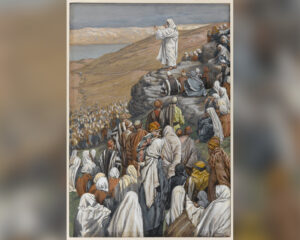
Photo: OSV News/Brooklyn Museum.
Hearers of the Word: The Liturgy
Readings 1 and 3
The first reading not only anticipates some of the virtues of the Beatitudes in the Gospel but it also portrays the difficult experiences which lie behind the spirituality being offered. Zephaniah is very realistic.
The responsorial Psalm
Zephaniah portrays the remnant, those who faithful to God. The Psalm hows the other side of that relationship — God’s faithfulness to those in need. God’s compassion and justice serve as the foundations blocks of Christian social teaching.
Sunday introductions
First reading Zephaniah 2:3, 3:12-13
Our reading is in two parts, both reflecting very difficult times. The first is an invitation to seek the Lord — an invitation never out of date. The second part profiles the virtue (lit. the strength) of truth telling. Some think we live in a post truth society. This is nonsense both socially and spiritually.
Second reading
1 Corinthians 1:26-31
Paul is always against puffing ourselves up in any away. Here, he takes the risk of reminding the Corinthian believers of their essentially humble backgrounds. All is grace. This excerpt can help us during the Week of Prayer for Christian Unity: there can be no place for superiority or competitiveness.
Gospel
Matthew 5:1-12
This important reading offers a kind of identikit of the Christian. In English, there’s a potential play on words: the Beatitudes are our “be attitudes.”
Weekday introductions
Monday 2 February
The Presentation in the Temple
Malachi 3:1-4
This rather fierce prophecy was offered at a time of religious reconstruction after disaster. There is no mistaking the plain meaning that it is the leadership which is in need of purification.
Hebrews 2:14-18
As we can see from the stories of his birth, Jesus can help us because he is one of us. This closing of the gap with humanity makes him the ideal priest, mediating God’s grace to us all.
Luke 2:22-40
There are so few elderly people in the New Testament, that it is delightful to find such wonderful characters as Simeon and Anna, still full of faith in old age.
Tuesday 3 February
St Ansgar, bishop; St Blaise, bishop, martyr
2 Samuel 18:9-10, 14, 24-25, 30-19:3
This is one of the most moving stories in the entire Old Testament. Absalom has rebelled again his father, but David still mourned him as his son.
Mark 6:1-6
It is surprising to see Jesus unable to do anything, so this scene is certainly historical. We do can block the action of grace in our own lives…
Wednesday 4 February
2 Samuel 24:2,8-17
In the Bible, why would a census be a sin? Possibly because the people belong to God, not to the king. True to his character, David repents, but is punished all the same.
Mark 6:1-6
This remarkable story is surely historical because it shows the powerlessness of Jesus. It is also a hint to us: sheer familiarity can close our eyes and our hearts to what God is doing today through the Gospel.
Thursday 5 February
St Agatha, virgin and martyr
1 Kings 2:1-4, 10-12
The tumultuous career of David comes to a close and, as his death approaches, he has advice for Solomon, his son and successor.
Mark 6:7-13
Jesus empowers the twelve to undertake the very same ministry of proclaiming and healing. They are to travel light, taking nothing extra that might impede them and also taking the risk of being welcomed or not, as the case may be.
Friday 6 February
St Paul Miki and companions, martyrs
Ecclesiasticus 47:2-13
David’s status grew after the Exile in Babylon. Our reading today is a late Jewish reflection, which helps us to see how people viewed David just before the time of Jesus, himself a son of David.
Mark 6:14-29
At the hands of Mark, the death of John the Baptism foreshadows the destiny of Jesus. The arbitrariness of John’s beheading—to honour an oath spoken in a frivolous moment—is still shocking
Saturday 3 February
St Mel, bishop
1 Kings 3:4-13
This scene is a key to Solomon’s reputation for wisdom. God’s makes a very open offer to Solomon and, significantly, he opts to the spiritual gifts, which would make him famous.
Mark 6:30-34
It is instructive to see that Jesus himself was aware of need to balance life and work, prayer and ministry. This is true of us all in our different roles.
At the same time, Jesus felt compassion for the crowd and, in spite of his own need of rest and refreshment, actually responded to the need of the people.