

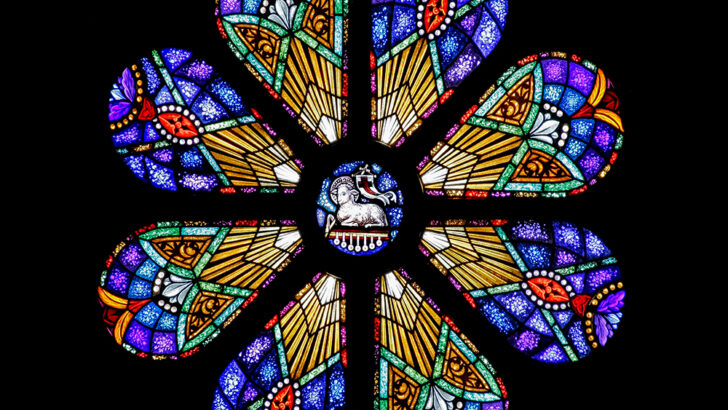
 A stained-glass window depicting a the Lamb of God is seen at St Charles Church in Chippewa Falls, Wisconsin. Photo: OSV News /CNS file, Crosiers.
 The Gospel – Here is the Lamb of God!
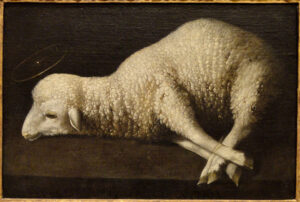
John 1:29 The next day John saw Jesus coming toward him and declared, “Here is the Lamb of God who takes away the sin of the world!

John 1:30 This is he of whom I said, ‘After me comes a man who ranks ahead of me because he was before me.’
John 1:31 I myself did not know him; but I came baptising with water for this reason, that he might be revealed to Israel.”
John 1:32 And John testified, “I saw the Spirit descending from heaven like a dove, and it remained on him.
John 1:33 I myself did not know him, but the one who sent me to baptise with water said to me, ‘He on whom you see the Spirit descend and remain is the one who baptises with the Holy Spirit.’
John 1:34 And I myself have seen and have testified that this is the Son of God.”
Initial Observations
In the tradition of the liturgical year, there are three “epiphanies” of Jesus: the first is the feast of the Epiphany (Jan 6), the second is the Baptism of the Lord (the following Sunday) and the third is the Wedding Feast of Cana (the next Sunday). With the current three-year lectionary, the Cana story is read in the year of Luke. For the other two years, an “epiphany” moment from John’s Gospel is used—today it is the witness of the Baptist to Jesus.
It is very often the case in the Fourth Gospel that we are (over)hearing not the historical words of John (or others) but rather the theology, the deep spiritual teaching of the evangelist.
Kind of writing
This is quite scenic, even theatrical writing. The author uses considerable freedom to create a narrative which makes John the Baptist identify Jesus and reveal him to Israel. This is unlikely to be historical—witness the questions of the Baptist in Matthew 7:18-20 and parallels. The language used is thoroughly Johannine: the next day: Mt (1), Mk (1), Lk (0), Jn (5); lamb: Mt (0), Mk (0), Lk (0), Jn (2); sin Mt (6), Mk (7), Lk (11), Jn (17); world: Mt (9), Mk (3), Lk (3), Jn (78); this is the one: Mt (14), Mk (4), Lk (7), Jn (18); revealed: Mt (0), Mk (3), Lk (0), Jn (9); witness: Mt (1), Mk (0), Lk (1), Jn (33); to remain or abide: Mt (3), Mk (2), Lk (7), Jn (40); to know: Mt (24), Mk (21), Lk (25), Jn (84); to send Mt (4), Mk (1), Lk (10), Jn (32).
This means we are dealing with a text full of Johannine vocabulary and theology. These scenes represent a remarkable theology of the identity of Jesus, the risen Lord present in the community of faith.
Day 1 scene one: “who are you?” 1:19-23
scene two: “why to you baptise?” 1:24-28
Day 2 scene three: “the purpose of John’s baptism” 1:29-31
scene four: “the identity of Jesus, baptiser in the Spirit” 1:32-34
The opening narrative of the Fourth Gospel is carefully choreographed. The author is keen to relate and distinguish the persons and roles of John and Jesus. All four scenes are connected (notice the number of denials by John) and lead to the climactic identification of Jesus. John the Baptist gives the first “human” reaction to Jesus in the Fourth Gospel and the image used—Lamb of God—is heavy with meaning.
Old Testament Background
The Lord said to Moses and Aaron in the land of Egypt: This month shall mark for you the beginning of months; it shall be the first month of the year for you. Tell the whole congregation of Israel that on the tenth of this month they are to take a lamb for each family, a lamb for each household. If a household is too small for a whole lamb, it shall join its closest neighbour in obtaining one; the lamb shall be divided in proportion to the number of people who eat of it. Your lamb shall be without blemish, a year-old male; you may take it from the sheep or from the goats. You shall keep it until the fourteenth day of this month; then the whole assembled congregation of Israel shall slaughter it at twilight. They shall take some of the blood and put it on the two doorposts and the lintel of the houses in which they eat it. They shall eat the lamb that same night; they shall eat it roasted over the fire with unleavened bread and bitter herbs. (Ex 12:1-8)
New Testament Foreground
(i) Jesus as the Lamb of God: the author has several things in view. Firstly, Jesus fulfils the symbolism of the Passover of Lamb, bringing a new liberation by his death. Secondly, Jesus is delivered to death at the moment when the slaughter of the Passover lambs started (Jn 19:14). There is some link with the Good Shepherd language and laying down one’s life for the sheep.
(ii) The pre-existence of the Word is already plain from John 1:1-18 (“John testified to him and cried out, “This was he of whom I said, ‘He who comes after me ranks ahead of me because he was before me.’” (John 1:15). Later in the Gospel, at the expense of grammar, theology is made clear: “Jesus said to them, “Very truly, I tell you, before Abraham was, I am.”” (John 8:58)
(iii) Jesus is the sender of the Spirit in the Fourth Gospel: John 14:16-17, 26; 15:26; 16:7, 13; 19:30; 20:22.
(iv) “The one sent me” is practically a name for God in this Gospel: John 1:33; 4:34; 5:24, 30, 37; 6:38-39, 44; 7:16, 28, 33; 8:16, 18, 26, 29; 9:4; 12:44-45, 49; 13:20; 14:24; 15:21; 16:5. The really pregnant text which combines (iii) and (iv) is: “As the Father has sent me, so I send you.” When he had said this, he breathed on them and said to them, “Receive the Holy Spirit” (John 20:21-23).
St Paul
Your boasting is not a good thing. Do you not know that a little yeast leavens the whole batch of dough? Clean out the old yeast so that you may be a new batch, as you really are unleavened. For our paschal lamb, Christ, has been sacrificed. Therefore, let us celebrate the festival, not with the old yeast, the yeast of malice and evil, but with the unleavened bread of sincerity and truth. (1 Cor 5:6-8)
Brief Commentary
Verse 29 John and Jesus seem not to meet in this Gospel (the baptism as such is not recounted here). Again, nothing prepares us for the identification of Jesus with the Lamb of God. It is historically most unlikely that John the Baptist made such a proclamation. Rather, we have here the spiritual teaching of the Fourth Gospel, which does indeed identify Jesus as our Passover Lamb, as is evident in the details of the death of Jesus in this Gospel: noon, hyssop, not breaking the bones. Noon was the established time when it was permitted to begin slaughtering the Passover lambs (John 19:14). Hyssop is impractical for sustaining a sponge, but it echoes the instructions for the Passover (John 19:29). The breaking of the legs is found only in this Gospel; again, it echoes the instructions for the Passover lamb (John 19:33). The human issue of sin (sin as such, and not sins) will be “resolved” by Jesus as he discloses the astonishing love of God both in his teaching and in his “lifting up”. Cf. For God so loved the world that he gave his only Son, so that everyone who believes in him may not perish but may have eternal life. (John 3:16)
Verse 30 Johannine anxiety about the relatedness and distinction of Jesus and John comes to the fore. Once more, this high Christology represents the teaching not of John the Baptist, of course, but that of the evangelist and his community. Although it seems historically unquestioned that John was the older of the two, here “he was before me.” This takes us back to the deep origins of Jesus in God, as explored in the Prologue of John. Cf. John 8:58 above.
Verse 31 Behind the deep theology may be a factual memory of John’s genuine ignorance of the person he was sent to introduce. There may also be historical fidelity in the limited revelation to Israel. This Gospel knows that Jesus is the saviour of the world, but John—in fact—had a mission only to Israel. John’s baptism is “only” symbolic; Jesus’ baptism will confer the reality, the Holy Spirit.
Verse 32 In this verse we come as near as this Gospel will allow us to the baptism of Jesus by John, one of the most certain things about the life of the historical Jesus. (See the previous Sunday’s notes for an explanation of this reticence.) However, the baptism is actually not recounted, although the accompanying symbols indicating a transcendent experience are indeed present. The witness of John is given first, and only then the chronologically prior revelation from God. Witness is a hugely important term for the Fourth Gospel and here John is shown as the first, truthful witness about Jesus.
Verse 33 The interpretation, given before to John, is only now recounted, almost as a confirmation before and after the fact. That the Spirit remains/abides is a key because Jesus will give the Spirit in such a new way that it is almost as if there were no Spirit active before him.
Verse 34 “Seen and testified” — all pure Johannine language. “Son of God” is used more frequently of Jesus in this Gospel than in any other (8-8-10-18). Cf. We declare to you what was from the beginning, what we have heard, what we have seen with our eyes, what we have looked at and touched with our hands, concerning the word of life— this life was revealed, and we have seen it and testify to it, and declare to you the eternal life that was with the Father and was revealed to us— we declare to you what we have seen and heard so that you also may have fellowship with us; and truly our fellowship is with the Father and with his Son Jesus Christ. We are writing these things so that our joy may be complete. (1John 1:1–4)
Pointers for Prayer
- The words of John point to a deep recognition of Jesus’ identity. Can I recall times when this recognition took place for me, first of all on a human level, and then on the faith level?
- John the Baptist admits to not knowing him—a place of real honesty which is the beginning of the pilgrimage of faith. At some point, perhaps, I heard the words of the Psalmist in my heart: a voice I did not know said to me, I freed your shoulder from the burden (Ps 81).
- What is my own conviction about being sent and about the one sending me? Prayer of call and response.
- Jesus baptises with the Spirit—a baptism I too have received, perhaps too young. In later life, there can be an awakening of the Spirit, an inner hunger and thirst, a sense of the Spirit’s help in our weakness. Prayer of Romans 8:26-27.
- Witness is the key. Who have been witnesses to me of the Good News? To whom am I today a witness? Prayer of 1 John 1:1-4.
Prayer
Merciful God, you sent your Son, the spotless Lamb, to take upon himself the sin of the world.
Make our lives holy, that your Church may bear witness to your purpose of reconciling all things in Christ, who lives and reigns with you in the unity of the Holy Spirit, God for ever and ever. Amen.
Thought for the day
In John’s Gospel, the first thing that any human being says of Jesus is found on the lips of John the Baptist: Look, there is the Lamb of God. We think naturally and correctly of the Passover lamb and of the Passover, the feast which marks the liberation of Israel. To be set free is a wonderful experience and we could reflect on how I experience my freedom in Christ. From what have I been set free? (For example, fear of death, the risk of absurdity, sins and false directions in life…) Even more important, for what have I been set free?
Prayer
Jesus, Lamb of God, help me to recognise whatever in me is holding me back from life in abundance: give me your life, your forgiveness, your healing. In you, I put my trust.
=============
Grace and peace to you from God our Father and the Lord Jesus Christ!
1 Cor 1:1 From Paul, called to be an apostle of Christ Jesus by the will of God, and Sosthenes, our brother,
Cor 1:2to the church of God that is in Corinth, to those who are sanctified in Christ Jesus, and called to be saints, with all those in every place who call on the name of our Lord Jesus Christ, their Lord and ours.
Cor 1:3 Grace and peace to you from God our Father and the Lord Jesus Christ!
Initial observations
The extensive correspondence with the Corinth gives us a unique insight into the community and Paul’s relationship with them. Clearly he loved them; just as clearly, they drove him mad! There’s a great deal of reconciliation and patching up across 1 and 2 Corinthians.
Kind of writing
1 Corinthians is a letter, showing the usual features, and at the same time a “persuasion”, following the culturally available categories of Hellenistic rhetoric. We may outline it as follows:
1:1-3 Epistolary superscript
1:4-9 Thanksgiving/Introduction
1:10-15:58 Deliberative argument
16 Appeal and epistolary conclusion
We will see the various arguments as the letter is explored over the coming Sunday. For the moment, it is enough to note that our reading is simply opening of the letter and the greeting.
Context in the community
The Corinthians Christians were experiencing divisions among themselves. This is partly a fruit of there being different “house churches” and partly a fruit of straightforward disagreement on moral, social, sacramental and doctrinal issues. While the divisions are not along the Jewish/Gentile divide known from Romans and Galatians, they are just as harmful to Paul’s overall project, the communion of all humanity in Christ. For the foundation of the church during Paul’s second missionary journey, see Acts 18:
After this Paul left Athens and went to Corinth. There he found a Jew named Aquila, a native of Pontus, who had recently come from Italy with his wife Priscilla, because Claudius had ordered all Jews to leave Rome. Paul went to see them, and, because he was of the same trade, he stayed with them, and they worked together—by trade they were tentmakers. Every sabbath he would argue in the synagogue and would try to convince Jews and Greeks. (Acts 18:1–4)
Corinth was a very large service city, recently “re-founded” by Julius Caesar. It had a reputation for immorality but was probably no worse than other ports around the Mediterranean. The usual temples and shrines have been found: Apollo, Athena, Poseidon, Hera, Aphrodite, Heracles, Jupiter Capitolinus, Asklepios, Isis, and Serapis. There was also at least one synagogue.
Related passages
The superscripts can be short and long. Longer ones are laden with theology and often anticipate the issues to come. Here are two examples:
From Paul and Silvanus and Timothy, to the church of the Thessalonians in God the Father and the Lord Jesus Christ. Grace and peace to you! (1Thessalonians 1:1)
From Paul, a slave of Christ Jesus, called to be an apostle, set apart for the gospel of God. This gospel he promised beforehand through his prophets in the holy scriptures, concerning his Son who was a descendant of David with reference to the flesh, who was appointed the Son-of-God-in-power according to the Holy Spirit by the resurrection from the dead, Jesus Christ our Lord. Through him we have received grace and our apostleship to bring about the obedience of faith among all the Gentiles on behalf of his name. You also are among them, called to belong to Jesus Christ. To all those loved by God in Rome, called to be saints: Grace and peace to you from God our Father and the Lord Jesus Christ! (Romans 1:1–7)
Brief commentary
Verse 1 Ancient letters began with the name of the sender. Paul gives a careful description of himself: his vocation (“called”), his role (“apostle”), his authority (“will of God”). This is not at all accidental. The Corinthians tended to factionalism and at least some of them had replaced Paul by Apollos in their esteem and affection. Cf. For though you may have ten thousand guardians in Christ, you do not have many fathers, because I became your father in Christ Jesus through the gospel. (1Corinthians 4:15) Paul was not one of the Twelves Apostles but always considered himself their equal. In Acts 18, a certain Sosthenes is mentioned: So they all seized Sosthenes, the president of the synagogue, and began to beat him in front of the judgment seat. (Acts 18:17) Like Paul, he was a Jew who became a Christ believer.
Verse 2 The word “church” (ekklesia) is neutral, meaning an assembly of any kind. Thus, it requires qualification: the assembly of God in Corinth. Saints means simply believers and is the ancient equivalent of Christians. Notice that Paul typically combines, even in this simple greeting, his trade-mark of indicative (“are sanctified”) and imperative (“called to be saints”). Cf. And may the Lord cause you to increase and abound in love for one another and for all, just as we do for you, so that your hearts are strengthened in holiness to be blameless before our God and Father at the coming of our Lord Jesus with all his saints. (1 Thess 3:12–13) Some of you once lived this way. But you were washed, you were sanctified, you were justified in the name of the Lord Jesus Christ and by the Spirit of our God. (1 Cor 6:11)
Paul goes on to mention “all in every place”, thereby signally a wider communion, which will be the very challenge as he writes to the Corinthians. However, 1 Corinthians is not a general epistle but is quite specifically focused on the issues emerging in Corinth. See the teaching on the Eucharist (ch. 11) and the teaching on the gifts (ch. 12-14).
Verse 3 Grace reflects the notion of unexpected gift or favour, triggering a sense of gratitude. It also points to the spiritual gifts, a point of contention. Peace or communal harmony is the very thing they lack. Notice no fewer than four mentions of Christ in a very brief passage. 1 Corinthians opens with an intense reflection on the crucifixion of Jesus in ch. 1 and closes with a deep exploration of the resurrection of Jesus in ch. 15.
Pointers for prayer
- What is my own sense of being favoured, gifted or graced?
- What is God asking of me now, so that I may grow in holiness?
Prayer
God of every gift and grace, help us to build a community where all are welcome and the gifts of each contribute to the well-being of all. Through Christ our Lord. Amen.
======
I will give you as a light to the nations
Is. 49:1 Listen to me, O coastlands,
pay attention, you peoples from far away!
The Lord called me before I was born,
while I was in my mother’s womb he named me.
2 He made my mouth like a sharp sword,
in the shadow of his hand he hid me;
he made me a polished arrow,
in his quiver he hid me away.
3 And he said to me, “You are my servant,
Israel, in whom I will be glorified.”
4 But I said, “I have laboured in vain,
I have spent my strength for nothing and vanity;
yet surely my cause is with the Lord,
and my reward with my God.”
5 And now the Lord says,
who formed me in the womb to be his servant,
to bring Jacob back to him,
and that Israel might be gathered to him,
for I am honoured in the sight of the Lord,
and my God has become my strength—
6 he says,
“It is too light a thing that you should be my servant
to raise up the tribes of Jacob
and to restore the survivors of Israel;
I will give you as a light to the nations,
that my salvation may reach to the end of the earth.”
Initial Observations
Following on last Sunday’s reading from Isaiah 42—one of the Suffering Servant Songs—we have today a second Song, this time from Isaiah 49. The full Song is four verses, 1-4, with a second song in 5-12, sensibly shortened in the Lectionary. The added verses are in italics, as usual.
Kind of writing
Apart from being poetry, this seems to be a report of the commissioning of the Servant. The speaker in vv. 1-4 to Israel, reflecting on her call. Cf. 41:8-10, 43:1-7, and 44:1-5. In some way, the Servant Israel seems not to have accepted the role assigned by God to Cyrus, who is the effective political anointed (= Messiah!) of God. Cf. 42:1- 4, 44:28- 45:7, and 45:13. There is feeling of disappointment in vv. 1-4, in contrast with the energy and confidence in vv. 5-12. Any reader will notice the change of tone in v. 5.
Origins of the reading
We are in Second Isaiah. For the detailed context, see last week’s fairly complete notes on Isaiah and on the songs.
The real context is the other Suffering Servant Songs, that is, Is 42:1-4; 49:1-4; 50:4-9; 52:13–53:12.
The word of the Lord came to me: Before I formed you in the womb I knew you, before you were born I dedicated you, a prophet to the nations I appointed you. (Jer 1:4–5)
But when God, who had set me apart before I was born and called me through his grace, was pleased to reveal his Son to me… (Gal 1:15–16)
Brief commentary
Verse 1 Notice the internationality of the address. Coastlands means the Mediterranean seaboard, view from the exile in Babylon. The true prophetic character is called, like Jeremiah earlier, before he was born. There are important echoes of Gen 25:23- 25 (Jacob and Esau) and Gen 32:28 (Jacob becomes Israel).
Verse 2 Notice the military images here: sword, arrow quiver. 2a and 2c go together: a sharp sword and a polished arrow. 2b and 2d go together in terms of protection: shadow of his hand, his quiver. Thus the call is challenging, but YHWH’s support affirmed. Israel always thought of itself as having a high role in God’s plans.
Verse 3 Here, Israel is identified as the servant—one of the potential “candidates” across the songs. To be glorified here means more than to receive honour but rather to be revealed as you. God’s “being” will be made apparent in his liberating action. Cf. Remember these things, O Jacob, and Israel, for you are my servant; I formed you, you are my servant; O Israel, you will not be forgotten by me. (Is 44:21)
Verse 4 This verse—missing from the reading—captures the moment of failure and disappointment. Even there, we find confidence in God. Israel complains—but without taking responsibility for the Exile and without any recognition for the role of Cyrus.
Verse 5 As before, the “innocent” expression “and now” indicates a change of context and perspective: 43:1; 44:1; 48:7, 16; 52:5.Vv. 5-6 represent a stark contrast with the preceding vv. 1-4. The person now in view is Cyrus or more probably a successor. This time, it is the Lord who is speaking. There is a reprise of v. 1, in an introspective moment. Notice the parallelism (Jacob brought back; Israel gathered) in 5cd and 5ef (honoured and Lord; God and strength). As the passage goes on, it seems to refer to someone who is not Israel, but who will help Israel.
Verse 6 “A light to the nations” takes us well beyond the national and religious issues of Israel. Cf. I am the Lord, I have called you in righteousness, I have taken you by the hand and kept you; I have given you as a covenant to the people, a light to the nations. (Is 42:6)
Pointers for Prayer
- A sense of call can reach deeply into our identity, so it is no exaggeration to speak of being call in the womb. Use this image to explore your own sense of vocation as a believer and / or in some special role.
- A sense of disappointment and bewilderment can be part of our reaction to way things turn out. If this is you at this time, use the feeling of exasperation to explore your own spiritual state right now.
- Our gifts are not given for our own delight, but for service in the community of faith and even beyond. When has this realisation become a reality for you?
Prayer
God, ever loving and always watching over us, help us to recognise you in all that happens us. Help us to respond in the words of the Psalm, here I am, Lord I come to do your will.