

 Frescoes of the Good Shepherd from a restored burial chambers in the Christian catacombs of St Domitilla in Rome.
Photo: OSV News/Carol Glatz.
Frescoes of the Good Shepherd from a restored burial chambers in the Christian catacombs of St Domitilla in Rome.
Photo: OSV News/Carol Glatz. John 10:1 “Very truly, I tell you, anyone who does not enter the sheepfold by the gate but climbs in by another way is a thief and a bandit.

John 10:2 The one who enters by the gate is the shepherd of the sheep.
John 10:3 The gatekeeper opens the gate for him, and the sheep hear his voice. He calls his own sheep by name and leads them out.
John 10:4 When he has brought out all his own, he goes ahead of them, and the sheep follow him because they know his voice.
John 10:5 They will not follow a stranger, but they will run from him because they do not know the voice of strangers.”
John 10:6 Jesus used this figure of speech with them, but they did not understand what he was saying to them.
John 10:7 So again Jesus said to them, “Very truly, I tell you, I am the gate for the sheep.
John 10:8 All who came before me are thieves and bandits; but the sheep did not listen to them.
John 10:9 I am the gate. Whoever enters by me will be saved, and will come in and go out and find pasture.
John 10:10 The thief comes only to steal and kill and destroy. I came that they may have life, and have it abundantly.
Initial observations
The Good Shepherd discourse or meditation is found only in John 10:1-21. It is the nearest thing to a parable in this Gospel. Today we hear the first part of this speech, which portrays Jesus as the point of entry, the shepherd and the door. In the first presentation, it is offered in the third person, while in the second, the writer uses the first person. This is Vocations Sunday.
Kind of writing
Our text is part of John’s Gospel, which means that the words placed on the lips of Jesus are the fruit of profound meditation and spiritual insight. The writer proceeds often in a spiral so to speak, stating a theme, bringing it forward, restating the theme with the new “freight” and so on. The writing is poetic, contemplative, apparently simple, powerful.
Old Testament background
(i) In the nomadic world of the ancient Middle East, the shepherd had a different role in relation to his flock than would have been typical in our own country. The sheep were never left alone on a hillside and the shepherd, as is well-known, led rather than drove his sheep. Furthermore, it was his task to find water and pasture and to ensure safety. Because of these roles, the figure of the shepherd was used to express the duties of a ruler, as pastor of his people. The king, just like the shepherd, has to ensure safety and nourishment. In the wider Middle East, a further step was taken: just as God was called a king, likewise, even outside the bible, shepherd was used for (the) God(s).
(ii) It is not accidental that the model king in the Old Testament, David, had been a shepherd before king. As regards rulers, there are tremendous passages in the OT, especially in Ezekiel, where the metaphor of shepherding is used to challenge the political and religious leaders for their gross failures (Jer 23:2, 4; Ezek 34:8; Zech 13:7).
Therefore, you shepherds, hear the word of the Lord: As I live, says the Lord God, because my sheep have become a prey, and my sheep have become food for all the wild animals, since there was no shepherd; and because my shepherds have not searched for my sheep, but the shepherds have fed themselves, and have not fed my sheep; therefore, you shepherds, hear the word of the Lord: Thus says the Lord God, I am against the shepherds; and I will demand my sheep at their hand, and put a stop to their feeding the sheep; no longer shall the shepherds feed themselves. I will rescue my sheep from their mouths, so that they may not be food for them. (Ezekiel 34:7–10)
(iii) Finally, God is both king and shepherd for the ancient Israelites, as we see from today’s responsorial psalm. See for an early example Genesis 48:15. Also, Num 27:17; Jer 31:10; Ezek 34:15; Zech 11:4; Sir 18:13.
(iv) Most notable for us is this passage from Ezekiel: I myself will be the shepherd of my sheep, and I will make them lie down, says the Lord God. (Ezekiel 34:15)
New Testament foreground
(i) Broadly, there is the language of shepherding, especially as found in the parable of the lost sheep (Matt 18:12-14; Lk 15:3-7).
What do you think? If a shepherd has a hundred sheep, and one of them has gone astray, does he not leave the ninety-nine on the mountains and go in search of the one that went astray? And if he finds it, truly I tell you, he rejoices over it more than over the ninety-nine that never went astray. So it is not the will of your Father in heaven that one of these little ones should be lost. (Matthew 18:12–14)
The Johannine reflection explores this metaphor in a way personal to Jesus. Such a personal development is entirely appropriate in the following way. Jesus preached the Kingdom and so the parable of the lost sheep is a parable of the Kingdom. The early church proclaimed Jesus, as king—especially in the Fourth Gospel—and therefore also as Shepherd. Very noticeably in this Gospel, the Christian proclamation is not a system of doctrine or a code of ethics but a person, the person of Jesus, king and shepherd (with many other metaphors such as light, the vine, bread etc.). The language allows for a certain paradox, because this shepherd lays down his life for the flock, surely not something an ordinary shepherd would be expected to do literally.
(ii) Across this Gospel, the expression “I am” has a special meaning (bread of life, light of the world, the shepherd, the gatekeeper, the gate, the resurrection, the way the truth and the life, the true vine). The background is the central revelation of God’s name in Ex 3:14, I am who I am. “I am” is used a few times in the Greek OT simply as God’s name. Using this language, the Gospel writer makes his theology of Jesus’ identity very deep indeed.
(iii) Following to failure the convince (v. 6), Jesus makes his meaning clear by a more startling image, “I am the door” (the image recurs only once, perhaps significantly, at 18:6). This mirrors an important phrase in the Gospel: John 14:6 Jesus said to him, “I am the way, and the truth, and the life. No one comes to the Father except through me.
(iv) The imagery of knowing the voice is resumed dramatically at the resurrection scene with Mary Magdalene. The Risen Lord addresses her directly and she immediately recognises him.
(iv) Life in abundance—perhaps this is the key text?
“For God so loved the world that he gave his only Son, so that everyone who believes in him may not perish but may have eternal life. Indeed, God did not send the Son into the world to condemn the world, but in order that the world might be saved through him.” (John 3:16-17)
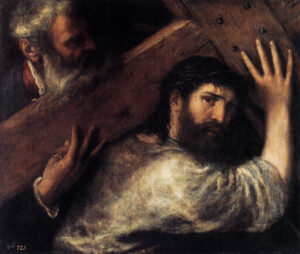
righteousness. Photo: Wikimedia Commons / Public Domain.
St Paul
You yourselves know, brothers and sisters, that our coming to you was not in vain, but though we had already suffered and been shamefully mistreated at Philippi, as you know, we had courage in our God to declare to you the gospel of God in spite of great opposition. For our appeal does not spring from deceit or impure motives or trickery, but just as we have been approved by God to be entrusted with the message of the gospel, even so we speak, not to please mortals, but to please God who tests our hearts. As you know and as God is our witness, we never came with words of flattery or with a pretext for greed; nor did we seek praise from mortals, whether from you or from others, though we might have made demands as apostles of Christ. But we were gentle among you, like a nurse tenderly caring for her own children. So deeply do we care for you that we are determined to share with you not only the gospel of God but also our own selves, because you have become very dear to us. (1Thessalonians 2:1–8)
Brief commentary
Verse 1 Very truly = Amen, amen. The warning here is against false leaders, who don’t come in by the gate, the authentic point of entry, i.e. through faith in Jesus.
Verse 2 The authentic shepherd does not enter by other means.
Verses 3-4 These are images of trust—he is recognised by the gatekeeper and by the sheep. Cf. Numbers 27:17. Cf. “Pilate asked him, ‘So you are a king?’ Jesus answered, ‘You say that I am a king. For this I was born, and for this I came into the world, to testify to the truth. Everyone who belongs to the truth listens to my voice.’” (John 18:37)
Verse 5 The believers will not entrust themselves to unknown leaders. But cf. “He came to what was his own, and his own people did not accept him.” (John 1:11) Cf. also, “I am the good shepherd. I know my own and my own know me,” (John 10:14); “Now before the festival of the Passover, Jesus knew that his hour had come to depart from this world and go to the Father. Having loved his own who were in the world, he loved them to the end.” (John 13:1)
Verse 6 Not for the first time in this Gospel, Jesus is not understood. In reality, the writer makes use of such misunderstanding to emphasise and deepen his teaching.
Verse 7 The metaphorical language has taken an unexpected twist. The identification of Jesus as the point of entry in his person is entirely in harmony with this Gospel.
Verse 8 Perhaps there is an allusion to nationalist leaders (bandits to the Romans) who sometimes used the language of “messiah” to lend authority to their revolts.
Verse 9 The pastoral imagery is most fully developed here.
Verse 10 Tremendous contrast, leading to one of the great sentences of this Gospel. “Life” is an omnipresent theme: John 1:4; 3:15-17, 36; 4:14, 36; 5:21-29, 39-40; 6:27, 33, 35, 40, 47-48, 51, 53-54, 63, 68; 8:12; 10:10-11, 15, 17, 28; 11:25-26; 12:25, 50; 13:37-38; 14:6; 15:13; 17:2-3; 20:31.
Pointers for prayer
- “Care” seems the fundamental image here. It invites a reflection on our own experience of being cared for, in all sorts of ways. It opens us to the experience of being cared for by God in Jesus. Prayer of being loved.
- Guidance is part of the metaphor. In what ways have I found myself lost in the labyrinth life and in need of direction? Where did I find guidance? Does the word of God guide me today? Prayer of being accompanied.
- In looking for meaning, when did I realise the Gospel is really not a teaching but a person? Prayer of relationship.
- We all want to live and be alive, to have life in abundance. How am I at this point in my life? Where does faith in the Jesus as the gate come in? Prayer of being alive.
Prayer
O God, you never cease to call even those far away, for it is your will that all be drawn into one fold.
Attune our ears to the voice of the Good Shepherd, who leads us always to you, that we may find under your tender protection life in all its fullness.
We ask this through Jesus Christ, the resurrection and the life, who lives and reigns with you in the unity of the Holy Spirit, God for ever and ever. Amen.
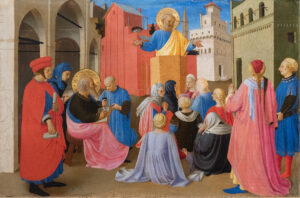
You have returned to the shepherd and guardian of your souls
The first reading
Repent, and be baptised every one of you in the name of Jesus Christ
The second reading
Acts 2:14 But Peter, standing with the eleven, raised his voice and addressed them, “Men of Judea and all who live in Jerusalem, let this be known to you, and listen to what I say.
Acts 2:36 Therefore let the entire house of Israel know with certainty that God has made him both Lord and Messiah, this Jesus whom you crucified.”
Acts 2:37 Now when they heard this, they were cut to the heart and said to Peter and to the other apostles, “Brothers, what should we do?”
Acts 2:38 Peter said to them, “Repent, and be baptised every one of you in the name of Jesus Christ so that your sins may be forgiven; and you will receive the gift of the Holy Spirit.
Acts 2:39 For the promise is for you, for your children, and for all who are far away, everyone whom the Lord our God calls to him.”
Acts 2:40 And he testified with many other arguments and exhorted them, saying, “Save yourselves from this corrupt generation.”
Acts 2:41 So those who welcomed his message were baptised, and that day about three thousand persons were added.
Initial observations
As is plain from the verse numbers, this is a shortened form of the Pentecost sermon of Peter. The division is correctly made, because v. 37 starts the second part.
Kind of writing
As the conclusion, this shows the marks of the classical peroration, that is, summing up, touching the emotions and the final appeal. It may well be that the first major part of the speech (not here) is judicial while the second major part (also not here, except for v.36) is deliberative, following the categories of ancient rhetoric.
Context in the community
The reading comes from the account of Pentecost is the Acts. The outline is as follows:
2:1-13 Pentecost
2:14-41 Peter’s sermon
2:14-15 Introduction
2:16-21 The Spirit (Joel)
2:22-36 The Christ (Psalms)
2:37-41 Conclusion
2:42-47 Life in the community
Our reading, therefore, comes from the the conclusion describing the effect of the proclamation. It includes the opening verse and a bridge verse (v. 36). It is noticeable that the interpretation of the Pentecost event is three times as long as the event itself.
Related passages
Typically, the speeches in Acts are interrupted at the most important moment. We can see this:
While Peter was still speaking, the Holy Spirit fell upon all who heard the word. (Acts 10:44)
When they heard of the resurrection of the dead, some scoffed; but others said, “We will hear you again about this.” (Acts 17:32)
Up to this point they listened to him, but then they shouted, “Away with such a fellow from the earth! For he should not be allowed to live.” (Acts 22:22)
In our reading, this technique serves both to liven up a rather long presentation and to indicate fairly directly to us the readers what the appropriate response to the kerygma should be.
Brief commentary
Verse 14 This is a classical and very respectful introduction to a speech. There are links with the Pentecost account. Voice is the same word as sound used earlier in v. 6. Declared is also the same word for the inspired speech in v. 4. His speech continues the Pentecost event and is a response to the exasperated question, “what does this mean?”.
Verse 36 This sentence summarises a long argument about Jesus and his identity. Notice that three claims are made: the crucified one, is raised and is Lord and—therefore—is the Messiah. All three are vital.
Verse 37 The audience interrupts (as we saw above), taking us directly to a question we have heard before: And the crowds asked him (i.e. John the Baptiser), “What then should we do?” (Luke 3:10). The interruption allows Peter to push come his conclusion on how we can access salvation.
Verse 38 Again, we have heard this before: He (i.e. John again) went into all the region around the Jordan, proclaiming a baptism of repentance for the forgiveness of sins. (Luke 3:3). 38a offers three elements: conversion (metanoia), baptism and forgiveness. 38b takes up a much wider teaching of the Acts: “And see, I am sending upon you what my Father promised; so stay here in the city until you have been clothed with power from on high.” (Luke 24:49) While staying with them, he ordered them not to leave Jerusalem, but to wait there for the promise of the Father. (Acts 1:4) Being therefore exalted at the right hand of God, and having received from the Father the promise of the Holy Spirit, he has poured out this that you both see and hear. (Acts 2:33) For the promise is for you, for your children, and for all who are far away, everyone whom the Lord our God calls to him. (Acts 2:39)
Verse 39 I.e. it will go on into the future and include the Gentiles.
Verse 40 This echoes what was said earlier: Then everyone who calls on the name of the Lord shall be saved. (Acts 2:21) See also: Then everyone who calls on the name of the Lord shall be saved; for in Mount Zion and in Jerusalem there shall be those who escape, as the Lord has said, and among the survivors shall be those whom the Lord calls. (Joel 2:32)
Verse 41 The effectiveness of the Pentecost proclamation is apparent.
Pointers for prayer
- When have I felt myself addressed “full on” by the Gospel? How did I react?
- Conversion can sometimes be linked to a moment, but, in reality is it never an isolated moment. Not only is there always a lead up (not always obvious at the time), but there is a follow-through, given that conversion is never really over and done with—at least not for the ordinary mortal!
Prayer
God, let your word penetrate our hearts and continue to change our lives. Only by your gift can we respond to your grace so send your grace again that we may saved. Amen.
The Liturgy
Acts 2:14a, 36-41; Psalm 23; 1 Peter 2:20b-25; John 10:1-10
Themes
across
the
readings
The Gospel is very clearly focused on the person of Jesus, as usual in the Fourth Gospel. Without using the same metaphors, the first reading is also centred on Jesus, whom “God has made him both Lord and Messiah.” Of course, earlier in Peter’s speech, in verses not used for the reading, there is reference to David, the proverbial shepherd-king, making an implied link.
The
responsorial
Psalm
The Psalm—the Lord is my Shepherd— is more directed to the Gospel reading, with the imagery of shepherd. Nevertheless, it is also suitable as a response to the proclamation resurrection and the response of conversion. There is a kind of home-coming which matches the gathering in which is the response to Peter’s sermon.
Sunday
introductions
First reading
Acts 2:14a, 36-41
Today, we hear a typical example of early Christian preaching. It illustrates an important question: if this is so, what should we do?
Second reading
1 Peter 2:20b-25
Is there a link between Jesus’ action and behaviour and our action and behaviour today? This reading says a firm “yes.” Towards the end of the reading, we hear of Jesus, our shepherd.
Gospel
John 10:1-10
The shepherd theme is picked up warmly and richly in the well-loved passage. Who doesn’t need guidance, care and even love, all gifts of the Good Shepherd.
Weekday introductions
Monday 27 April
Acts 11:1-18
Should followers of Jesus follow all the Jewish Law, including circumcision, Sabbath and food regulations? It was an important question for the first generation. The answer, given three times in a vision, shaped the future of Christianity.
John 10:11-18
We encounter another of the seven I am sentences of this Gospel, perhaps one of the more remembered one: “I am the good shepherd. The reflection is multi-layered, with rich contrasts and affirmations.
Tuesday 28 April
Acts 11:19-26
This is a summary statement, letting us know about the expansion of The Way after the decision not to impose Jewish regulations on Gentiles.
John 10:22-30
The feast of Dedication (Hanukkah) is mentioned: this feast celebrated the re-dedication of the Temple in the previous century. At the time of writing that restored Temple was also in ruins, causing consternation for both Jews and Christians. The Christian response was to name Jesus as our shepherd, who would lead us both to God and to eternal life.
Wednesday 29 April
St Catherine of Siena, virgin and doctor
1 John 1:5-2:2
The first letter of John manages to be both inspirational and realistic. We need to keep an eye on both, stay on the path of conversion of heart.
Matthew 11:25-30
This wonderful passage (going back to the Q sayings and probably to Jesus himself) contains a great truth: the Gospel is for all and not for some élite group. We can all come to Jesus when we are burdened.
Thursday 30 April
Acts 13:13-25
The continuing story of Paul takes us rather breathlessly to Antioch in Pisidia (Turkey today). We hear the first part of a sermon, outlining the story of salvation until the ministry of John the Baptism. You may notice the emphasis on David—great symbol of God’s faithfulness through time, fulfilled in Jesus. Tomorrow we get to hear the second part of the sermon, when Paul challenges the hearers directly.
John 13:16-20
Our reading from John takes place at the Last Supper and follows the washing of the feet. As it draws out some of the meaning of the foot washing it also looks ahead to Jesus betrayal.
Friday 1 May
St Joseph the Worker
Acts 13:26-33
For this scene, we have moved to Antioch in Pisidia (14 cities bore the name Antioch in antiquity!). In a typical speech, Paul started yesterday reviewing the history of salvation; today Paul gives an account of the death and resurrection of Jesus, in the light of the Holy Scriptures.
John 14:1-7
Today we hear a reading familiar from funerals; perhaps we can reflect on it today without the tragic context of death. It is really about Jesus own departure / death first of all. The last line offers us another of the great I am sentences from this Gospel.
Saturday 2 May
St Athanasius, bishop and doctor
Acts 13:44-52
The switch to the Gentiles is signalled yet again in this brief story. Most likely, the Gentiles were the so-called God-fearers, that is, people already attracted to Judaism because of its pure doctrine of God, high moral code and its antiquity.
John 14:7-14
Our reading from John is very rich again today. It does contain a startling line: whoever believes in me will perform the same works as I do myself, he will perform even greater works. What could that possible mean? Somehow it means that after the great event of Jesus’ death and resurrection, our task is to offer salvation, the salvation not yet achieved or somehow not available before Good Friday and Easter Sunday.