

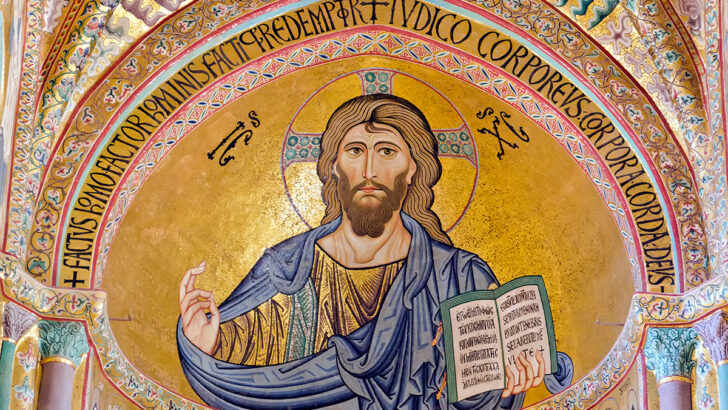
 An image of Christ Pantocrator on the ceiling of the Cathedral of Cefalu in Cefalu, Sicily, Italy. Photo: iStock.
 Acts 6:1-7; Psalm 32 (33); 1 Peter 2:4-9; John 14:1-12

I am the way, and the truth, and the life — no one comes to the Father except through me
John 14:1 “Do not let your hearts be troubled. Believe in God, believe also in me. John 14:2 In my Father’s house there are many dwelling places. If it were not so, would I have told you that I go to prepare a place for you? John 14:3 And if I go and prepare a place for you, I will come again and will take you to myself, so that where I am, there you may be also. John 14:4 And you know the way to the place where I am going.” John 14:5 Thomas said to him, “Lord, we do not know where you are going. How can we know the way?” John 14:6 Jesus said to him, “I am the way, and the truth, and the life. No one comes to the Father except through me. John 14:7 If you know me, you will know my Father also. From now on you do know him and have seen him.” John 14:8 Philip said to him, “Lord, show us the Father, and we will be satisfied.” John 14:9 Jesus said to him, “Have I been with you all this time, Philip, and you still do not know me? Whoever has seen me has seen the Father. How can you say, ‘Show us the Father’? John 14:10 Do you not believe that I am in the Father and the Father is in me? The words that I say to you I do not speak on my own; but the Father who dwells in me does his works. John 14:11 Believe me that I am in the Father and the Father is in me; but if you do not, then believe me because of the works themselves. John 14:12 Very truly, I tell you, the one who believes in me will also do the works that I do and, in fact, will do greater works than these, because I am going to the Father.”Initial observations
This familiar passage (often read at funerals) opens the final speech of Jesus in the Fourth Gospel, running from chapter 14 through 17. Our passage today picks up many of the themes of the entire speech, while giving some a certain prominence. As always in the Fourth Gospel, we are dealing with meditations from the end of the first century, not the actual words of the historical Jesus. This doesn’t make them less true or reliable.Kind of writing
As noted above, John 14-17 belongs to a recognisable literary genre, that of Farewell Discourse. This kind of writing can be identified by its location and by its themes. In terms of location, a Farewell Discourse takes place before the death of the “hero” or chief protagonist in a story. A Farewell Discourse deals with departure, final arrangements, the importance of past relationships, the future shape of relationships, the duties of those left behind, future problems and the resources for living, unity of the group. In particular, the continued gift of life (in Christ) is guaranteed by the future gift of the Holy Spirit, the Paraclete or Advocate.Old Testament background
(i) The form—Farewell Discourse—resembles OT models. Genesis 49 is an example (see below), as are Tobit 14 and 1 Macc 2:49-68. The whole book of Deuteronomy is the Farewell Discourse of Moses. (ii) The Torah or Old Testament Law is really a way of life: “Happy are those whose way is blameless, who walk in the law of the Lord.” (Psalms 119:1). (iii) God is “true” in a relational way in the Bible. This is expressed by the word emeth, which means faithfulness to a relationship: “Know therefore that the Lord your God is God, the faithful God who maintains covenant loyalty with those who love him and keep his commandments, to a thousand generations, and who repays in their own person those who reject him. He does not delay but repays in their own person those who reject him.” (Deut 7:9-10) (iv) Choosing life is an OT theme: “I call heaven and earth to witness against you today that I have set before you life and death, blessings and curses. Choose life so that you and your descendants may live, loving the Lord your God, obeying him, and holding fast to him; for that means life to you and length of days, so that you may live in the land that the Lord swore to give to your ancestors, to Abraham, to Isaac, and to Jacob.” (Deut 30:19-20).New Testament foreground
(i) In the New Testament, there is a notable Farewell Discourse in Acts 20:17-38. Luke uses a Farewell Discourse in Lk 22. 2 Peter is also a testament, or farewell speech and shows the following features: ethical admonitions and revelations of the future (cf. Acts 20:17-34; 2 Timothy; also Acts of Peter, Acts of John, Acts of Thomas). 2 Pet. 1:3-11 is a homily which follows a pattern found, e.g., in the farewell speeches of Ezra (2 Esdr. 14:28-36). 2 Pet. 1:12-15 is replete with language typical of farewell addresses, and specifically mentions Peter’s knowledge of his approaching death. 2 Pet. 2:1-3a; 3:1-4 predict the arrival of false teachers. (ii) It would be good to read John 14:1-12 in the light of the closing section of the Farewell Discourse, chapter 17, where the themes of life, faith, work, word and communion are taken up again, this time echoing the language of the Lord’s Prayer. The brief commentary makes explicit some of the links with the Gospel text elsewhere.St Paul
To get a sense of role of a Farewell Discourse, it would be useful to read Acts 20:25–35.Brief commentary
Verse 1 The preceding conversation (13:36-38) is very disturbing and the present excerpt is a kind of response or consolation in the light of that. V. 1a is a version of “Do not be afraid”, the experience of consolation in the encounter with God (Jn 6:20; 12:15—see also the first words of the risen Lord). V. 1b resumes many passages in this Gospel, for example: “Jesus answered them, ‘This is the work of God, that you believe in him whom he has sent.’” (John 6:29) Verse 2 This well-known verse echoes another: “The slave does not have a permanent place in the household; the son has a place there forever.” (John 8:35) Verse 3 Cf. “Whoever serves me must follow me, and where I am, there will my servant be also. Whoever serves me, the Father will honour. (John 12:26) “Simon Peter said to him, ‘Lord, where are you going?” Jesus answered, ‘Where I am going, you cannot follow me now; but you will follow afterward.’” (John 13:36). In this Gospel, the present reality of salvation is so strong that future hope and longing seem less significant; however, this verse corrects this perceived “lack”. Verse 4 This verse continues the theme of misunderstanding, even among the closest followers of Jesus. This observation triggers the next conversation. Verse 5 Thomas has a higher profile in this Gospel (John 11:16; 14:5; 20:24, 26-28; 21:2) than in the other Gospels. He does make seemingly uncomprehending remarks, but in itself, the question at this point seems quite reasonable. It also provides the vocabulary of the “way”, so important for this Gospel. Verse 6 As often noted, the I am sentences of the Fourth Gospel echo the name of God in Ex 3:14, I am who I am. Calling a person the way, the truth and the life strikingly reflects the teaching of this Gospel that the Good News is the person of Jesus. Way: John 1:23; 14:4-6. Truth: John 1:14, 17; 3:21; 4:23-24; 5:33; 8:32, 40, 44-46; 14:6, 17; 15:26; 16:7, 13; 17:17, 19; 18:37-38. Life: John 1:4; 3:15-16, 36; 4:14, 36; 5:24, 26, 29, 39-40; 6:27, 33, 35, 40, 47-48, 51, 53-54, 63, 68; 8:12; 10:10, 28; 11:25; 12:25, 50; 14:6; 17:2-3; 20:31. Verse 7 This verse captures a core teaching of the Fourth Gospel that to know who God really is is to know the Son and that to know the who is the Son really is is to know the Father. A clear expression of this is found in 1 Jn 5:1 (the NRSV version fails here): “Everyone who believes that Jesus is the Christ has been born of God, and everyone who loves the Father loves whoever has been born of him” (1 John 5:1 ESV); “Whoever believes that Jesus is the Christ is a child of God, and whoever loves the father loves the son.” (1John 5:1 NJB). The ESV is very close to the Greek; the NJB is an accurate rendering of the content. V. 7b captures the sense that salvation is now, in the present moment. Verse 8 Philip has an unusual importance in this Gospel (John 1:43-46, 48; 6:5, 7; 12:21-22; 14:8-9). This may be because in Asia Minor (western Turkey), where this Gospel most likely was finished, there were traditions about Philip. The desire to see the Father, even in the context of misunderstanding, serves the purpose of the Gospel. Verse 9 The intimacy of the Father and the Son is a theme not only of chapters 14-17 but of this whole Gospel as such. Cf. 1:18; 6:46; 8:19; 12:44-45. Verse 10 “The one who sent me” is practically a name or title for God in this Gospel, expressing the communion of the Father and the Son. It is not used here explicitly but lies behind the expressions used. Verse 11 The works of Jesus and the Father in this Gospel symbolise the great “work” of the lifting up and glorification in the hour of the cross/resurrection (John 3:19-21; 4:34; 5:20, 36; 6:28-29; 7:3, 7, 21; 8:39, 41; 9:3-4; 10:25, 32-33, 37-38; 14:10-12; 15:24; 17:4). Verse 12 Doing “greater works” than Jesus himself is a bit of a surprise. It needs to be read in the light of the chronology of this Gospel. The death/lifting up of the Messiah is a new creation, taken in a very strong sense. There is, therefore, a “before” and an “after”. We see this again in the hyperbole regarding the gift of the Spirit: “Now he said this about the Spirit, which believers in him were to receive; for as yet there was no Spirit, because Jesus was not yet glorified.” (John 7:39). The last line is obviously not true at a literal level and at the same time astonishingly true. The believer can live in the light of the resurrection in a way way not possible before Easter took place. Jesus’ “going to the Father” is the context of the Farewell Discourse.Pointers for prayer
- “Do not let your hearts be troubled. Believe in God. Believe also in me.” Trust in another person can help us in difficult times. Remember and give thanks for the people you were able to trust in difficult moments. Remember also when your faith in God helped you through anxious moments.
- Thomas struggled with the desire, which is in all of us, to know exactly the destination before we set out. Jesus invites us to make an act of faith and to take one step at a time. Can you recall times when it helped you to take that trusting attitude to life?
- Jesus proposed himself to Thomas as the way, the truth and the life. In what ways has Jesus been the way, the truth and the life for you on your faith journey?
- Philip wanted Jesus to give him a glimpse of God and got the surprising answer “whoever has seen me has seen the Father”. Jesus put a human face on the love of God. Who are the people whose love has helped you to believe in the love of God? To whom have you given an occasional glimpse of the divine?
Prayer
We have beheld your glory, O God in the face of Christ Jesus, your Son. Enliven our faith that through Christ we may put our trust in you. Deepen our faith that in Christ we may serve you. Complete our faith that one day we may live with you in that place which Christ prepares for us, where he lives and reigns with you in the unity of the Holy Spirit, God for ever and ever. Amen.Thought for the day
Jesus is already now, today, our way, our truth and our life. As the Gospel says, to have eternal life is to believe in him whom God has sent (Jn 5:24; 17:3). This is a reality for us now and it guides our life, in matters great and small. At the core of this reality is trust, that is, the capacity to entrust all that we have and are to the living God and to his Son, raised from the dead. It is not an accident that the verb “to believe” occurs no fewer than ninety-eight times in the Fourth Gospel.
Prayer
You gave us Jesus, the Word made flesh as Mediator, and he has spoken your words to us and called us to follow him. He is the way that leads us to you, the truth that sets us free, the life that fills us with gladness. Amen.
A chosen race, a royal priesthood, a holy nation, a people of his own
Initial observations
A rich vein of metaphor is exploited in this passage: stone, cornerstone and an implied reference to the Temple sayings. It takes us from multiple OT references, through the story of the historical Jesus to the experience of early Christians. The synthesis of references to the Gospels and the letters of Paul, in particular, serves to confirm 1 Peter as a late document, harmonising different strands of the tradition — Pauline and Petrine — for a later generation of believers.Kind of writing
Letter opening: 1:1-2 Thanksgiving: 1:3-12 Three main sections Opening 1:13-2:10 Middle 2:11-4:11 Closing 4:12-5:11 Letter conclusion: 5:12-14 Our reading comes from the the first main section of the letter, 2:11-4:11. The full subsection concludes with v. 10, reinserted above. The sequence of thought is a follows:- 4-5: Topic introduced.
Context in the community
The reader is referred to the notes for Easter 2 for information regarding context, date, authorship and purpose.Related passages
To grasp to force of this reading, it is necessary to pay close attention to the rich Old Testament background behind the imagery.Main citations
Therefore thus says the Lord, See, I will lay for the foundations of Sion a precious, choice stone, a highly valued cornerstone for its foundations, and the one who believes in him will not be put to shame. (Isa 28:16 LXX) A stone which the builders rejected, this one became the chief cornerstone. (Ps 117:22 LXX) He will become a sanctuary, a stone one strikes against; for both houses of Israel he will become a rock one stumbles over—a trap and a snare for the inhabitants of Jerusalem. (Isa 8:14)Other allusions
Now therefore, if you obey my voice and keep my covenant, you shall be my treasured possession out of all the peoples. Indeed, the whole earth is mine, but you shall be for me a priestly kingdom and a holy nation. These are the words that you shall speak to the Israelites.” (Exod 19:5–6) The wild animals will honour me, the jackals and the ostriches; for I give water in the wilderness, rivers in the desert, to give drink to my chosen people, the people whom I formed for myself so that they might declare my praise. (Isa 43:20–21) Say to your brother, My People, and to your sister, Pitied. …and I will sow her for myself in the land. And I will have pity on Not Pitied, and I will say to Not My People, “You are my people,” and he shall say, “You are the Lord my God.” (Hos 2:1, 23 LXX) Cf. in general the earlier us of the top three citations in Romans 9:25-33.Brief commentary
Verse 4 Just immediately before, Jesus was compare to a wet nurse; the brusk change of metaphor is powerful. Stone (lithos) means dressed stone for a building cf. Acts 4:8–12; Rom. 9:30–33; Eph. 2:19–22. Living stone is quite startling because the lifelessness of idols is often noted in the OT. It means Jesus is indeed our true God. He was of course rejected by mortals but “chosen” and “precious” to God through the resurrection. Verse 5 “Living stones” can also refer to believers in the Risen Lord, the stones making for a spiritual house, that is, a temple. The writer takes up a commonplace of the New Testament: 1 Cor. 3:16–17; 6:19; 2 Cor. 6:16; Eph. 2:19–22; Rev. 3:12; 11:1. Holy priesthood is a reference to Exodus 19:6. Spiritual sacrifices encompass more than worship — rather the whole life of the Christian, in both worship and practice is in view. Verse 6 The citation is from Is 28:6. This makes it clear that the shift from a physical place of worship to a spiritual house is really a fulfilment of scripture, part of God’s plan. Notice the double negative of not being put to shame. Verses 7-8 A combined reference to Ps 118:2 (117:2 in the LXX) and Is 8:14. Unbelievers stumble and fall because they are not listeners and doers of the word. Verse 9 In contrast, believers are positively portrayed using Is 43:21 with reference also to Exodus 19:6. The whole purpose of this gracious election is precisely that the Christians might proclaim God’s wonderful deeds. The metaphor of passing from darkness to light is widespread: Acts 26:18; 2 Cor. 4:6; 6:14; Eph. 5:8; Col. 1:12–13. Verse 10 A considerable reworking of Hosea 1:6–7, 9; 2:1; 2:25 makes for a resounding, very poetic climax.Pointers for prayer
- How can I set myself close to Christ, the living stone?
- How do I see myself as called and chosen precisely to proclaim God’s wonderful works, the mirabilia Dei?
Prayer
Lord Jesus Christ: help me set myself close to you. Open my ears to hear, open my heart to obey, open my lips and my life that I may proclaim your praise.The word of God continued to spread and the number of the disciples increased greatly in Jerusalem
Initial observations
The reading may appeal to people involved in ministry today, given the sheer quantity of “secular” tasks which can impede availability for ministry proper! It should certainly appeal to Pope Francis, who writes in The Joy of the Gospel: “Preparation for preaching is so important a task that a prolonged time of study, prayer, reflection and pastoral creativity should be devoted to it. With great affection I wish to stop for a moment and offer a method of preparing homilies. Some may find these suggestions self-evident, but I consider it helpful to offer them as a way of emphasising the need to devote quality time to this precious ministry. Some pastors argue that such preparation is not possible given the vast number of tasks which they must perform; nonetheless, I presume to ask that each week a sufficient portion of personal and community time be dedicated to this task, even if less time has to be given to other important activities.” (EG §145)Kind of writing
Stories of conflict resolution show this pattern: Problem: vv.1-2 Solution: vv.3-4 Leaders set apart: vv.5-6 Unity restored: v.7 The scene is very close to similar stories of election in Exodus 18 and Numbers 27.Context in the community
- From Jerusalem (1-7)
- Throughout Judea and Samaria (8-12)
Related passages
In the Acts, there is a regular pattern of conflict resolution: 5:1–11; 8:18–24; 9:26–28; 11:1–18; 15:1–35; 21:20–26 (given here). They praised God when they heard it but said to him, “Brother, you see how many thousands of believers there are from among the Jews, and they are all zealous observers of the law. They have been informed that you are teaching all the Jews who live among the Gentiles to abandon Moses and that you are telling them not to circumcise their children or to observe their customary practices. What is to be done? They will surely hear that you have arrived. So do what we tell you. We have four men who have taken a vow. Take these men and purify yourself with them, and pay their expenses that they may have their heads shaved. In this way everyone will know that there is nothing to the reports they have been given about you but that you yourself live in observance of the law. As for the Gentiles who have come to believe, we sent them our decision that they abstain from meat sacrificed to idols, from blood, from the meat of strangled animals, and from unlawful marriage.” So Paul took the men, and on the next day after purifying himself together with them entered the temple to give notice of the day when the purification would be completed and the offering made for each of them. (Acts 21:20–26 NABRE)Brief commentary
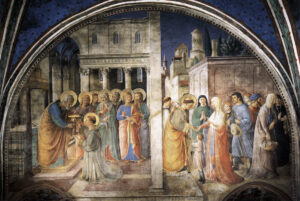
Verses 1-2 The issue is unity and communion in the church. Hellenists are most like Greek-speaking Jews rather than Gentiles. Hebrews are probably Aramaic-speaking Jews. There is considerable echo of the Exodus “murmuring” against Moses. The daily distribution could be food or money, both important in Luke-Acts. Widows are also important in Luke-Acts, where we learn a good deal about them. Care for widows was singled out in the OT. Not caring for the widows and other people in need shamed the community. Verses 3-4 Part of the solution is a separation of roles. Seven are chosen with the specific task of serving at the tables. The separation is not absolute because Philip and Stephen do go on to preach the word. It is also not hierarchical because for Luke practical service is also deeply spiritual. (Cf. For who is greater, the one who is at the table or the one who serves? Is it not the one at the table? But I am among you as one who serves. Luke 22:27.) The criteria are instructive, as indeed is the note “from among yourselves.” Verses 5-6 The names are all Greek, meaning that those chosen come from the Greek-speaking community where the neglect was felt. They will not only be qualified by laying on of hands but also motivated by direct experience. Verse 7 In spite of conflict, the early church continued to grow and attract converts even from among the priests.Pointers for prayer
- Having to choose between responsibilities can be difficult but necessary. What has your experience been and how did you make your discernment?
- Conflict is normal, not exceptional as we know from both life and church! What makes the difference is how we respond. Is there anything to be learned from today’s short story?