

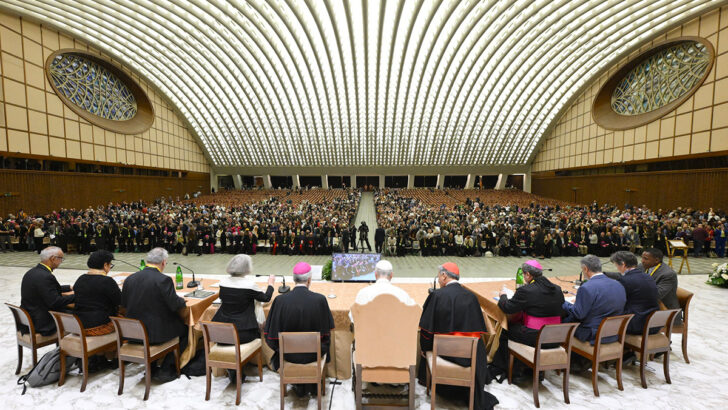
 Pope Leo XIV, with regional representatives of synod teams, listens to and answers questions from participants in the Jubilee of Synodal Teams and Participatory Bodies in the Vatican audience hall October 24, 2025. The final reports for two Synod on Synodality study groups, on formation for the priesthood and on navigating the Church’s presence in digital spaces, were released on March 3, 2026. Photo: CNS / Vatican Media.
 As readers of this newspaper may recall, a resource was offered by the Irish Synodal Pathway for use during Lent this year. Baptised and Sent in Lent was presented as a “Reflection Programme” for parishes, schools, individuals and groups. As the title suggests, the resource was related to the previous Irish synodal document Baptised and Sent, published last autumn. Baptised and Sent had been a preparatory document for the Pathway’s Pre-Synodal Assembly in Kilkenny in October. The document had combined feedback from synodal gatherings across Irish dioceses, last spring, with the National Synodal Team’s reflections upon that feedback.

Their reflections had led the National Team to recommend seven priorities for the next stage of the Synodal Pathway. The pre-Kilkenny document proposed that these be approached “through the lens of baptism” – as the National Team had come to see baptism as “the root and unifying principle” giving coherence to the priorities. This emphasis upon a renewed sense of baptism being critical to the ‘mission’ of the Church led to the title Baptised and Sent being attached to that document. The Lenten resource drew significantly upon it, and was accordingly entitled Baptised and Sent in Lent.
Resource
The Lenten programme appeared primarily a resource for communal prayer and reflection. It involved participants reflecting on the Sunday gospels of the season in light of a range of quotations taken from the pre-Kilkenny document. The programme’s introduction explained: “Each week offers a simple structure for prayer, Gospel reflection and conversation which is linked with key insights from Baptised and Sent. These themes, belonging, healing, renewal and mission, flow from the document’s call to see baptism as the unifying paradigm for the renewal of the Church in Ireland”. The first of the above themes – belonging – has arguably become the central motif of the Synodal Pathway and was the focus for the material provided by the programme for the Third Sunday of Lent.
Alternative interpretations see the ‘husband’ reference as unrelated to the woman’s domestic circumstances – a metaphor, rather, for the ‘spiritual adultery’”
The gospel text for that Sunday was St John’s story of the meeting of Jesus with the Samaritan woman at Jacob’s well. As with scripture passages generally, the episode permits multiple interpretations. Much has been speculated about the woman’s various ‘husbands’, to whom Jesus refers. Those who assume, from this, that the woman had a disreputable personal history, typically see her going to the well at noon the result of social isolation. Others dismiss this as unwarranted, arguing that her story may suggest more by way of resilience in the face of hardship – with her capacity to rally her townspeople to Jesus, in the aftermath of their meeting, evidence of the esteem she enjoyed among them. Alternative interpretations see the ‘husband’ reference as unrelated to the woman’s domestic circumstances – a metaphor, rather, for the ‘spiritual adultery’ with foreign gods of which mainstream Judaism traditionally accused Samaritans.
Excluded
Baptised and Sent in Lent adopted that reading of the story which views the woman as socially excluded and proposed the passage be considered through the prism of “Who belongs?” Two quotations from the 2025 Baptised and Sent document were provided to encourage reflection, drawing upon the experiences of the Irish Synodal Pathway. The longer of these quotations read as follows: “Belonging and inclusion appeared in nearly every conversation. The Church is perceived as struggling to welcome those on the margins, LGBTQ+ persons, non-traditional families, those who have experienced relationship breakdown, those in second unions, those who feel judged or hurt, and those estranged from faith communities. There is a deep desire for a listening Church that makes space for the wounded, those who are doubting, and those who feel on the margins.” Two follow-up questions were posed for participants: “In what way/s is your parish welcoming and inclusive?” and “What concrete action or steps can I/we take to help more people feel that they belong?”
Would it always reach out to everyone in a spirit of invitation? If so, the answer seems yes”
‘Belonging’, and the related concepts of ‘inclusion’ and ‘exclusion’, have been central not just to the Synodal Pathway in Ireland, but to synodal processes throughout much of the wider world. They were evident in the working documents for both sessions of the Synodal Assembly in Rome, in 2023 and 2024, and in the texts emerging from these. One participant in both those sessions was the Minnesota bishop, Dr Robert Barron, who – due to his internationally acclaimed Word on Fire Ministries – is probably considered the most effective Catholic evangelist in the English-speaking world. Bishop Barron has repeatedly questioned, in recent years, the meaning and implications of these concepts as they have arisen in synodal contexts.
Inclusive
“Again and again, we hear that the Church must become a more inclusive and welcoming place for a variety of groups”, wrote Robert Barron in early 2023, “but I have yet to come across a precise definition of either term.”
“What exactly would a welcoming and inclusive Church look like?”, asked the bishop. In response, he suggested the following: “Would it always reach out to everyone in a spirit of invitation? If so, the answer seems yes. Would it always treat everyone, no matter what their background, ethnicity, or sexuality, with respect and dignity? If so, again, the answer is yes.”
Bishop Barron continued: “But would a Church exhibiting these qualities never pose a moral challenge to those who would seek entry? Would it ratify the behaviour and lifestyle choices of anyone who presented him or herself for admission? Would it effectively abandon its own identity and structuring logic so as to accommodate any and all who come forward? I hope it is equally evident that the answer to all those questions is a resounding no”. The bishop went on to suggest that “The ambiguity of the terms is a problem that could undermine much of the Synodal process.” (‘Inclusivity and Love’, Word on Fire, 27/01/2023)
My very real hope is that the engagement of both the pastoral and properly theological dimensions of this issue of inclusivity will be a key work of the synod”
Robert Barron returned to the topic on the eve of the first Rome session: “Now addressing feelings of alienation and trying to make the Church as welcoming as possible” he wrote, “is always a legitimate pastoral concern”. The bishop went on to argue, nonetheless, that “feelings, however intense, do not in themselves constitute a theological argument”. Convinced that “we cannot adjudicate the matter by remaining at the level of feelings”, Barron proposed that “we have to move to the level of real argument based on the Bible, the theological tradition and the natural moral law”. The bishop concluded: “My very real hope is that the engagement of both the pastoral and properly theological dimensions of this issue of inclusivity will be a key work of the synod.” (‘As I leave for the Synod on Synodality’, Word on Fire, 26/09/2023)
How well the Synodal Assembly addressed Bishop Barron’s concerns is hard to say, though the Synthesis Report emerging from the 2023 session appeared to echo his perspective. Regarding what it described as “matters that are controversial within the Church”, it proposed that in order to “develop authentic ecclesial discernment in these and other areas, it is necessary to approach these questions in the light of the Word of God and Church teaching, properly informed and reflected upon.” Considering this – and considering Bishop Barron’s concerns with concepts like belonging and inclusion – one would wonder about the ultimate value of the Baptised and Sent in Lent programme for Irish Catholics in recent months.
Mindful of the material offered for that Third Lent Sunday, what precisely was hoped to be achieved by placing a multilayered and fraught topic on the agenda of meetings in schools and parishes – ostensibly organised for scriptural reflection and spiritual nourishment? Were participants expected to be so grounded in Church teaching that they could bring this to bear upon the question of belonging – and the related ecclesial concept of ‘communion’? If not, then it seems noteworthy that the programme neither provided catechetical resources, nor inferred any need of them. With what sources, meanwhile, were the ‘insights’ from Baptised and Sent intended to dialogue, so that meaningful ‘conversation’ could ensue? What, moreover, would be the stages in a process of discernment which might lead participants to the ‘concrete action or steps’ the programme envisaged?
Weakness
As that 2023 Synthesis Report implied, there seems an obvious weakness in inviting people to confront complex contemporary issues, without enabling them to do so “in the light of the Word of God and Church teaching, properly informed and reflected upon”. The likelihood is – as Robert Barron suggests – that people will rely predominantly upon feelings and emotional reactions, which become the essential bases for their response. As Church in this country, we hardly need a US bishop to point this out to us. The campaigns which led to ‘same-sex marriage’ and a liberal abortion regime in Ireland, in recent years, boasted of the success they achieved by highlighting personal stories at the expense of theoretical debate. Highly charged emotional testimonies gained much more traction among Irish voters than appeals to weigh the deeper consequences for their society of what was being advocated.
While contemplating the future of the Church may seem a very different project, it is vital to remember that it is being undertaken within that same pseudo-liberal and increasingly secular Ireland. If parishioners or school pupils, engaging in synodal initiatives, lack the background or resourcing to bring distinctly faith perspectives to the questions they are invited to address, there is little reason to expect that the responses they offer – or the actions they propose – will reflect anything other than the priorities of the prevailing culture. It seems pertinent to recall, in this regard, that the Irish Synodal Pathway’s own documents have persistently emphasised a lack of faith formation and adequate catechesis among the country’s Catholics. If this is true, then its implications are manifold for exercises of this kind.
At least some participants in last year’s spring gatherings expressed concern ‘that LGBTQ+ issues had been emphasised too much in schools and the wider culture’”
One further consideration: There are faithful in every diocese in Ireland who are uncomfortable with the term ‘LGBTQ+ persons’ – included in the material for the Lenten programme. Many find it objectionable. The National Synodal Team are aware of this, as the Baptised and Sent document noted how at least some participants in last year’s spring gatherings expressed concern “that LGBTQ+ issues had been emphasised too much in schools and the wider culture”. In justifying their concerns, those people need point no further than another synodal text of recent years. The Final Document of the 2018 Synod on Young People addressed the matter, stating clearly: “Among the questions that emerge are those regarding the difference and harmony between male and female identity and sexual inclinations. In this regard, the Synod stresses that God loves every person and the Church does the same, renewing her commitment against all discrimination and violence on sexual grounds. Equally, she reiterates the key anthropological relevance of the difference and reciprocity between men and women and believes it to be reductionist to define personal identity on the sole basis of the person’s ‘sexual orientation’.”
Feedback
While featuring in feedback from earlier synodal consultations, the ‘LGBTQ+’ acronym remains highly contested and somewhat ironically, therefore, is far from inclusive. The 2023-24 Synodal Assembly was cautious about its use – hence its absence from the documents emanating from both its sessions. The 2023 Synthesis spoke, instead, about “people who feel marginalised or excluded from the Church because of their marriage status, identity or sexuality” – with the Final Document from 2024 using virtually the same words. It seemed both a respectful and sensitive way of expressing an important pastoral concern. One imagines such wording would have been more than adequate to allow the Irish Synodal Pathway convey the same concern, in the context of its Baptised and Sent publication last year. Such care about language may well have helped broaden the overall appeal of that document. It might also have hindered a politicised and divisive term’s intrusion into a supposedly spiritual resource for this year’s Lent.