

 Mary Kenny
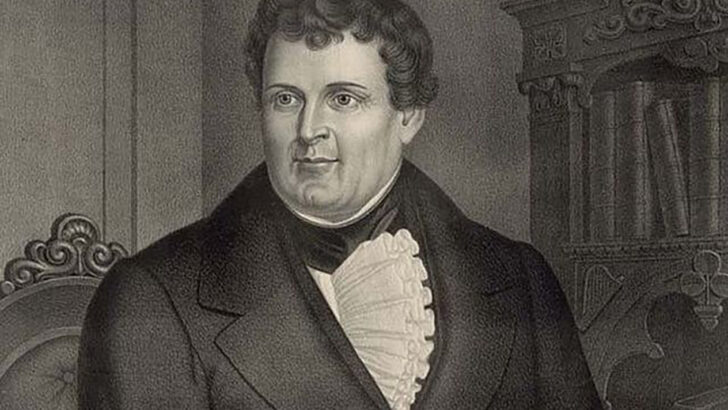 Daniel O’Connell. Photo: Public Domain.
 Holly Cairns’s bill to amend abortion legislation in the Dáil this week has, obviously, prompted renewed debates about the termination of pregnancy.

Leave aside the issue of the three-day ‘reflection period’ before the procedure, quite a few people are unsettled by the statistics: abortion in Ireland has risen from about 3,000 a year pre-2018 to nearly 11,000 currently. This latter figure represents a 62.8% increase since 2019.
Correspondents and commentators in the national media have asked why the increase has occurred? There may be many answers to that question, and I’d hazard a guess that housing and lack of accommodation plays a part.
In one very distressing case, he was terminating a pregnancy at 22 weeks – on a healthy baby and a healthy mother”
Back in the 1980s, a gynaecologist permitted me to observe abortions at a London hospital, for purposes of research; he believed in being open about what he did. In one very distressing case, he was terminating a pregnancy at 22 weeks – on a healthy baby and a healthy mother. I asked the reason why the abortion was occurring and I was told that the young woman was being evicted from her flat and her boyfriend had left her.
Present
That situation would not be legal in Ireland, at present. But it stuck in my mind that for some individuals, housing and accommodation may play a substantial role in such an awful scenario.
The one word that is hardly ever mentioned in this conversation is the word that tore the Catholic Church apart – and Irish politics – forty years ago. Contraception”
In the current Irish debate those on the pro-choice side simply say it’s a woman’s own business why she chooses abortion – if there’s a large increase in the numbers, that’s because that’s what people want. For pro-life advocates, obviously, the issue is to respect both lives, of mother and unborn infant.
The one word that is hardly ever mentioned in this conversation is the word that tore the Catholic Church apart – and Irish politics – forty years ago. Contraception.
Pioneers
The pioneers of birth control believed that contraception – fertility control before conception – was always better than abortion. Marie Stopes actually believed that effective contraception would abolish abortion altogether.
Conservative Catholics thought that contraception would lead to more abortion – because terminations would come to be regarded as “retrospective contraception”. As it turned out.
Contraception is seldom mentioned because, to be honest, it is awkward for both sides. The Catholic Church has never formally revised its ban on artificial birth control, although most Catholics couples seem to practice it (and most priests, so far as I know, leave it as a matter of conscience).
Meanwhile, the pro-choice lobby sees abortion as the more “empowering” form of birth control and seldom includes contraception as a desirable “choice”. If they allude to it, it is usually to draw attention to failure rates (although the Pill and the condom are 99% successful in laboratory conditions. A Family Planning counsellor once told me: “the greatest failure of the condom is the failure to take it out of its packet.”)
Yet, nasty though her views were on a range of topics, Stopes was surely correct about this: contraception is preferable to abortion. But this is now treated as ‘omertá’.
***
It’s welcome news that the European Central Bank is planning to adorn the Euro notes with the human face. I have always thought it would humanise the currency more to put great Europeans on the paper money.
I heard it said that originally, the French, Germans and Italians couldn’t agree whose national figure might grace the prestigious €50 note: Da Vinci, Beethoven, or Victor Hugo? It seems now that a consensus can be reached.
There could be several Irish candidates: James Joyce, of Dublin, Paris, Zurich and Trieste, must be one such, having invented the stream-of-consciousness literary form. St Columbanus, who evangelised so much of Continental Europe in the great monastic age, might be another.
But I suggest Daniel O’Connell is the most deserving Irish face on a Euro note. He was educated in St Omer, France, and after his death, his heart was sent to Rome. He showed that political change could be achieved by the rule of law; he delivered suffrage reform, which emancipated Catholics, and opened political votes to the working man. He was the leading role model for Frederick Douglass, the black American who campaigned against slavery and racism. Dan’s the man for this honour!
I regard the Rose of Tralee as a pleasant and genial institution which brings people of Irish background together (and supports Kerry’s tourism.)
Now there’s controversy over the young woman chosen to represent the Dublin Rose, Suad Mooge – she’s a Muslim of Somali ethnicity.
But she was born in Ireland and raised in Dublin. It seems to me that Irish identity can be acquired by birth and acculturation.
Suad is a medical scientist and very pretty – qualifications for a charming Rose. There are objections to her head being covered – but Irishwomen often traditionally covered their hair with scarves, shawls and hats, so what’s the big deal?