

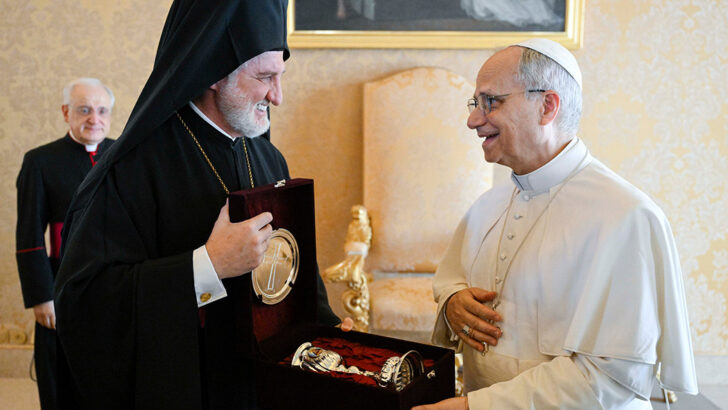
 Pope Leo XIV speaks with Greek Orthodox Archbishop Elpidophoros of America during a meeting with US visitors at his residence at the papal villa in Castel Gandolfo, Italy, July 17, 2025. The archbishop was leading an ecumenical pilgrimage together with Cardinal Joseph W. Tobin of Newark, New Jersey. Photo: CNS/Vatican Media.
As the Catholic Church continues its synodal journey, Irish Catholics are being invited to rediscover something essential about Christian unity. It’s not simply a destination or a hoped-for future moment when all Christians will be visibly united. It’s already happening in every prayer we share, every dialogue we engage in, and every moment of encounter where Christ is present among us.

The experience of the Synodal Pathway in Ireland has made this clear. During the diocesan stage of the Universal Synod, many participants noted that ecumenism was already ‘happening’ here at home, often quietly but deeply, in the relationships between church leaders and in shared initiatives such as Christian Unity Week, Ecumenical Bible Week, the Way of the Cross, and the Women’s World Day of Prayer. More recently, moments in our calendar such as the Season of Creation have shown that working together for the care of our common home is also a profoundly ecumenical act.
In Ireland, 11 such gatherings were held in seven dioceses, echoing the same prayer for unity”
The Season of Creation resource prepared by Trócaire, the Laudato Si’ Working Group, and the Irish Synodal Pathway in 2023 became a remarkable moment of shared witness. It linked the local Church in Ireland with a truly global event: The Together Gathering of the People of God in St Peter’s Square that October. That evening, Pope Francis prayed for the work of the Universal Synod alongside 13 leaders from other Christian traditions. In Ireland, 11 such gatherings were held in seven dioceses, echoing the same prayer for unity. In these moments, the bonds of baptism – the root of both synodality and ecumenism – were felt deeply.
Commitment
After the October 2023 assembly, Synod participants wrote to all the people of God explicitly affirming that the synodal journey and the ecumenical journey cannot be separated. Their section in the Synthesis Report on ecumenism echoed this conviction: listening, dialogue, and repentance are not just internal Church reforms but steps toward Christian unity. They described this as an ‘ecumenical kairos,’ reminding us that what unites us is far greater than what divides us: “one Lord, one faith, one baptism, one God and Father of all, who is over all, among all and in all (Eph 4:5–6).”
It calls us to “exchange gifts” with other Christians, learning from their witness”
The more we learn to listen to each other within the Catholic Church, the better we will listen to our brothers and sisters in other Christian traditions. This point was reinforced in the recent Towards October 2024 document of the Irish Catholic Church, which encouraged local communities to deepen relationships with other Christian communities, seeing this not as a secondary task but as part of what it means to be a synodal Church. The synodal journey invites us to meet one another in a spirit of deep listening, where understanding grows and collaboration becomes possible. It asks for patience and commitment, but it nurtures fellowship, solidarity, and prayerful concern for the needs of our communities, strengthening our shared witness to Christ in the world.
Globally, the Church is experiencing a new moment of hope. The Final Document of the Synod on Synodality describes synodality and ecumenism as sharing the same foundation: baptism, which introduces us into communion with the Holy Trinity. It calls us to “exchange gifts” with other Christians, learning from their witness and even remembering their saints and martyrs as part of our common heritage of faith.
Vision
Under Pope Leo XIV, this vision is gaining fresh momentum. His first major address to other churches and faith communities (May 2025), expressed gratitude for their presence during his inaugural liturgies and called for a “synodal spirit” in ecumenical dialogue; one that listens, consults, and discerns together. He also invited Christians worldwide to reflect on the Council of Nicaea, which we commemorate this year on its 1700th anniversary. Nicaea reminds us of the shared Creed we profess with other Christians and challenges us to seek greater visible unity.
Here in Ireland, we might ask: what does all this mean for us in practical terms? Well, it begins locally. Every parish, prayer group, and school can nurture this ‘walking together’ by building friendships with other Christian communities, praying together, and collaborating in works of mercy. Every encounter, no matter how small, is a step toward the unity Christ prayed for in John 17, “that they may all be one.”
The synodal journey is reminding us that Christian unity is not a theological ideal or a future goal; it is something we live here and now. Every time we meet, pray, and serve together, we witness to the world that Christ’s love is stronger than our divisions. Ecumenism, like synodality, is a pilgrimage. Every step, even the smallest, matters.
The synodal journey is reminding us that Christian unity is not a theological ideal or a future goal; it is something we live here and now
The more we learn to listen to each other within the Catholic Church, the better we will listen to our brothers and sisters in other Christian traditions