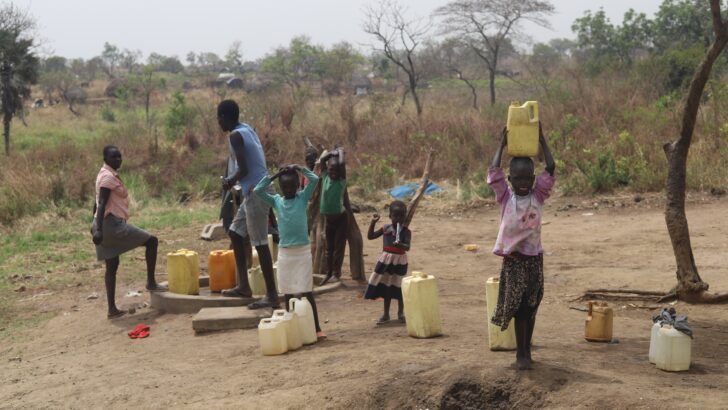
Congolese refugee children fetch water from a borehole at Mantapala Refugee Settlement in northern Zambia March 14, 2021. Church aid agencies are helping refugees at the camp learn how to cope with the trauma that forced them to flee their homeland. (CNS photo/Tonny Onyulo)
In July it was a church, now a mourning society: Islamist terrorists in eastern Congo are not picky when it comes to killing.

Islamist terrorists have once again carried out a massacre of civilians in the east of the Democratic Republic of Congo. Several African media unanimously report that the Ugandan militia Allied Democratic Forces (ADF) killed at least 50 people in the village of Ntoyo in the province of North Kivu; other sources speak of 70 or even more than 100 dead.
The fighters surprised the inhabitants of the village late on Monday evening, reported the pastor of the Manguredjipa community, Paluku Nzalamingi, from the scene. The Islamists had deliberately attacked a place of mourning where many people had been in the room of a deceased person. Bodies were lying in the house, on the street and on several plots of land near the centre of Ntoyo. Cars, houses and motorbikes had been set on fire. According to reports, a Congolese army base and units of the Ugandan armed forces are located in the attacked village.
Waves of refugees
The former guerrilla organisation ADF has links to the Islamic State (IS) and carries out attacks in Uganda and Congo. At the end of July, the ADF attacked the eastern Congolese town of Komanda and killed more than 40 civilians. This triggered a wave of refugees from the region. Massive population movements occur time and again in this part of the country, where Congolese armed forces and armed groups clash. The attacks now took place after several months of calm in the region; many displaced people had only recently returned.
The densely populated Democratic Republic of Congo is the second largest country in Africa after Algeria and almost seven times the size of Germany. Various rebel groups have been fighting for dominance for decades, particularly in the resource-rich east of the Congo. Conflicts in the neighbouring states also contribute to a politically unstable situation. Added to this is a mostly weak central government in Kinshasa.
Related

