

 Fr Dominik Domagala
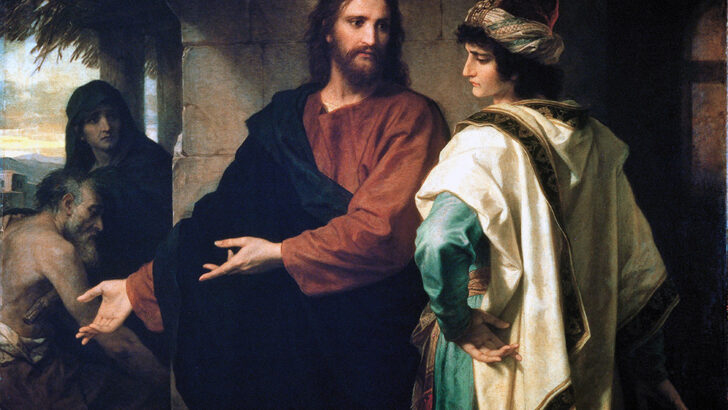 Heinrich Hofmann, ‘Christ and the Rich Young Ruler’, 1889.
 Readings:
Wisdom 9:13-18
Philemon 9-10, 12-17
Luke 14:25-33
Education? Erudition? Expertise? Are these the same as wisdom? Do they automatically translate into prudence? This Sunday’s readings don’t give us a clear-cut answer to that question. Instead —as so often happens in the pages of Scripture—they point us toward those dimensions of wisdom that are easily forgotten.

The first reading, from the Book of Wisdom, is a prayer. It’s part of a longer prayer that begins at the start of chapter 9. The author, speaking in the voice of the wise King Solomon, asks God for support in acting with wisdom, convinced that without God’s help, a human being cannot truly be wise. That is also the message of this Sunday’s passage. Notice something important: the one who prays is convinced that if a person struggles to make sound judgments even in earthly matters, then dealing wisely with divine matters is utterly impossible—unless God sends His Spirit: “Thus have the paths of those on earth been straightened, and people been taught what pleases you, and saved, by Wisdom.” This is an allusion to the Covenant that Israel entered into with God at Sinai, which was bound up with the giving of the Law.
Through the Law, the Chosen People came to know God’s will. Heavenly Wisdom allowed them to align their lives with God’s demands. In this way, they were saved because they could avoid offending God—even if only in theory, for we know that knowing the Law does not mean automatically living by it. It is a crucial reminder! If we want to live and act according to God, we need more than ordinary human prudence. Both the second reading and the Gospel present us with demands that stretch far beyond conventional human ideas of wisdom and good sense.
Obedience
The second reading comes from the Letter of St Paul to Philemon. Paul asks him to welcome back his runaway slave, Onesimus, with love. He explains that Onesimus has since become a Christian and is now very dear to him. Paul expects not only that Philemon will receive Onesimus kindly, but also that he will ultimately return him to Paul, so that Onesimus may serve Paul (in his chains) for the Gospel.
We should remember: in that time and place, slavery was a deeply entrenched institution. A master owned a slave as fully as he owned cattle or household tools. Disobedience—especially running away—was punishable with severity, and no authority or court interfered with such practices. To people used to this way of thinking, the very idea that the relationship itself might be unjust hardly crossed their minds. Yet Paul, by asking Philemon to receive Onesimus as a beloved brother, overturns the social order and challenges those habits. He does so not from the standpoint of human convention, but from the perspective of God’s wisdom.
The greatest commandment remains love of God, followed immediately by love of neighbour”
And finally, the Gospel this Sunday, taken in the wider context of Luke, presents a demand that Jesus places upon His disciples. Note this: just before today’s Gospel passage, Jesus tells the parable of those invited to a banquet who found excuses not to come. While this scene isn’t directly tied to today’s Gospel, it sheds light on it: those who reject Jesus’ teaching are like the invited guests who decline His banquet. They may appear to be His friends, but by scorning His invitation, they lose their seat at the table. An even more striking thought emerges from the verses that follow this Sunday’s Gospel, where Jesus says that His disciples must be like salt. If salt loses its flavour, it is worthless. Likewise, disciples who lose their fervour—who cease to live for Jesus—become useless. So, what must characterise a true disciple of Jesus?
First comes a startling requirement: no one can be His disciple unless they “hate father and mother, wife and children, brothers and sisters, and even their own life.” Strong words. But this is a deliberate hyperbole. We see that clearly when Jesus includes “hating oneself”—which, taken literally, would be quite inhuman. The meaning is this: a disciple must place Jesus absolutely first, above family ties, even above self-love. Always. In every circumstance. But this priority must be rightly understood. The greatest commandment remains love of God, followed immediately by love of neighbour.
Vocation
Then comes the second demand: a disciple must carry his cross. What does that mean? We usually equate the cross with suffering—but that is a simplification. When Jesus spoke these words, He had not yet been crucified, so His listeners could not have understood them literally. Yet by the time the Gospel was written, the phrase “take up your cross” had become a well-known expression, shaped by the memory of Jesus’ passion. What really happened to Him? Yes, He was arrested, beaten, and killed—and He suffered greatly. But that is only part of the truth. His death was an offering on the altar of obedience to the Father. He could have avoided it. He chose instead to hand Himself over freely, because it was His vocation, the way to save the world. His obedience unto death repaired the disobedience of Adam. From this perspective, “the cross” is not simply suffering. It is fidelity to God’s will, the living out of one’s Christian vocation—even in the face of opposition, difficulty, and yes, suffering if need be.
If you face an enemy stronger than yourself, don’t launch into a hopeless battle. Negotiate, or you will lose everything”
Jesus then gives two images to explain why such demands are necessary.
If you want to build something, you must first calculate whether you have enough resources. Otherwise, you will fail and become a laughingstock. Likewise, unless you give Jesus your whole life, you won’t have the ‘spiritual resources’ to reach the goal.
If you face an enemy stronger than yourself, don’t launch into a hopeless battle. Negotiate, or you will lose everything. Similarly, Jesus says: Be wise—give Me everything, or else you will lose everything.
In the end, Jesus is saying that His disciples must follow Him without any ‘ifs’ or ‘buts.’ We must place Him above family and even ourselves. We must humbly carry our cross accepting the path of life God has marked out for us, even when it includes the demands of the Gospel. Otherwise, we risk falling short of the goal. And what is that goal?
Following
Simply this: to be a true disciple of Jesus. Of course, heaven has room even for the ‘stragglers’—the lost sheep, the missing coin, the prodigal sons and daughters. But those who truly desire discipleship cannot calculate how much to give God while keeping the rest for themselves. They must give all. This teaching—like Paul’s appeal to Philemon—goes beyond human categories of wisdom and the usual hierarchy of values. Yet is it not wiser to listen to the One without whom we would stumble in the dark? To carry the cross means always saying yes to God in the circumstances life brings. That doesn’t mean passively accepting illness if it can be treated or ignoring evil when it can be resisted.
Part of our ‘lot’ in life is also the ability to fight disease and oppose injustice. But when there is no righteous way to avoid hardship, the disciple must accept it. And so, we must ask ourselves: how selectively do I follow the Gospel’s demands? Jesus never said that His disciples may choose only the parts of His teaching that are convenient. Whoever follows Him without taking up the cross—whoever picks and chooses what suits them—is not worthy of Him.
Fr Dominik Domagala studied Theology in Poznan (Poland), acquired a Master’s in History of Liturgy and obtained a Licentiate in Sacred Scripture at St Patrick’s College in Maynooth. His main interests concern the Books of Maccabees. He is the author of the sermon blog “The Social Oblate,” available on Facebook and YouTube. Send your questions to thesocialoblate@icloud.com