

 Breda O'Brien
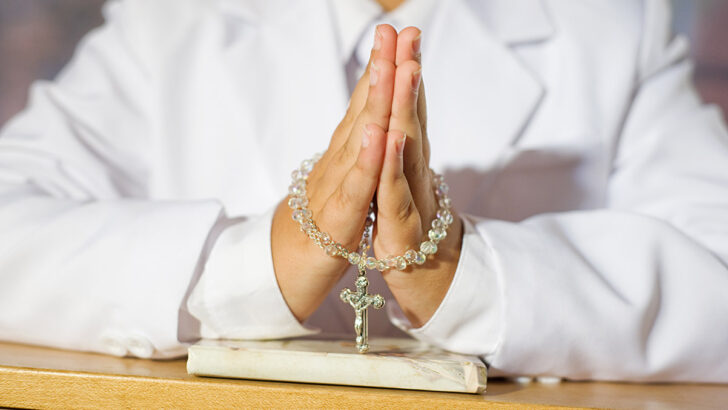 Photo: iStock.
 Simon Lewis wrote a challenging article in The Irish Times recently about First Holy Communion. He was chatting over a few drinks to a psychologist, who was preparing for the sacrament by spending weeks doing up the house and garden and securing a bouncy castle, no easy feat. The worst part, she told him, was that she does not even believe any of it.
Simon Lewis was recently featured on The Irish Catholic’s Education Nation podcast and in an article written by host Nicky Cuddihy. As the only principal of a primary school from an ethnic minority in Ireland (as far as he knows), Simon Lewis has strong views about education. Raised in a Jewish household, he found that the only way to get a job at a Catholic primary school was to answer yes when asked whether he would uphold its ethos.
This left him in the difficult position of preparing second class to receive the Eucharist for the first time. While his situation was unusual, he contends that many teachers who do not believe are in the position of preparing the children of parents who do not believe, either, for the sacraments.
Numbers
It is hard to disagree with this assessment, given that rates of belief and practice have fallen so much, including among school personnel. I have written before about the findings of the GRACE Reports, part of international research on Catholic education.
For example, the first of six reports states: “Older people are more likely to adhere to Roman Catholicism and be religious, while younger people are less likely to believe in God, attend religious services, or identify as religious. The patterns that emerge from this survey in respect of the influence of age indicate that the make-up of personnel in Catholic schools is becoming increasingly non-Catholic, and this trend is likely to continue over the coming years.”
Even though he is a principal of an Educate Together school, he would like to see an end to all patronage”
While this confirms aspects of Simon Lewis’s thesis, it is important to remember that some teachers are completely committed Catholics.
Nonetheless, it is difficult to dispute his claim that as belief diminishes, the celebratory party following the sacrament becomes more lavish, akin to a wedding. We have all heard stories about children who were running late at the hairdresser’s and decided to go straight to the hotel.
Where I would differ from Simon Lewis is in the solution. Even though he is a principal of an Educate Together school, he would like to see an end to all patronage, including that of Educate Together.
Change
In his view, all schools should be run directly by the State, under the auspices of the local authority, and all faith formation should take place outside school hours.
One size would fit all, in other words. It would remove all choice from parents and make the State the primary educator, which would be in direct contradiction to the Constitution.
There is little appetite for this kind of radical change among Irish parents. By and large, they like their schools, and that is one reason why the rate of divestment is so slow.
However, the present system does not challenge parents in any way and puts an unfair burden on schools to carry out all the faith formation that most children will receive.
Currently, for many people, First Holy Communion and Confirmation are just a day of celebration of the child, rather than a sacred moment.
At the age they receive first holy communion, many children have not lost their sense of wonder”
Perhaps the basics should be covered in class, but parents could be asked to opt-in to further preparation after school as a condition for taking part in the celebration. Ideally, trained parents should run these sessions.
Dioceses could cooperate to produce materials that are both child-friendly and accurate, emphasising the miracle of Christ’s presence and the importance of communal celebration and thanksgiving. At the age they receive first holy communion, many children have not lost their sense of wonder, and would be very open to hearing how amazing a privilege the Eucharist is.
Transition
I would also love to see Confirmation move to Transition Year in school. Transition Year RE classes could be run concurrently, with one or more strands dedicated to confirmation preparation for those who choose it. There could even be a connection to First Holy Communion, perhaps by confirmation candidates talking to the eight-year-olds to explain why they have chosen to be confirmed.
Their peers saw them making a mature choice to be confirmed, and it sparked powerful conversations”
One of the greatest privileges of my teaching career was preparing three teenage students for confirmation. They had been abroad for a few years and missed out on being confirmed at 12. It was a powerful witness to those who had simply been confirmed as a matter of course in sixth class. Their peers saw them making a mature choice to be confirmed, and it sparked powerful conversations.
Numbers might drop if confirmation is celebrated in Transition Year, but it would be more honest than the current situation.