

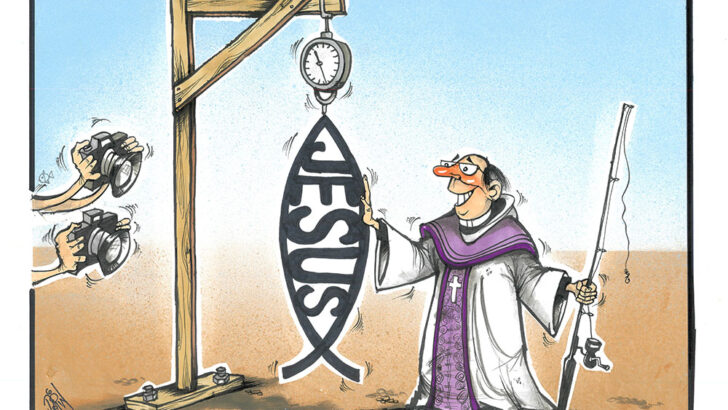
Dear Editor, I wish to commend Fr Martin Delaney for his powerful and courageous article addressing the annual transfer of priests. In highlighting the personal and communal impact of these transitions, Fr Delaney invites us all to reflect more compassionately and thoughtfully on how we support our priests and our parish communities through such changes.

Is it not unjust that a priest may be informed of his new appointment, often with no real consultation, only days before the transfers are publicly announced – leaving him little time to process the personal, spiritual, and emotional implications of such a change?
This process can be deeply destabilising, particularly for older priests whose energy, memory, and resilience may not be what they once were.
Like anyone else, priests age. And unlike many professionals, they are on call 24/7, deeply embedded in the lives of the people they have served faithfully. Priests work incessantly – often under immense pressure and with dwindling support. They are not easily replaced, nor should they be moved without careful pastoral sensitivity.
Beyond the personal impact on priests, there is a broader issue at stake – how these decisions affect the people of God. When a priest is moved, especially without replacement, it has profound consequences for parish life: sacramental availability, pastoral care, community cohesion. Decisions of such weight should never be made behind closed doors. Parishioners deserve to be consulted – not simply informed – especially in communities where a change will directly affect their spiritual and pastoral well-being.
Surely there must be a point in a priest’s ministry where such disruptive transitions are no longer expected of him. If we speak so often about the dignity of the priesthood, then we must also ensure that priests are treated with the dignity and respect they deserve – not only in public praise, but in private processes and practical decisions.
It is time to move toward greater compassion, transparency, and consultation with both priests and their communities – especially when the priest will not be replaced. As our synodal path continues, so too must our commitment to listening and respecting those who serve so selflessly.
Yours etc,
Paula Stapleton
Ballyragget, Co. Kilkenny
Mass readings must adapt to our current concentration span
Dear Editor, I read with interest the article – July 31 – on the Joint Lectionary Project and it has caused me to reflect. On the issue of translation, I hope they get a better translation for ‘ezer’ in Genesis 2:18. The current translations are a cause of mockery and derision among many – especially women – who feel that the Bible treats women as second class. Please, get it right this time!
I remember a priest once saying that Jesus became flesh 2,000 years ago, and that we have spent the last 2,000 years putting His flesh back into words. The concentration span of most of us is much shorter than the number and, sometimes, the length of readings we are presented with at Mass. We have three readings plus a psalm at the weekend. Some of these readings are quite long, regularly read badly, and more than often go over the head of most of the congregation, for one reason or another. Weekday Mass is usually attended by aged people and, again, many of the readings – especially from the Old Testament – are often mesmerising and quite incomprehensible. I know the aim of the 3-year cycle is to give us a flavour of the entire bible. This is a highly commendable objective. But I just wonder if it is over-ambitious and unrealistic.
I know that my latter concern is outside the remit of the project. But it would be nice to be presented with readings that are short, but that contain a challenge and a message of comfort.
Yours etc,
Malachy Duffin
Randalstown, Co. Antrim
What can be done to take the Church off life support
Dear Editor, I write in response to Archbishop Kieran O’Reilly’s invitation (The Irish Catholic, July 31) for lay people to become more proactive in our Church. I offer two suggestions. The first is that in our parishes, which ideally should be communities of faith and love, we throw a welcome home party for our lapsed brothers and sisters. Before the party begins, we celebrate a service of general absolution so that we can all experience the mercy, love and healing of this encounter with Jesus.
I appreciate that general absolution is normally only offered in emergency situations, but I would argue that we are in an emergency situation in Ireland today, and our Church is on life support. Hopefully, this experience will help people to return to private confession.
My second suggestion is that we begin offering communion under both kinds, at all parish Masses. I attend Mass in England and Scotland where this is normal practice. In Ireland, the priest raises the chalice at the consecration and says, “Take this all of you and drink from it”, and no one drinks except the priest. Five hundred years ago, Luther asked for “the cup for the laity”, and more recently Vatican II recommended this practice. Lay people greatly appreciate the privilege of receiving the bread and the wine at the Eucharist.
Yours etc,
Peter Boucher
Portlock Place, Derry
A tale of two countries and the role of women
Dear Editor, imagine, if you will, a country where women needed a man’s signature to obtain a mortgage for a house or even open a bank account. Where unmarried mothers were officially described by statute as ‘moral imbeciles’. Where young women were publicly paraded around in front of millions of people, forced to dress in swimwear and asked patronising questions by leering males.
By contrast, imagine another country where pioneering women were in the vanguard of establishing its countries hospital and educational infrastructure. And selflessly applying those skills in less advanced societies also. Where the glass ceiling was shattered in many other spheres. Electing the first woman member and appointing the first woman minister to its parliament. Appointing the first female stockbroker in the world. Appointing the first female lord mayor of its capital city. Considerable achievements.
In case anyone isn’t aware, the first country referred to is England the second, Ireland. Of course, all societies have their darker sides, but we have to acknowledge the positive also.
Yours etc,
Eric Conway
Navan, Co. Meath
Parishioners should have a voice in diocesan changes
Dear Editor, Fr Martin Delaney in Notebook of July 31 suggests that bishops should consult parishes before moving clergy.
Indeed, in some dioceses, not only is there no consultation but the changes aren’t even made public. The first the parishioners know about a change of priest is when the priest himself informs them. This lack of consultation goes further when, once again in certain dioceses, the Parish Pastoral Council consists solely of the nominations of the parish priest. This further increases the feeling amongst parishioners – who support the parish in many ways, including financial – that consultation is non-existent.
Yours etc,
Tony Corcoran
Rathfarnham, Dublin 14
Someone needs to shout ‘stop’
Dear Editor, it’s with interest that I notice the controversies surrounding abortion and euthanasia with the pro-death sections of the medical world and businesses using both these practices to get rid of people of the ‘wrong’ age or suffering from ill health. Perhaps, they might end up attacking the poor as a burden on society?
As somebody said about the nazis – they came after the Jews and nobody shouted stop; they came after the Romas and nobody shouted stop; when they came after me, there was nobody left to shout stop.
Yours etc,
Brid Fitzpatrick
Terenure, Dublin