

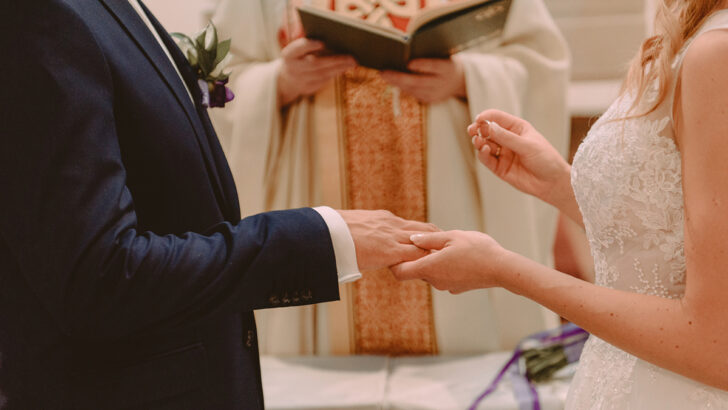
I had the wedding from hell this month — or maybe more correctly the bridal couple who seemed to have been spawned there. It is probably my fault, my misunderstanding: I thought that in giving the couple oodles of time to share their story with me, I was building rapport with them, but in fact I was not. Since like so many couples now, they were not Mass-goers, their impression of me was simply a dinosaur to be strung along and manipulated — certainly not one whose insights might have any great value.

This was certainly brought home to me in the sacristy as the papers were signed, when the bride wondered why I had not pronounced them ‘Man and Wife’. I pointed out that this was not part of the Catholic marriage rite, to which she replied: “So how will the people in the church realise we are married!”
One would have thought that the ceremony which preceded might have brought this home to people, but it clearly went over the bride’s head. Playing somewhere in her mind was a script that was an amalgam of wedding scenes from television and movies, so not seeing these words replayed at our church wedding meant that, for her, they were not really married at all.
Unfortunately, I had previously agreed to attend the couple’s wedding reception, a bad decision on my part. I found myself seated at the top table, but at the other end of the table from anyone I knew. The mother of the spouse who didn’t live in the parish where I live was a fine person, but she did not know me, so conversation was strained and difficult. There are only so many things one can say about the weather, this year’s, previous years, etc.
It turned out that the reason I was invited to the wedding reception was to say the Grace, since this was not a prayer known to anyone else. One would think that attending a wedding reception should be a pleasant occasion where fine food was enjoyed, but it also meant tedious speeches to be endured before the food came. For the guests plied generously with wine, this wait did not worry them, but for the non-drinking me, the wait seemed endless. It did not strike me until that moment that one of the outcomes of living in a secular culture is that all mentions of religion were studiously avoided by the speech-makers — no word about the ceremony we had shared in the church, in fact no mention of God at all. Instead, everyone (else) was endlessly thanked, even the flower-arrangers whose bill apparently came to several thousand euro. Hearing of the amount paid for flowers made the pittance I received all the more stark.
It is hard to know where to start to redeem church marriage at this stage. So many are familiar with marriages in a non-religious context, that they seem to expect church weddings to be similar to the other kinds of celebration. Certainly what passes for ‘hymns’ at church weddings would not seem suitable to me, since neither God nor faith nor even selfless love ever seem to get a mention. In the sessions preceding the wedding, the bride remained elusive about the music choices; these had not been tied down, she would say. In fact, the wool was being pulled over my eyes. She knew what she wanted, she just knew I had to be placated by the thought they might not be as bad as I might imagine.
In planning the wedding with the couple, there was no enthusiasm for what God might be saying to the couple in their choice of readings, but the so-called Communion Reflection”
Have heard Stand by Me used as a nuptial Mass Entrance Song, and Grace sung at Communion, I already knew how bad wedding music can get. (I might add that this was not Amazing Grace but rather that ballad that begins:
“As we gathered in the chapel here,
in old Kilmainham jail……”
The link to the Bread of Life wasn’t particularly clear to me.
In planning the wedding with the couple, there was no enthusiasm for what God might be saying to the couple in their choice of readings, but the so-called Communion Reflection did attract some attention (though its link with Communion was non-existent, just more goo about love…).
More and more it seems that there are people marrying in church who shouldn’t — or at least who shouldn’t have a wedding Mass as part of their celebration. Holy Communion may be included to please Granny or to calm rows at home, but a wedding service (outside of Mass) would surely be a far more flexible solution, and so much less hypocritical for young couples seeking to live authentic lives.
***
Communal baptism services work
June brought another communal baptism to the parish, with three local families sharing in one celebration. The help of a baptism team ensured that each family took an equal part in the liturgy, and that each felt welcomed. Certainly I would find it a big struggle to organise and implement such celebrations alone. But ‘Ní neart go cur le chéile’… when many help, great things happen!
***
Tragedies unite rural parishes
From time to time, every rural parish experiences a loss that stops it in its tracks. In former years, agricultural accidents took young lives, while in recent years more have died in road accidents or by suicide, or in those single-vehicle accidents which could be the result of suicidal thoughts (and which add layers of extra sadness to those who wonder what really happened).
Whenever such a loss comes to a rural parish, the pain and sorrow is immense. Everyone touched by it, whether the one who dies is known to them or not. It seems the whole parish psyche is impacted. One man who lived through such a happening spoke of the sudden accidental death of a farmer’s eldest child, the son and heir: “When word got out about what had happened, it was like the whole parish stood still”. It’s an awesome occasion, heartbreaking of course, but also an event that affirms the ties that bind people in our small rural parishes.
Because once news filters out about the tragedy that has happened, unbelievable deeds of kindness come to pass. No effort is spared to make the funeral days as smooth as can be. Everything else in the parish is suddenly cancelled; matches, tours, parties. Nothing can happen in a parish’s days of mourning, as all attention goes rather to the grieving family and their comfort.
And because the parish never forgets, the event is remembered every circling year; the family again surrounded with love, and the parish’s bonds of affection renewed. It is a great privilege to live in such a place, though such events also convey the strong message that you cannot live in such a place as if you are immune; you either play your part in the parish and experience its love when you need it, or if you stand outside parish moments of grief, you may find yourself very lonely and unhealed in your day of trial.
No man is an island, especially if he lives in rural Ireland. Trying to be one could be a dangerous stance.