

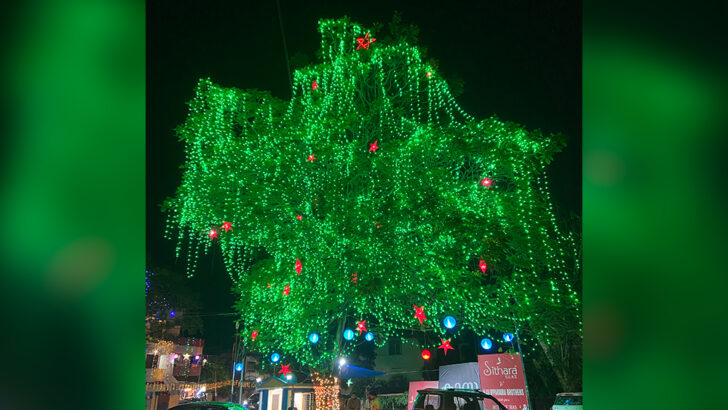
 A large tree illuminated with Christmas
lights dominates the streetscape
in the heart of Kochi, Kerala, India.
Photo: Rohith Kinattukara
A large tree illuminated with Christmas
lights dominates the streetscape
in the heart of Kochi, Kerala, India.
Photo: Rohith Kinattukara The Syro-Malabar Catholic rite, a rite that has a tradition for almost 2000 years, dating back to the apostle Thomas, who evangelised people in the sub-continent around 52 AD. The Syro – Malabar community is a proud one, and wherever they go around the world, they bring their traditions (in a smaller package) with them, and Christmas is no different.
I was quite fond of Christmas while growing up, I would possibly say that cooler weather and a 3-week Christmas break added up to that excitement along with a great get together with family and friends. Today, however I realised the process leading up to the 25th had been more of than just the usual ‘Christmas day’ I had always assumed.
Dec 1st begins with the 25-day lent leading up to Christmas. It is taken very seriously, and most households even avoid any functions such as weddings to be held during those 25 days. Like Easter lent, it is a way of forming a more spiritual connection, so on the 25th, you are ready to receive Him. It is also a time in which everyone, like in Europe, would start decorating for the festive season.
Decorations
The decorations consist of a Christmas tree, lights around the house and a nativity crib that is kept at the entrance of the house. The next few days is all about prayers, reflections and positivity, which is enhanced by a Christmas carol. This is usually hosted by the Church, and it’s a mix of both adults and children.
There will be an individual from the group dressed up as Santa Claus, and they go around different houses around the parish, singing local Christmas songs in Malayalam (the local language) and the Santa’s role is to dance to the songs. Some find it comical seeing a Santa dancing to a Christmas carol, but that is the idea conveyed, it’s a way of spreading joy amongst the community, with a little laugher and humour.
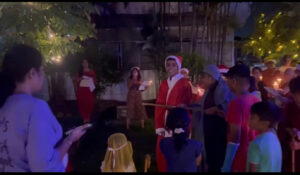
a Santa and kids dance
around to Christmas songs.
Photo: Rohith Kinattukara
When the carol visits a house, the people residing usually gift them with money, that usually goes to the charity or parish fund. This happens throughout the 25 days, but the carols tend to die off around the 22nd of December. The next stage of this would be the preparation of Christmas, with more prayers and adoration happening across churches, and every family starts to buy necessary items for Christmas, all the Christmas sales start flowing and if you are not early, your lent could last longer!
On the eve of Christmas, the parishioners start putting on star shaped lanterns outside their houses, usually at the entrance of the house. It symbolises the star of Bethlehem and the beginning of Christmas. The star hangs up proudly until the end of December to early January, to spread the message that Christmas isn’t just one day or a few days, but a whole season of joy. The blessing of the fire, is a tradition that has been part of the Christmas ritual for centuries and till this day, many parishes still follow the tradition the Fire’s blessing. A modest bonfire is prepared in the courtyard as the devout assemble outside the church before to the Holy Qurbana. In order to symbolise the light of Christ entering a darkness world, the priest blesses the fire with prayers from the ancient East Syriac liturgy.
Families approach the flame in shifts; some light tiny candles to bring the glorious light into the church, while others just stop to think”
The Old Testament burning bush and the light that led the shepherds to Bethlehem are both symbolised by fire, which stands for purification, warmth, and heavenly revelation. Families approach the flame in shifts; some light tiny candles to bring the glorious light into the church, while others just stop to think.
The parishioners’ faces shine in the orange light as the flames crackle beneath the night sky, creating a moment that unites the material and the spiritual. It serves as a reminder to the devout that Christmas is about transformation as much as celebration, light triumphing over darkness, faith reignited.
Elders see it as a live reminder of early Christian tradition, when the community would assemble around the first light before declaring, “Christ is born.” Children see it as a moment of amazement. The shift feels both symbolic and solemn as the procession enters the church with the blessed flame; hope has been rekindled in the world.
Mass
The Mass is celebrated with plenty of songs with both the local language which is Malayalam and some Syriac hymns that complement each other. The Mass then follows the regular gospel reading about the humble birth of Jesus Christ. Some parishes often have a mini procession on display, where children from the parish dress up as angels and the parishioners hold the statue of Infant Jesus during the procession.
The Mass usually lasts for 1.5- 2 hours depending on the parish and parish priest and as soon as it ends, the big celebration of Christmas begins. Many parishes often distribute plum cake and wine/grape juice to everyone, as a tradition. Once everyone reaches home at midnight, it doesn’t stop there, often there would be a mini feast of breaking the lent, where many families have traditional meat filled stew to commemorate the start of a big day ahead.
Christmas day is the usual celebration like in Europe, with traditional food such as pork vindaloo, beef roast and some sort of rice and curry dish. Of course, this varies from family to family, and food is also shared among neighbours, and the day ends with the next big preparation, New Years!
Christmas is a big holiday in Kerala, a celebration which welcomes all walks of life to join in the festivity. Kerala’s Christian history is as old as Christianity itself, 2000 years of belief, faith, and unity in Christ. It always makes me proud when priests, fellow parishioners often say we are people with great faith. It has been a great year for Catholics, more young people coming back to faith, and a fantastic New Pope, Merry Christmas and God bless!